I spent my youth in a quiet suburban midwestern neighborhood. Fascinated with nature, I spent much of this time in nearby woods, riverbanks, and old farm fields. Like many children, I was fascinated with outdoor skills, often building shelters, making bows and arrows from sticks and string, rubbing sticks together to make fire, eating wild berries, and stalking squirrels, rabbits, and frogs. I dreamt of living in the wilderness by using these survival skills.
By the early 1970s, my interests began to focus more specifically on wild foods. Initially, through the study of Bradford Angier’s book How to Stay Alive in the Woods (1956), and shortly thereafter by Allan Hall’s The Wild Food Trailguide (1973), and by Euell Gibbons’ Stalking the Wild Asparagus (1962), I seriously began studying and gathering edible wild plants.
While pursuing a science curriculum at Michigan State University, I organized a six-month vagabonding trip for myself through Europe. I planned to supplement my diet with wild foods, hoping to save some money during my travels. In preparation, I took college courses in wilderness survival, nutrition, and edible wild plants.
I spent my time in the European countryside, traveling on old back roads and through small villages where tourists did not travel. In the mid 1970s, these areas were less affected by modern American culture then they are today. People were still practicing traditional foodways. In the process of traveling, I met locals who invited me for dinner or to stay with them a few days. I routinely asked the food preparers if they knew of and used any wild foods. They almost always did and gladly showed me what they knew. After studying in this way for months, I was getting all of my vegetables from wild plants. Upon returning to the States and with encouragement from administrators and professors, I began teaching senior-level classes in edible wild plants at Michigan State University. That continued from 1978 to 1985.
While teaching and working on my master’s and doctorate degrees, I studied botany under Dr. John Beaman, curator of the MSU herbarium. I also took conventional botany and taxonomy courses. Over the years, many wild food research expeditions were conducted, including ones to Washington, D.C., North Carolina, West Virginia, Michigan, Indiana, Illinois, Wisconsin, North Dakota, Montana, Idaho, Utah, Wyoming, Georgia, Nevada, Ohio, Oregon, Washington, California, British Columbia, and Alberta. My PhD in nutrition is helping me achieve my long-term goal of advancing the field of wild foods. My formal academic training has helped me learn about nutrients, human physiology and biochemistry, cultural foodways, anthropology, food preparation, and nutritional toxicology.
I moved to Oregon in 1989, where I continued my research and teaching. Since moving to Portland, I have taught wild food classes at Portland State University, Clackamas Community College, Portland Parks and Recreation, and Wild Food Adventures. As of January 1994, I have been running Wild Food Adventures as a full-time career. It is a teaching and research institution devoted to edible wild plants and other foragables. You can find more information about Wild Food Adventures at http://www.wildfoodadventures.com.
As a result of my experiences, I have a doctorate in nutrition, a master’s in education, and degrees in biology and zoology. I’m a trained botanist, nature photographer, writer, researcher, and teacher. Over the years, I have taught and trained thousands of people about wild foods all over North America, given hundreds of wild food presentations to a wide variety of groups, assembled a comprehensive wild food library, and documented hundreds of wild foods in photographs and notes. Between newsletters, magazines, academic periodicals, and the Internet, I have published over 100 articles on edible wild plants.
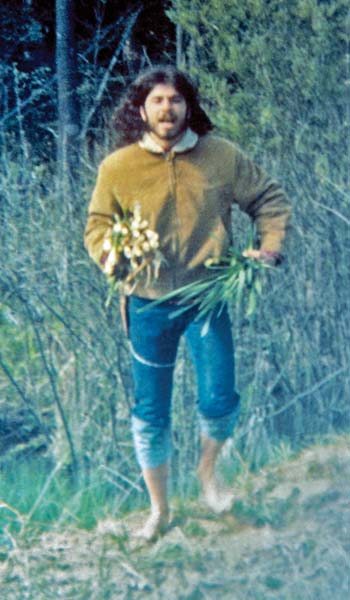
John Kallas emerging from a Michigan Swamp with a bundle of cattails. (Photo by Raelle Corliss, 1973.)