Identifying and Enjoying Wild Foods
This chapter helps you better understand edible plants and offers some guidance to make the most of the information in Part II of this book.
The Life Story of Plants
There are secrets to wild foods—secrets that used to be common knowledge, part of a way of life for people all over the planet. These secrets are revealed when you begin to learn the “life story” of plants, which is composed of two things. First, the phases and forms the plant passes through as it grows from seedling to mature plant is often called a plant’s “natural history,” sometimes a plant’s “life cycle.” Second, plant form (what it looks like) is a result of both nature and nurture; the conditions under which it is growing affects the expression of those forms.
Each story is unique and gives clues to why a plant and its parts at various stages of growth turn out a certain way—why leaves on one plant are great-tasting while others may be intolerable. Heed these life stories, and you will reap the great rewards that wild foods have to offer. Ignore them, and both your understanding and your success will be limited.
The reason store-bought vegetables are relatively consistent in flavor and texture is because of modern agricultural practices in which farm-raised vegetables grow in similarly prepared land from the same genetically consistent seed, are planted at a similar time in similar climates with similar soil and water conditions, and are harvested at the prime of their lives. In other words, these foods are domesticated. They tend to have relatively consistent flavors and textures, and you typically get what you expect.
Wild plants, on the other hand, do not share this regimented fate. Enlightenment has arrived when you can come upon a wild plant wherever it happens to be and know where it is in its own life story. It “speaks to you” by its appearance, its surroundings, and a myriad of other clues that we’ll talk about in this book. It will tell you if and when its plant parts are worth gathering or not.
Due to modern-day preoccupation with general busy-ness, indoor technology-based entertainment, and the taming of nature for our convenience, there is less and less common knowledge of the natural world. Nature is paved over and built on, and is finding its way farther and farther from our everyday lives. And where it remains, nature is becoming a distant place of postcards and vacations instead of being a comforting friend with whom to commune and interact. Nature has become a shallow relationship.
Because of these trends and the resultant ignorance of nature, there is less and less understanding and appreciation of why anyone needs to know the details of plant life. Even publishers (except mine, obviously) resist including detail from authors who want to give it, because they think readers will just want the summary—just the bottom line. This book takes you where you need to be, because in nature, a summary alone tells you nothing.
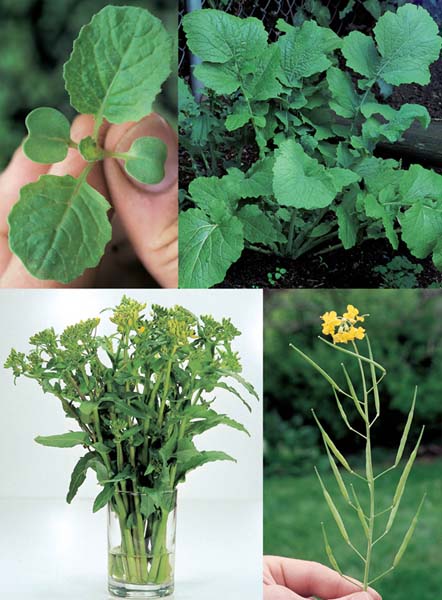
Plants change as they mature. Look carefully at these four pictures of field mustard. Each shows different leaves, stems, and other structures. They represent only some of the stages and parts of the life story of one plant. Additional variations will occur if the plant is growing under stressful conditions. If you do not learn the life story of this plant—wild mustard—you will only learn a fraction of its usefulness.
Getting on the Path
In lieu of your own personal local wild food expert, this book will get you started on your path to wild food fun. We’ll start with plants you can use every day—those that are within walking distance of your kitchen, easy to locate, quick and easy to gather, nutritious, and will provide great-tasting foods with little or no preparation. Yes, you heard me, great-tasting with little or no preparation. Perhaps you’ve heard that before and have been disappointed. This book should change all that—but only if you learn the life stories of the plants we cover.
The principles discussed in this book are just as important as the plants we are focusing on. You may be tempted to take shortcuts—but there are no shortcuts to experience-based wisdom. You have to spend time observing and experimenting with these plants to gain that wisdom. So think of this book as a springboard, a resource that will help you connect to that outdoor world.
Recognize that I am one person with some personal experience with wild foods. And while I think you will have similar experiences to mine under similar conditions and understanding, you may find yourself having a different experience occasionally. Sometimes differences occur because we may have done something in a different way; perhaps we have different taste sensibilities, or we’ve used plants with different life histories; or perhaps my experiences were too limited and I drew conclusions before the time was right. I make great efforts to speak only from experience and to know the plants well enough to put you on the right track.
This book covers plants I know intimately. A couple of them are relatively new to me, but I am including them because they fit the theme—common, classic wild foods eaten by our European and American ancestors. Most people today know them as weeds. The more experience you have with a plant, the more accurate your perceptions and conclusions are about their uses.
How to Learn the Most
One of my goals for this book is to provide you, the wild food adventurer, with the kind of information that will help you be a successful forager and enjoy what you are doing. To get the most out of this book, consider the following recommendations:
A) If you are unfamiliar with the plants in this book, keep the book handy in a relaxing place. Leaf through the pictures at every opportunity. Go for occasional walks around your house and neighborhood, eyeballing all plants growing in disturbed areas. Become an observer all year long. Sit on the ground with the plants on occasion and study everything around you. Look for interesting and unique characteristics and patterns. At some point you will begin to recognize plants you’ve seen in this book. Once you’ve verified your identification, follow the steps in part B.
B) If you already know a plant, read the chapter covering it. This will clue you into its life story and its possibilities. Then locate the plant nearby. Once you’ve found it, study the plant. Try to determine the following:
Where is it in its life cycle? Is it a seedling in a rapidly growing phase? Is it in a vegetative form only, or has it begun its reproductive phase by producing buds, flowers, or seeds?
What life history (growing conditions) has it experienced? Is it in its ideal habitat or is it under stress? Is it flourishing or is it struggling?
What parts, if any, are edible at this stage of growth? What parts are pre-prime, at prime, or post-prime?
If any parts are considered edible at this point, predict what the flavors and textures will be like considering where the plant is in its development, soil conditions, etc.
Try the part(s). If your predictions are true, then gather some of the plant. If your predictions are wrong, check this book to try to determine why the part was different from what you expected. If your understanding comes out differently than mine, it may be as simple as you and me having different taste or texture sensibilities. It may be that you need to study the plant a little more. Or it may be that my understanding of the plant is inadequate. There is so much more to any plant than I’ll ever know. You will gain answers with experience and time.
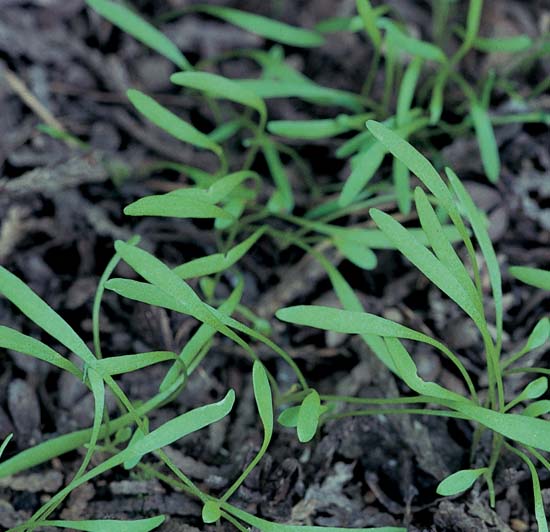
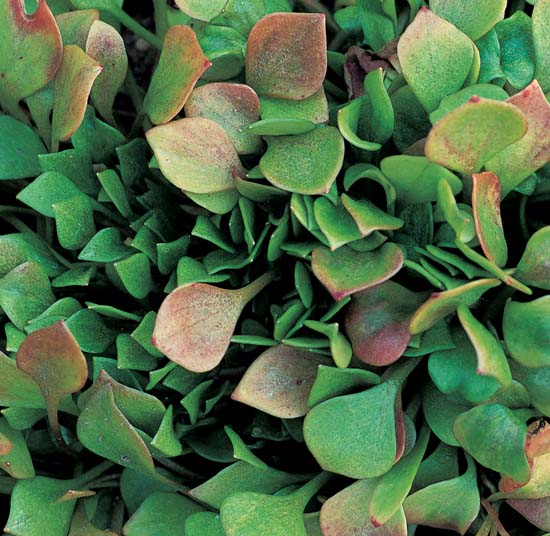
Plant forms can vary within the same species. Both of these plants are young miner’s lettuce (Claytonia perfoliata). They are both at the same stage of growth, just different forms. Their similarities will increase when they are in flower.
To get the most out of this book, don’t just read the first section for each plant; read the entire chapter. If you go right to the explanations of edibility, skipping the developmental history, you are missing some of the most important parts of understanding the plants you will be eating.
Observe, experiment, and play with plants you find. What you get from this book is only the beginning. You will learn more by being carefully observant in the field and innovative with what you do in the kitchen. Gather, process, and prepare these foods in any way imaginable. A person with enough experience could go beyond the scheme of this book and write a whole book about each plant. I limited what I included in some chapters to get a good representative coverage of plants. Experiment and play. You’ll find they are the same thing. DO NOT eat or experiment with plants or plant parts you do not “know” to be edible!
Identifying Plants
Identifying plants is always a wonderful challenge and part of the adventure of wild foods. The same plant can look different not only in this book but in other books, depending on the angle of the photograph, the condition of the plant, and the sensibilities of the photographer. The same plant can also take on several different personalities; that is, you can have several of the same species growing side by side but get the impression that they are different species. This is why it is so difficult to match what you see in nature to what you see in a book. The photograph may only show one version of a plant’s personality, while real life may offer another version.
Miner’s lettuce, for example, has one form as a sprout, two forms as an adolescent, and two forms as an adult. A novice may only recognize one of these five versions.
As a plant grows, it develops different structures. While moving through different stages of growth, a plant can transform so much that young and old versions look like different species. While I make an effort to familiarize you with all the major developmental stages of each plant, most field guides only show you how a plant looks as a flowering adult. Most edible parts of vegetables are at their prime for eating at young stages of growth—before the flowers appear. So it is essential to know what plants look like in all their developmental stages.
Inedible or poisonous look-alikes
This is one of the most frustrating areas for beginners. There are thousands of plants out there, so how do you begin separating out the edible ones? Make no mistake, this is an important issue. Inedible plants are ones not suitable, for one reason or another, to be used as food. Some inedible plants are poisonous. While most inedible plants and their parts are relatively harmless in small quantities, there are certainly a few really bad players out there.
In lieu of becoming a professional botanist, one must take advantage of multiple resources to positively identify plants. I cannot overemphasize the benefits of knowing the natural history of the plants you are interested in eating. If you study the detailed characteristics I will show you, it will be very unlikely that you will accidentally consume a poisonous look-alike. Even so, I make it a point to include some poisonous look-alikes in this book so you can see which common plants to avoid.
Hunting and Gathering Strategy
Plants are found everywhere that has not been paved. It is a great joy to find them clean, in prime condition, in great quantity, and in a form that is easy to gather. Nature and its seasons are relatively predictable, so there are many things we can look forward to. Climatic changes can make things less predictable. One year, chickweed (Stellaria media) may be abundant; the next, it may be scarce or stringy. This becomes a problem when you have expectations about what you want to gather. Nature does not always provide exactly what you want.
Once you learn the fundamentals, gathering wild foods will often be quite easy. There are many times now that I can go into my backyard with an empty bowl and come back with a large, delightfully delicious salad in less time than it would take me to make one from grocery foods in the refrigerator. Some yards may be this way naturally, but others need to be enabled. I’ll get into this more later on.
Opportunity Harvesting: Since you may not always find the plant parts you want, gather the ones you find. This strategy is very productive. Opportunity harvesting is gathering whatever you find that’s worth harvesting. This year the wild spinach may be abundant and in season when you are foraging, so you collect it. The wild lettuce, on the other hand, may be struggling, so you leave it. The greater your knowledge of the life story of plants, the better you will be able to predict what will be available, at what quality, and in what part of the season. The uncertainty is part of the adventure. It is extremely satisfying, however, when your predictions turn out to be right.
Play/Work to Do: A supermarket is convenient and a restaurant even more convenient. As a forager getting your food directly from nature, you happily take on the following jobs: naturalist, harvester, food transporter, food cleaner, food storer, food processer, recipe designer, cook, waiter, and consumer. This requires very little effort if the food is close to the kitchen and easy to prepare, and if you are creating a simple dish. I am trying to create these easy conditions through the content of this book. Proportionately more effort is required if you are working with less-convenient wild foods and/or if you are challenging yourself with an ambitious outcome.
For example, want some dandelion root crowns? The cleaning time required to get out all the soil and creatures wedged in the mass of leaf bases can make these more of a pastime project than a quick meal. But if you are like me, the joy is mostly in the journey.
Aside from nature not providing you with the conveniences offered by modern food systems, there are other things to consider. It is inconvenient that nature generates different species that look alike and that individual plants within a species may have unique genetics affecting flavors and textures. So even if you have everything figured out, sometimes a plant part you eat may just not come out the way you expect it. That’s okay. Try again. That is part of the adventure.
Microanalyze This! How to Taste a Wild Food for the First Time
Over a lifetime, the flavors and textures of food you’ve eaten develop meaning. Food is associated with good times, family, holidays, and other patterns in your life. It is associated with acquired tastes, satisfaction, and comfort, among other things. Because of this, most of us have developed our own comfortable eating patterns. We eat certain foods in certain ways—liking some more than others. We accept their flavors as is and rarely just sit and carefully analyze them. We enjoy our domesticated broccoli. And even if we did do a slow, careful tasting, we can no longer judge it independently from our cumulative experience. Judging broccoli now would result in an expression of how good it is relative to our “idealized” broccoli.
Now propel yourself into a totally new culinary sensation. Every new wild food you try is unknown and mysterious—there is no idealized version of it to compare it to. This results in a much more cautious, deliberate, and focused tasting procedure. You examine each item’s flavor and texture more closely than you would any other food in your regular diet. You search for ways to characterize it. You microanalyze it. You can do this from one of three perspectives:
You can timidly examine it, hoping you will not come across anything disagreeable like off-flavors, bitterness, or rankness. This makes you sensitive to and looking for the disagreeable. And if there is any there, you are darned and determined to find it.
You can hope that it will taste like a familiar comfort food you already know. How can a new food compete with the old favorites? Or
You can view this new sampling as an adventure—looking for the plant’s uniqueness, character, and potential. An open-minded anticipation of potential will result in a more pleasurable and useful wild foods kind of experience. And if you are like me, all sorts of culinary options will pop into your mind.
During your microanalysis, you should keep in mind that tasting a raw unadorned food is a very different thing than tasting a food prepared for eating. There are many dandelion dishes that are totally delicious; many without a shred of bitterness—even though the raw dandelions used were tongue torturers. So raw wild foods that are bitter, pungent, or tart, if treated properly, can transform into something pleasing to even the wimpiest palate.
Not that you have to get rid of those interesting flavors. With time, you may learn to like them or learn to use them sparingly to spice up dishes rather than be the dish. I am not a fan of bitter and strongly pungent flavors eaten alone, but I find that the more I work with these plants and experiment with them in different recipes, the more I enjoy the accents and variety they add to my diet.