What Is Edible?
I’ve often heard people say that such and such a plant is “edible.” Well, what exactly does “edible” mean in the context of wild foods? If a plant is edible, it’s edible—right?
People generally consider blue elderberry to be an edible plant. You might assume that you can eat its flowers, berries, leaves, and stems—right? But wait! My poisonous plant book says that blue elderberry is poisonous! Herein lies the problem. You must “know” a so-called edible plant well before you start eating it. Assuming edibility for a plant or its various parts can be dangerous and even deadly.
Considering the potential confusion, I have created some formal definitions for edible wild plants (also known as wild food plants), poisonous plants, and medicinal plants. These definitions will help you intelligently navigate your way through the world of wild foods.
Edible Wild Plants Defined
Edible wild plants are endowed with one or more parts that can be used for food if gathered at the appropriate stage of growth and properly prepared.
Let’s divide this definition into meaningful pieces and discuss the significance of each.
“One or More Parts”
Plants typically have a variety of parts. Stems, leaves, roots, buds, fruits, seeds, and shoots are just a small number of parts that can be found on plants. If a plant is considered edible, that means there is at least one part of the plant that you can eat. But the plant may also have poisonous parts, medicinal parts, woody parts, bitter parts, or parts that are too hairy to use. For instance, all but the cooked underground tuber of the potato plant is poisonous! All but the flowers and the ripe fruit of blue elderberry (Sambucus canadensis [eastern North America] / Sambucus cerulea [western North America]) is poisonous. In reality, potato and elderberry are both edible plants and poisonous plants, so one key to the successful and safe use of wild plants for food is to focus on the part or parts known to be edible. Generalizing and improvising by eating unspecified parts of plants can be deadly.
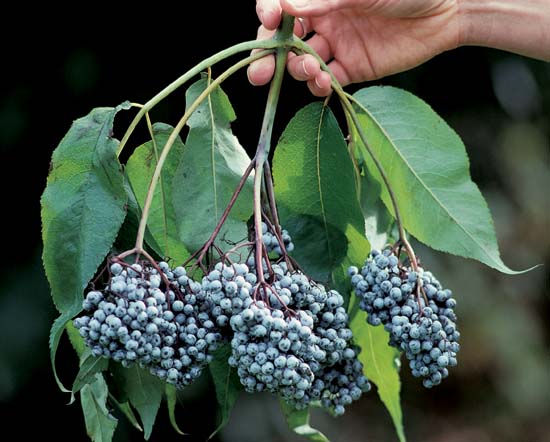
Western blue elderberry (Sambucus cerulea). This branchlet has fully ripe edible berries. The plant contains cyanide and other toxins in its leaves, stems, branches, and bark.
“Gathered at the Appropriate Stage of Growth”
Each edible part has its own ideal stage for eating. Knowing that stage not only provides the best food, it can also keep you safe.
Some plant parts become poisonous with maturity. Common milkweed (Asclepias syriaca) produces a pod containing seeds. When the pods are young and tender, and the immature seeds are still white, the pod is an excellent cooked vegetable. But once the seeds start maturing (turning brown), the pod is poisonous—and that poison cannot be cooked out. So the bottom line is that if you wish to consume a plant part, gather it at its edible stage. Not paying attention to a plant’s various stages of growth can lead to a deadly experience.
“Properly Prepared”
Some “edible” plant parts may not become truly edible or palatable unless they are processed in some way. Processing may involve, among other things, physically removing certain parts of a plant (like the seeds from a fruit or the rind of a root), leaching undesirable water-soluble substances out of a plant part (like soaking tannin out of the acorn), or heating to a certain temperature (like wintercress leaves). Even the edible leaves of dandelion in the raw form carry sesquiterpenes and other substances that, in high enough quantity, can cause excessive urination and diarrhea. Using them sparingly when raw or boiling them helps to minimize these effects.
The biggest and most dangerous mistake that you can make when using wild foods is to eat parts of plants not known to be edible. In addition to making a proper identification, you must make sure that only the proper parts are collected at the appropriate stages of growth and properly prepared.
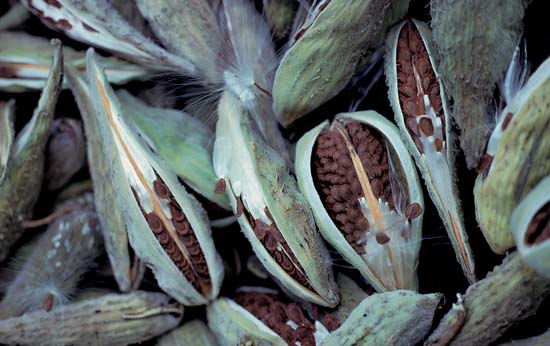
Mature milkweed pods (Asclepias syriaca). Fully mature poisonous brown seeds are shown here. Milkweed is considered both an edible and a poisonous plant, depending on the part and its stage of growth. These pods are edible at a younger stage of growth.
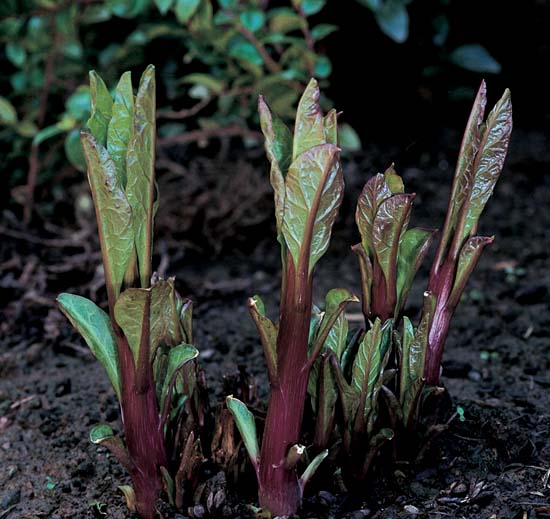
Young pokeweed shoots (Phytolacca americana). Most people harvest them at the growth stage shown here. Because of the name “poke sallet,” which identifies a common cooked dish served in the South, many novices misunderstand salat to mean that the greens can be eaten raw. Pokeweed is poisonous raw but becomes edible once cooked properly for that dish.
Poisonous Plants Defined
Poisonous plants are plants endowed with one or more parts having chemical or physical attributes that can cause acute or underlying injury or death upon ingestion, touch, or inhalation. Dosage determines the severity of the damage. Poisons can affect some species differently than others.
Okay, that was a mouthful. But if you take this definition piece by piece, it will be easier to grasp.
Poisonous plants have at least one poisonous part. As I’ve said, blue elderberry has both edible and poisonous parts. Of course, a whole plant can be poisonous. A plant is considered poisonous even if the poison can be cooked or processed out.
Most people are only familiar with the kind of poison you see in the spy movies, where someone keels over and dies within a few seconds of ingesting that poisoned martini. But toxins found in nature are more clever and diverse than that. Something you’ve eaten may be causing damage to your liver, kidneys, heart, nervous system, or reproductive system, even if it tasted good and you are feeling fine after eating it.
This hidden toxicity demonstrates the difference between an acute toxin and a more subtle or underlying one. An acute toxin is fast-acting and dramatic. You may not die from it, but you feel symptoms as soon as the toxin starts affecting the body. With an acute toxin, you know that you’ve been poisoned. Symptoms may include confusion, disorientation, nausea, vomiting, diarrhea, chest pains, arrhythmia, cramps, intense sweating, and even death. You may totally recover from an acute toxic incident, you may retain some permanent damage, or you may die from it.
An underlying toxin is one that works at a less obvious level. The toxin may build up over time to produce more dramatic symptoms later or may continually damage some organ or physiological process, thereby degrading function. It may also have a temporary effect. That is, your body heals over time if you stop being exposed to it; or the toxin may cause permanent damage even if you stop being exposed to it. An underlying toxin can cause death by damaging vital systems over time. These toxins are the reason you cannot assume that just because a plant part tastes good, it is edible. Many novices and some wild food instructors make this mistake. You must know that a plant is edible from a long tradition of use.
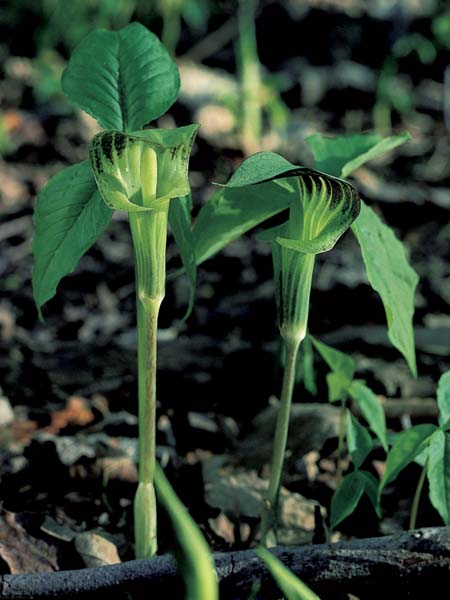
Jack-in-the-pulpit (Arisaema triphyllum). This plant contains calcium oxalate crystals, a physical and chemical toxin.
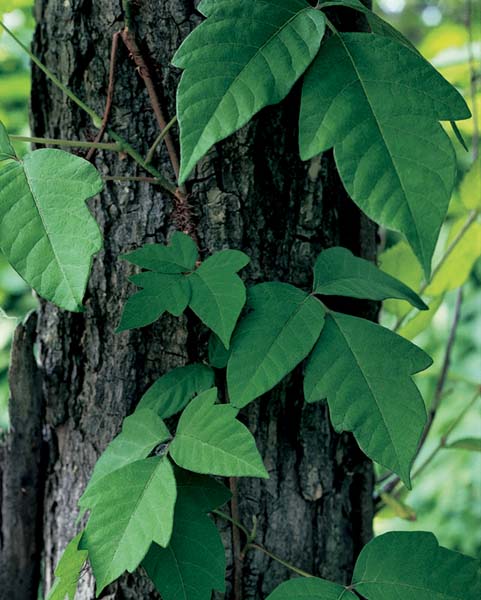
Poison ivy (Toxicodendron radicans). Urushiol, this plant’s toxin, causes a rash on the skin or in the lungs if the smoke from a burning plant is inhaled.
Basically, a toxin has to get into your body in order to do damage. Ingestion (eating) is the obvious way to bring a toxin into the body. Certain toxins can enter the body by absorption through the skin, by injection by a plant under the skin, or by inhalation. Poison ivy’s toxin urushiol absorbs through the skin. Urushiol can also be inhaled accidentally through smoke when one of these plants is being burned. Inhalation of urushiol can be deadly. If inhaled in quantity, poison hemlock pollen can also produce permanent lung damage. This can happen if you are in a field where the plant is in flower. As you walk through, brushing against plants or trying to hack them down, the air can get thick with the pollen. The more you breathe in, the greater your exposure.
Obviously, the more of a toxin you ingest, touch, or inhale, the greater the potential damage. Some toxins are cumulative; that is, they build up over time. That buildup is reduced by the body’s ability to remove it. So if you intake the toxin faster than your body can remove it, it builds up. If you are ingesting a toxin at very low levels, your body’s ability to remove it may render it harmless. A good example of this is cyanide. The body gets rid of cyanide by exhaling it from the lungs. Many plants you eat contain some cyanide. Eating small amounts is harmless because your body moves it to the lungs where you breathe it out. Ingest too much cyanide, however, and you overwhelm your lungs’ ability to clear it, so it builds to harmful levels—harmful enough so that it can kill you.
Medicinal Plants Defined
Medicinal plants are plants endowed with one or more parts having therapeutic effects when gathered at the appropriate stage of growth, properly prepared, and properly administered.
Note the similarity of this definition to the edible plants definition. This definition is relatively self-explanatory. I would like to point out, however, that most medicines are poisons administered in controlled amounts for specific purposes. Self-medication can be dangerous or even deadly without enough knowledge of preparation and administration. Further confusing things, some edible parts like dandelion leaves are also considered medicinal. We’ll talk about this in the dandelion chapter.
There are two important things to take away from this discussion on edible, poisonous, and medicinal plants. First, before you eat anything, learn your plants well enough to know which parts at what stage of growth are edible, poisonous, medicinal, or of unknown status. Knowledge is power and safety. Second, if you are faced with an unknown part, always keep in mind the concept of what I’ve called “underlying” toxin. Hopefully this will deter you from recklessly experimenting with parts of unknown edibility, because even though they may taste fine, they may cause some underlying damage to you or anyone you feed. Only experiment with and eat plant parts that you know to be edible, that are found at the appropriate stage of growth, and that you know how to prepare. If you do not know all three of these things about a plant, you do not know enough to be eating it.
Caution—Uncharted Territory
For the most part, if you learn the basic information you need to know to safely eat wild foods, you can expect to experience many happy dining adventures. Your body will treat these new foods just like any other foods in your diet. For a few people with sensitive digestive tracts, eating a new food for the first time may initiate a temporary laxative effect and possibly some minor flatulence. This is not of concern except to friends breathing nearby. As you eat more of the food, particularly in the context of normal meals, your digestive tract will adjust and behave more in public.
There are a couple of other issues that, on rare occasion, can complicate matters for some people. Your genetic makeup may be sensitive or allergic to certain substances commonly found in certain plants or plant families. For instance, some people are sensitive to edible fruits of the nightshade family (tomato, green pepper), while the rest of us can eat them with impunity. Others are sensitive to peanuts. Some rare individuals are so sensitive that even mild contact can cause anaphylaxis and death. If you have no food sensitivities to conventional foods, you will probably have no food sensitivities to wild foods. On the other hand, if you have lots of food sensitivities to conventional foods, your chances are higher that this might also be true for wild foods.
You might also come across a mutant strain of a common wild food that is harmful if eaten. This is rare. One such plant is the tawny daylily. Common to yards and roadside ditches all across North America, it apparently has two forms that differ in their chemistry. The predominant form has buds and flowers that are perfectly edible—a fantastic wild food. A less common, physically identical form has something in it that can cause severe nausea and diarrhea, raw or cooked. Since you cannot tell the difference between these two versions of this species, it is always a bit of a gamble to eat it from an unfamiliar patch.
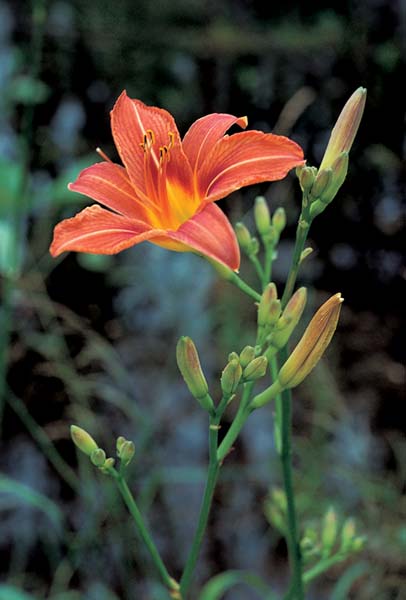
Tawny daylily (Hemerocallis fulva). A small percentage of this plant’s population is a mutant strain that causes nausea and diarrhea.