When Plant Parts Morph into Food
There are certain tendencies that plants have as they develop. The more you know about these tendencies, the better you will be able to make judgments about exactly when an edible part will be at its best. You will also have a better idea of what might have gone wrong if something (taste or texture) does not go as expected.
In this chapter, you will NOT learn how to determine if an unfamiliar plant part is edible. There are no good rules for guessing edibility. What you will gain from this chapter are more insights into plants that are already known to have edible parts. The idea is to improve your chances of success by giving you a basic understanding of how plants change as they go through life and how those changes affect edibility.
In general, vegetative plant parts evolve from being tender to becoming fibrous as they mature. “Rapid growth” and “end size” are important concepts in this chapter. These concepts will give you the best way to determine when a plant part will be at its highest quality for eating. Each plant part will have its own story of growth and size, so let’s cover them one by one.
What Makes Plant Parts Tender?
Any plant part undergoes growth until it reaches its end size. Rapid growth results from optimal growing conditions, resulting in larger stems, roots, leaves, etc.
Growth does not happen uniformly across all plant parts. For instance, a lower stem may have solidified into a sturdy nongrowing support structure, but at the same time, it can be transporting nutrients and water to new growth points near the top of a plant. That lower mature stem is fibrous or even woody, while the emerging new growths are tender. The fastest-growing parts are determined by where the emerging new growths are.
Gathering an edible part at the right stage of growth is important to maximize flavor and texture. Here we will examine the roles that growth and end size have on various parts of plants
End size
End size can refer to the whole plant once it stops growing. But for the purposes of this book, we are only referring to individual plant parts. Individual plant parts each grow at their own rate and at their own time. The end size of each part is determined by both genetics and how nature has nurtured the plant. The end size of a leaf, for instance, can be large if it has had generous amounts of water, nutrients, and sunlight during its life. The end size is smaller if the plant has been starved of any of these factors.
For most plant parts, chemical and structural changes occur once the end size is reached. Those parts transition from growth to support and maintenance structures. What happens in a maintenance metabolism? Fiber builds to strengthen the leaf, and some of the nutrients that were required for growth travel out to still-growing parts of the plant. Off-flavors often develop as the sun continues to bake a static leaf.
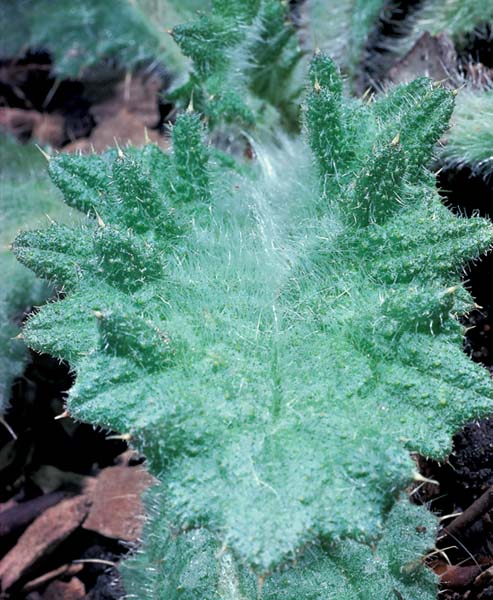
Young bull thistle leaf. There is tenderness underneath all the hairs and spines of young, rapidly growing bull thistle leaf (Cirsium vulgare). Most leaves of plants we generally eat do not typically have these barriers (hair and spines) to good mouth feel. If you get a young enough rapidly growing bull thistle leaf, it is completely tender, spines and all, once boiled for a few minutes. When older, the spines remain solid and sharp even after boiling. This is because the spines have reached their end size and stiffen, even though the leaf may still be growing.
Leaves
As a general rule, leaves (like other plant parts) start out tender and remain reasonably so until they reach their end size. Don’t be fooled by small leaf size. Just because a leaf is small does not mean it is young, tender, or tasty. As I’ve just said, a small leaf might be small because it has been starved of water and nutrients, reaching its end size very early in life. This is often the case in summer, when the soil has been hard and dry for a while. On the other hand, if you find small leaves on a well-watered plant, it is most likely that those leaves are young and still growing. More mature (not so young) plants can have rapidly growing parts that are great for eating.
Some leaves like those found on miner’s lettuce (Claytonia perfoliata) and wild spinach (Chenopodium album) never get “too” fibrous to eat; they just get less choice until they brown, wither, and die. I’ve enjoyed eating properly prepared dandelion (Taraxacum officinale) leaves that were eighteen inches long. These leaves were growing in such excellent conditions that, even at eighteen inches, they had not yet reached their full size. They looked beautiful, like they were found on display in the farmers’ market. They were still tender, and their bitterness had not yet had a chance to get intolerably harsh.
In some naturally bitter leaves, the strength of their bitterness is related to slow growth and end size. Plants like dandelions or wild lettuce (Lactuca serriola) accumulate bitterness over time. The faster a leaf is growing, the more spread out and less intense that bitterness is. The slower the leaf is growing, or if it has reached its end size, the more bitterness that is concentrated from exposure to the sun. Think of it this way: The longer the leaves bake in the sun, the more bitter they become, and the harder it is to manage that bitterness in the kitchen. So, rapidly growing leaves are not only more tender, they tend to be less bitter in those plants that produce bitter flavors.
Stems
Stems provide structure and support for leaves, flowers, fruits, and seeds. Stems grow to expand the length of a plant, allowing new leaves and other structures to spread out. Depending on the plant, stems can grow upright, along the ground, under the ground, or they can spread outward. Some plants have obvious stems and some do not. All the stems we’ll talk about in this book are on herbaceous (nonwoody) plants. Some plants generally called biennials only grow stems in their second year of growth. Stems can be a great source of food if you know the right time to use them in the plant’s development.
Just like leaves, stems that are actively growing have more tender parts. It is almost always the tips of stems that are actively growing. Like leaves, the parts of the stem that are not growing serve a support function. The no-longer-growing areas will become more fibrous. The longer the stem gets, the more fiber is laid down to support the weight. Let’s talk about the potential edibility of different stages of stem development in plants with edible stems.
Shoots (growing tips of plants)
Let’s start at the soil level when a plant is emerging from the ground. Some herbaceous plants like asparagus grow rapidly in the spring from perennial roots. They send up thick shoots that look like the asparagus we buy from the grocery. If you think about it, asparagus is an immature stem that hasn’t branched out yet. When it still has that asparagus-sprig look, it is rapidly growing and will be tender enough to eat. We also know that there is a point near the base of that stem that is too fibrous to eat. So we peel it, or snap it off to be discarded. That fibrous part is there to stiffen the stem so it can better support a taller plant.
The asparagus we find in the produce department is typically picked when it is about ten inches long. Rapidly growing asparagus can be eaten as long as the spear can be easily snapped from the elongating stem. I’ve snapped the tender upper spears of stems up to two feet tall. Even after branching, the growing branchlet tips are tender enough to eat when they are still forming. Asparagus becomes too fibrous to eat once the stem is only supportive and all the leaves have fully grown out. I mention asparagus because most people know this plant—or at least what it looks like in the market or on a dinner plate. But this same principle applies to many wild foods.
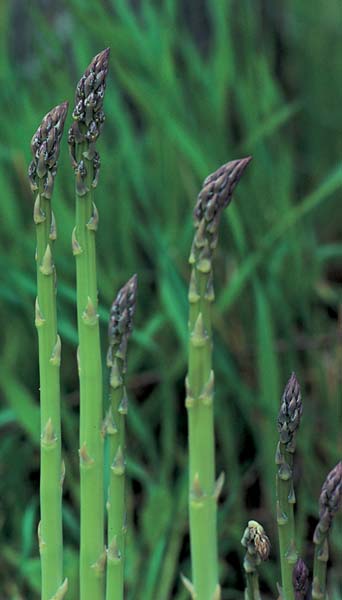
Rapidly growing wild asparagus shoots about 15 inches tall. As long as the upper part of the spears are tender, they are still harvestable. They are tender as long as you can easily snap the stem.
Leafy stem
When I was getting started with wild foods, I tried exactly what they said in the books. Since the leaves of wild spinach (Chenopodium album) are edible, I would pluck them one by one from the stem. Clearing a stem of leaves can take some time. Once I realized that the whole leafy upper stem was edible, one pluck got me about ten leaves and some tender stem. This makes the job easier and gives you more food. If you just harvest the growing leafy stem tips, your pruning will stimulate growth, providing you with even more food for a later harvest.
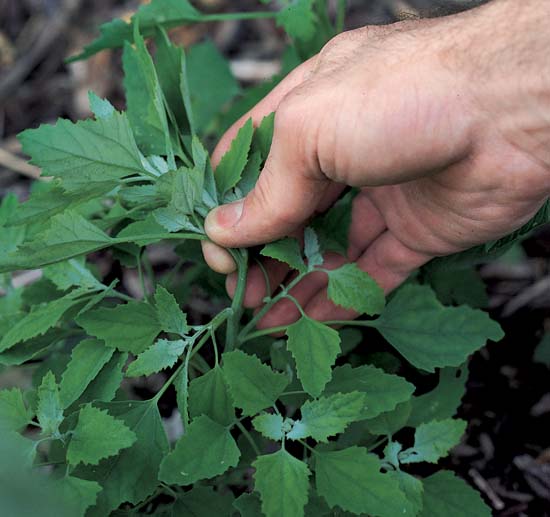
The upper edible leafy stem of young wild spinach. The top of the plant is tender above where the stem snaps cleanly.
Factors Affecting Rapid Growth
Growing conditions
As I’ve explained, rapid growth is the source of tenderness and choiceness. Many things affect the growth of a plant and its parts. The appropriateness of the soil, the length of daylight, the amount of water available, temperature range, and when the seeds germinate are the main factors. When all of these things are optimal for a particular plant, the plant grows rapidly, becoming larger and more vigorous. Seed production is delayed so the plant can continue to grow, producing more photosynthesizing machinery (leaves and stems). Then, after achieving vigorous growth, tremendous quantities of seeds are produced.
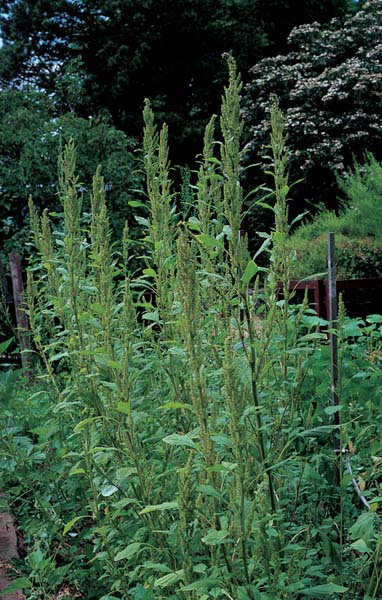
Green amaranth (Amaranthus retroflexus), 5 feet tall, mature, and going to seed. This plant germinated early in its season, allowing for a long happy life before that season ended. It had the further benefit of growing in the rich well-watered soil of a garden. This long life in rich conditions allowed lots of tender, edible, rapidly growing stems and leaves (food for us) to be produced prior to seed production. In these conditions, huge amounts of seed (food for us) are eventually produced because the plant was so healthy.
In contrast, when one or more of these things are restricted, or at least nonoptimal, the plant will change what it does, how big it gets, and how it looks accordingly. This is often called stress. The greater the stress, the more stunted and less productive a plant becomes.
Eating plants stressed by poor growing conditions is one reason why many people give up on wild foods. The first plants they find and experiment with may be growing under harsh conditions. Let’s face it, many wild plants survive in severe conditions that would kill other plants. But stressed survival takes its toll. Under stress conditions, instead of putting what little energy, food, and water they have into growth, the plant puts its resources into reproduction. This results in rapid aging rather than rapid growth. Growing slowly but aging quickly results in stunted plants with fewer, smaller, fibrous leaves and shorter stems going to seed. Bitterness and overall rankness also increase in many edible plants with age.
So, if you are sampling wild foods for the first time, tasting leaves from a stressed plant will provide a much less satisfying culinary experience. And from a time perspective, it will take you longer to collect a reasonable amount of food from smaller plants that are near their end size. The leafy stems and leaves will be fewer in quantity, smaller, more fibrous, and less choice.
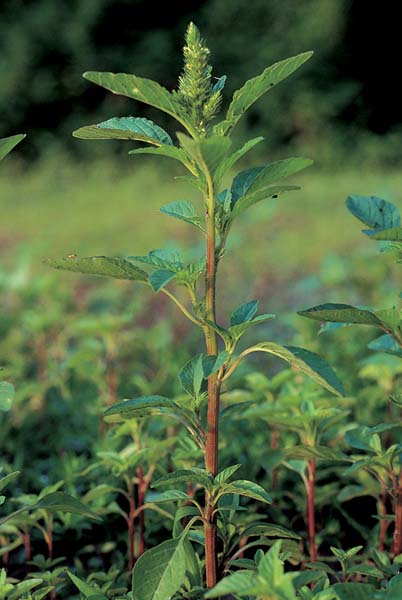
Green amaranth (Amaranthus retroflexus), 10 inches tall, mature, and going to seed. This plant germinated late in its season—not allowing much time to grow before that season ended. The soil was dry and there was a lot of competition from surrounding plants. These conditions forced the plant to mature quickly, using what little energy and water it had to go right to seed—at the expense of leaf and stem growth. So the plant is tiny, almost leafless, and produces only a few seeds. There is not much food to be eaten from plants growing under this kind of stress.
Germination time
Another factor causing plants to age quickly is late germination. If you are near the end of a plant’s growing season but other conditions are right for it to germinate, it will still grow from seed. For some annuals, this can happen if the soil is turned over in late summer and there is just enough moisture to stimulate germination. Since the season is late, the main mission of the plant is to produce seed before it runs out of growing season. Aging accelerates, which results in stunting. The degree of stunting will be greater the closer you are to the end of the season.
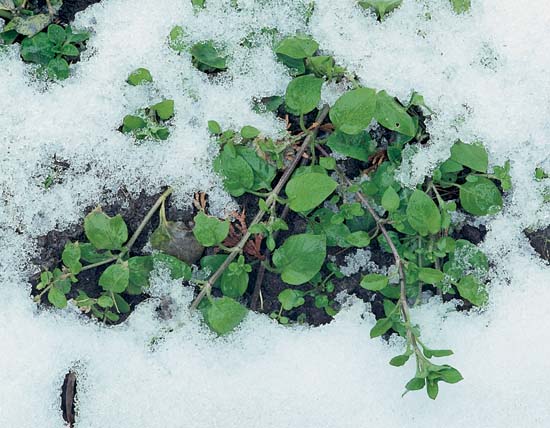
Chickweed (Stellaria media) surviving winter under the snow. Regular bouts with 20 degree temperatures do not kill chickweed. Colder, harsher conditions and physical damage will kill chickweed.
Overwintering
Many of the plants in this book are winter hardy; that is, in spite of below-freezing temperatures and being covered by snow, they continue to maintain some aboveground greenery. But let’s put this in context relative to usability. Winter conditions are harsh. These conditions include temperatures that will crystallize liquid water; very short days, cloudiness, lack of sunshine, or burial by snow; growth-promoting soil organisms hibernating or being compromised; and hardened, regularly frozen soil limiting root growth and restricting water, among other things.
Overwintering plants have to adapt to cold weather in order to survive. In scientific literature, this is called “cold acclimation.” This process involves gene expression, special protein production, fluid management, and other things.
How do all these things affect a plant’s edibility? Most plants undergo winter changes that make them less desirable as food. They are still edible, just less desirable. Growth seems to stop—old leaves hang on and age in place. Few new leaves develop, if any. Remember that rapid growth improves tenderness and choiceness. Slow or no growth tends to do the opposite. Overwintering plants tend to be fibrous, chewy, and more paper-like. Structural support in the form of increased fiber becomes a physiological priority to prevent damage to the plant. Already-hairy leaves become thicker with additional hairs to insulate them from harsh conditions. Plant parts become less crisp and more dry because crystallizing water is what can do the greatest damage to plant cells. Sugars and alcohols increase to lower the freezing point, allowing the plant to survive lower temperatures.
Four-legged herbivores like deer and rabbits are happy to eat overwintering plants, but they are less picky than humans. Plants that seem to survive with the most vigor include miner’s lettuce (Claytonia perfoliata), chickweed (Stellaria media), and wintercress (Barbarea vulgaris). But they still suffer from a quality standpoint. And if you pick what few leaves are there, new ones do not easily grow back.
Another overwintering issue is increased contamination by dirt and mud. Overwintering plants tend to grow closer to the ground, almost flattened. And whether they are fully exposed or growing under the snow, they are immersed in moist grit. So winter plants also require much more cleaning for what you get.
Since there are many fresh supermarket alternatives to wild greens in the winter, I use those. Other than as a curiosity or for recreational survival training, I personally do not do much with aboveground, cold-hardened, overwintering plants.
In summary, being able to evaluate the growth stage and condition of a plant’s parts will tell you whether it is worth gathering and how choice it might be. Understanding how good growing conditions foster rapid growth can lead you to gathering more tender and flavorful parts.