Purslane
A low-growing tasty summer succulent
Family: Portulacaceae
Species: Portulaca oleracea
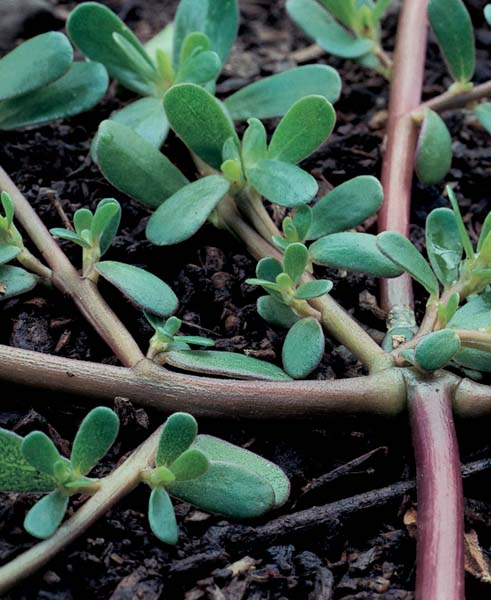
Purslane is a small-leaved plant whose reddish stems look like a network of tiny plumbing laid along the ground with offshoots of small leafy stems. Makes a good edible ground cover.
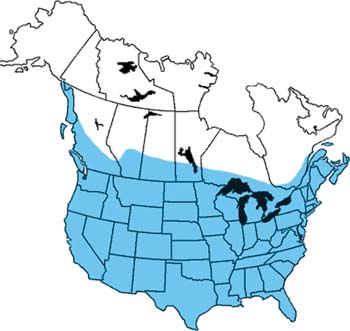
Estimated Range
Official Species Name:
Portulaca oleracea L.
Synonyms (Historical Names):
Portulaca neglecta Mackenzie & Bush
Portulaca retusa Engelm
Common Names:
Purslane
Pursley
Pusley
Portulaca
Little hogweed
An herbaceous annual weed naturalized from Southern Europe, it is widespread and abundant in North America, primarily where humans have invaded and where soil has been disturbed. It loves wet summers and is not found in abundance in cold regions and high elevations.
Edible Parts
Growing tips of young leafy stems
Leaves
Buds and flowers
I’ve never been a plumber, though I’ve dabbled in it as any manly kind of guy would. And while you don’t have to be a plumber to eat wild plants, it might help you to recognize purslane. On the ground, purslane looks like a Lilliputian attempt to pipe water along at foot level. Tiny pipes, no; but a plant with succulent stems and leaves, yes.
Purslane is not well known as a food in North America, and this is perplexing because it is a very popular food in the Mediterranean and many other parts of the world. I was recently asked by someone how purslane could be edible when he had heard it was poisonous. Purslane is no more poisonous than spinach. This is a normal food that can be eaten with impunity in the context of a normal diverse diet.
Nutritionally, purslane is a powerhouse. It has more than double the omega-3s that kale has and, as far as I know, more than any other leafy green ever analyzed. It has over four times the vitamin E of turnip leaves, more than any other leafy green ever analyzed. It has glutathione and other antioxidants and about as much iron as spinach. It also has reasonable amounts of other nutrients as well as phytochemicals, like all these leafy greens. So purslane is no slouch, not a poison, and definitely worth eating. (Simopoulos, 1992; 1995.)
Many people studying the Mediterranean diet think that it is foods like purslane and other omega-3 greens that give the Greeks their good balance of fats. Olive oil only contributes some of the omega-3s; the greens, walnuts, oily fish, and a few other foods give them the rest of what they need.
Knowing Purslane
Purslane is a hot-weather plant. It will not sprout until the ground temperature is somewhere between 76 and 90 degrees F. A strong hot sun warming the soil along with good moisture are required for it to sprout below 80 degrees.
The sprouts are green with a reddish tint. The first four leaves look like little rounded propellers surrounding a reddish engine tip. At first, these early leaves are elliptical, but they get a little fatter near the tip very quickly. The tips of these leaves are about as rounded as you can get, not pointed at all.
In general, purslane sprouts and grows best in the hottest four months of the year. Once established, it is very drought resistant. If a young plant is growing in dry conditions, growth will slow and the plant may be tiny. This can be seen often in the cracks of sidewalk cement. The plant starts growing, but the moisture dries up. In these conditions, the plant is so small that it goes unrecognized by most people.
If a healthy more-established plant is exposed to very dry conditions, its stems will pull the moisture from the leaves and drop them. The stems, however, survive longer and can grow new leaves when moisture returns. If conditions continue to dry, even the stems will die.
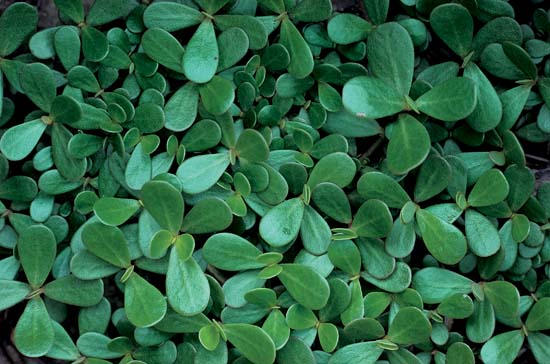
Leaves of young purslane before they start producing much in the way of stems. This is dense growth created by lots of sprouts emerging from a small area. This stage of growth is too young to be producing flowers or seeds.
As long as the days are long, vegetative growth continues. Great growing conditions will hold off flower and seed development for awhile. I’ve seen individual stems up to eighteen inches long.
Purslane is a succulent, a plant that retains a lot of water in its leaves and stems. Those leaves and stems appear thick and fleshy relative to their size. This ability to store water is what helps this plant thrive in heat and survive drought.
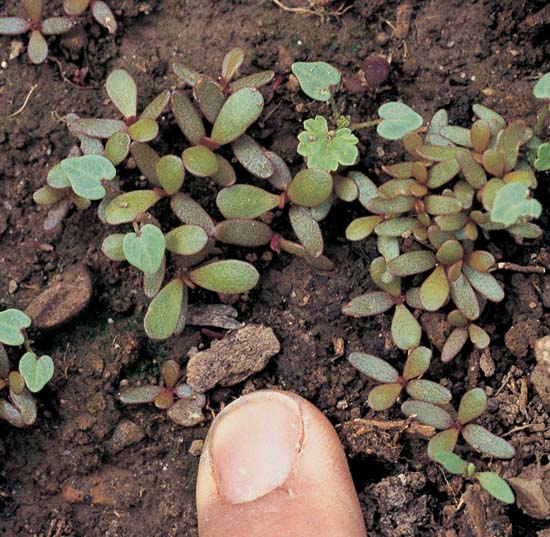
Purslane sprouts, life-size, relative to my index finger. Note that there are a few mallow sprouts mixed in with the purslane.
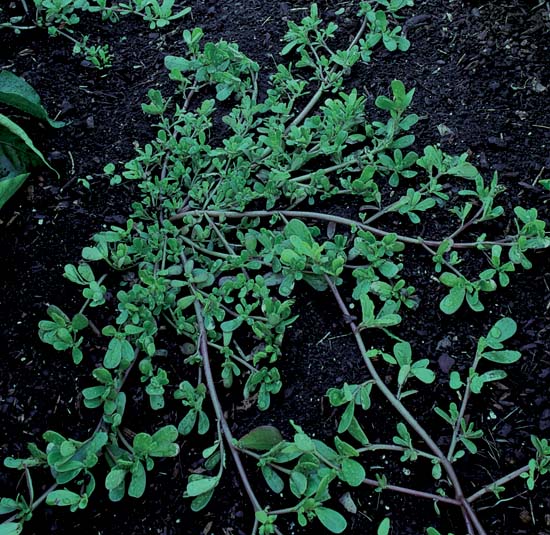
Rapidly growing purslane, spreading in the open area of a planting bed in my backyard garden. Purslane branches regularly, trailing along the ground.
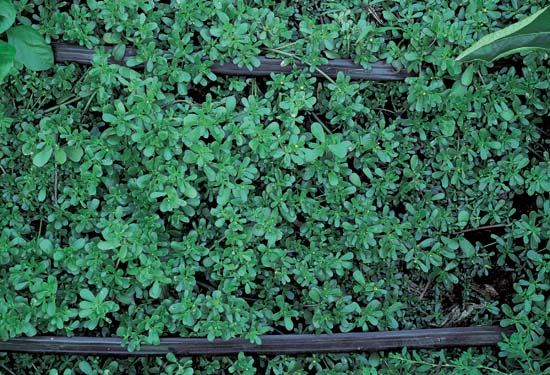
Planting beds at an organic farm. The rubber hoses are supplying plenty of water, and the sun is supplying plenty of—well—sun. Of course, the hoses are not there for the purslane, but the purslane benefits. This growth is about as thick as purslane can tolerate.
Stems: As long as there is direct sunlight, purslane will spread out, with thick primary stems that tend to resemble reddish-green piping. The plant crawls along the ground in huge mats. Sun-exposed open space can be completely covered by purslane. Unlike some other plants that crawl along the ground, purslane does not root at its nodes. If, however, you chop up thriving plants, like when turning over the soil, you may get a surprise. If there is enough moisture in the soil, many of the cut segments may begin rooting and grow new plants. This is particularly troublesome for farmers who want to get rid of purslane. They plow, plant new crops, then water new seeds they’ve planted during the hottest time of the year. Guess who loves those conditions? Purslane and wild-food enthusiasts.
Purslane has limits on its growth. Shade and competition will kill it. Anything that restricts sunlight can kill it—not necessarily the whole plant, but parts can atrophy and die, leaving the rest of the plant to grow where there is sun. Purslane competes with itself as well as other plants. The earlier that purslane emerges from the soil, the longer it can stay in vegetative growth, continuing to develop its potential. Where you are in North America will determine when temperatures get hot enough and days get long enough for purslane to sprout. Southern climates will be earlier; northern climates will be later—it could be April, May, or June. Individual plants can live for two to four months.
Flowers: As purslane reaches a certain age or as growth conditions decline, it starts producing flowers. Individual flowers open only on bright hot days and last for only a day. As long as the plant continues to grow new stems, flower and seed production will be progressive. This means that older stems will flower first, with younger ones flowering later.
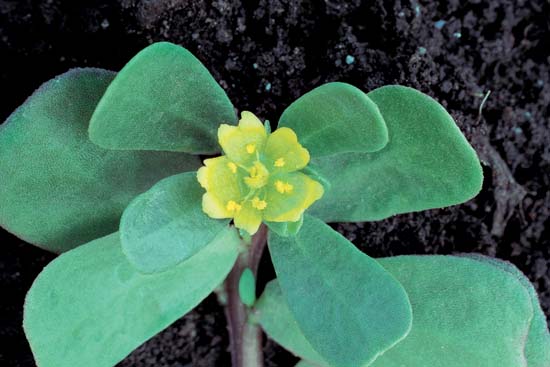
A tiny purslane flower, magnified. This flower is a little less than 1/4 inch in diameter. The leaves are fairly big here for purslane and appear more flat-tipped than usual.
Seeds: Of course, seeds are produced when flowers have been fertilized. When ripe, the top part of the seedpod pops off, revealing what looks like a little miniature bird’s nest of black eggs. These seeds quietly sit there until some disturbance forces them out of the nest. This could be an animal knocking the plant as it walks by, a raindrop hitting it, or a strong wind blowing through. The seeds do not travel far from the plant unless they hitchhike on some clothing or digging tool, or if the soil is moved.
Since purslane stores moisture, pulled plants do not stop the seed-ripening process, making eradication difficult. Seeds fall to the ground as the plant is pulled, and seeds continue to mature and drop if you pull the plant and leave it. Even worse (or better).
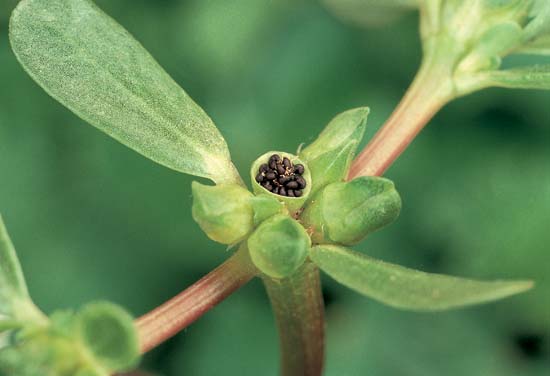
Bird’s-nest-style seed capsule of purslane. Other capsules shown here will pop open as they mature.
Harvesting Purslane
While it is perfectly possible to eat the tiny plants growing in cement cracks, I typically only gather purslane when it is growing lushly in more desirable places. Vigorously growing purslane is not hard to find. The best parts are the new, rapidly growing tips before plants go to seed. By “best,” I mean that they will work fine in your most delicate salads served to your most-finicky wild-food-fearing friends—and at fine restaurants everywhere.
Gather the leafy stems—not just the leaves. Plucking the leaves individually would be the best way to procrastinate from doing anything important in your life. The leaves are too small to pluck except for specific purposes. Some larger individual leaves can be used as a garnish. Kids love plucking the leaves. Lovers who are gambling on their relationship do the “she loves me, she loves me not” thing (daisies are good for that too).
And remember, the stems are part of the food! Say this again to yourself: the stems are part of the food—a great part.
If you plan on using purslane as greens, either fresh or cooked, and you have lots of purslane to choose from, just collect the tips. The last inch or two of the leafy stems will be the most delectable. Why not? You can be choosy.
If you can’t find much purslane to gather, either let the plants go to seed for next year or collect whatever you can and use whatever you get.
While gathering, if you are thinning an area to allow something else to grow, pull purslane out by the roots. Be careful to keep all the root material together as you carefully stack them for transport. Doing this will help you in the cleaning process later.
Once collected, purslane travels well. Because it’s a succulent, it does not wilt quickly; but it is still helpful to spray-mist your take unless you collect it with root material. Moistening the dirt on root material just makes a big mess. Keep harvested purslane cool until you can trim and wash it in cold water. Its solid structure makes it easy to clean. Use your harvest fast for the best quality.
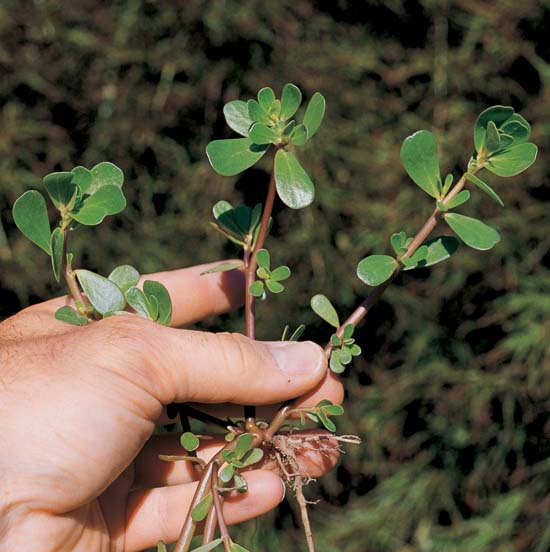
A healthy, rapidly growing, young purslane plant—roots and all—prior to flowering. The closer the leafy stems are to the tips of these branchlets, the more tender they will be. But this plant provides good eating down most of its stem.
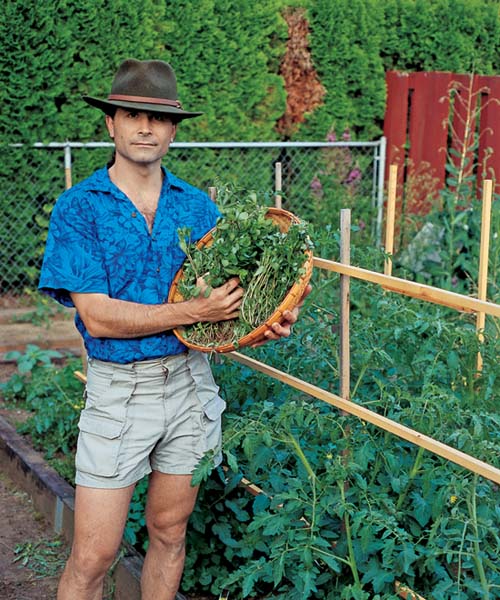
Several minutes of purslane weeding/harvesting from my garden. Whole plants were pulled out by the roots so the tomato plants could spread out. (The author, 1995.)
Serving Purslane
Purslane is a pleasant-tasting food with a hint of lemoniness, but I do not find it sour. It fits right into the foundational greens category because it is so mild. To most newcomers, the texture is not as familiar as a conventional green. Purslane’s succulent three-dimensional form and mildly mucilaginous texture offer a pleasantly unique experience. It transforms into a more conventional green once cooked.
Use the tender leafy stem tips in all fresh-food applications. This will satisfy everyone. The tips (the upper one to two inches of leafy stems) are great in a purslane salad—a wholesome food all by itself. Most people, however, like to have more complex salads, and mixed salads are better for you. Aside from salads, purslane is great where lettuce, alfalfa sprouts, and any other leafy green are used. Make them into pesto. Experiment.
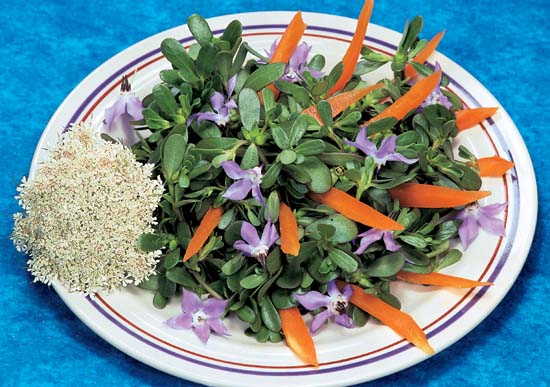
Purslane Salad. Contains orange sweet pepper slices, borage flowers (Borago officinalis), and a large wild carrot flower head (Daucus carota) as a garnish.
Since the stems are a major part of this plant, and they have their own unique texture, they can have applications all their own. These are succulent, interestingly crunchy stems that are different from leafy material you are used to. So use them in different ways. Try older, stiffer ones for dipping in fondues or to poke into dipping sauces. Give them to kids as snacks. With experience, you’ll learn how to exclude parts that are too close to the root area. I love the stems.
The older leafy stems, below the stem tips and quite far down the stem, are good too. They are crunchier than the tips and have small leafy stems sprouting out of them. I chop bite-size pieces of the stems into my salads.
Cooking of any type relaxes the greens, making them more like the cooked greens that you are used to. They can be boiled, sautéed, stir-fried, steamed, baked—you name it; you are only limited by your imagination. Cook them into lasagnas, spaghetti sauces, bean casseroles, stews, and anywhere vegetables go.
Cooking reduces the coarseness you might find in some of the older stems, making them more agreeable.
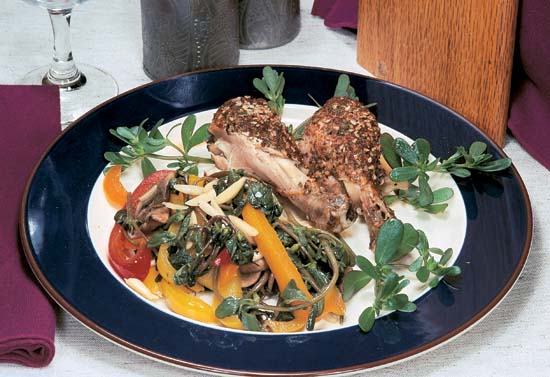
Roasted Lamb Chops. Served with a stir-fry that includes purslane, accompanied by yellow and red sweet peppers, topped with almond shavings, and garnished with purslane leafy-stem tips.
The flowers and seeds of purslane are edible but too tiny to have any use of their own. So go ahead and eat them along with the leafy stems you gather.
Purslane is a wonderful wild food. It is nutritious, with great flavor, and can be eaten raw all by itself. For a leafy green, it is extremely high in omega-3 fatty acid, vitamin E, and glutathione, and will make even the persnickety less so. If you can wait till summer, it will be there for you.
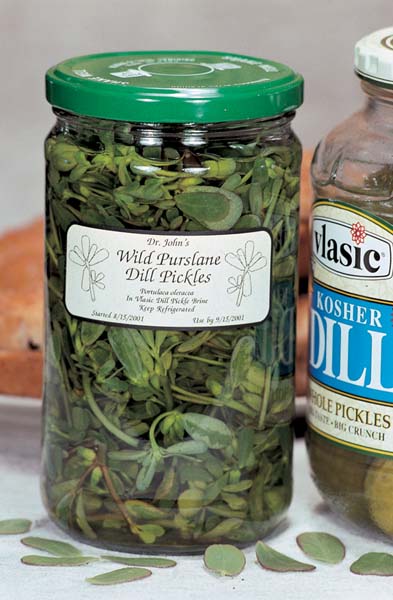
Dill Pickle Experiment. Due to purslane’s crunchy texture, it is a natural for pickling. This bunch of purslane leafy-stem tips were placed in the leftover juice of store-bought pickles and then put in the fridge for a few days. Due to a short soaking time, these purslane pickles were understandably weak in flavor and quite limp. To make purslane pickles, use the older, thicker stems—they will stay more solid then the tips used here. And look up a real pickling recipe—it will take more time, but the results will be worth it.