Sheep Sorrel
A tart treat for both kids and adults
Family: Polygonaceae
Species: Rumex acetosella
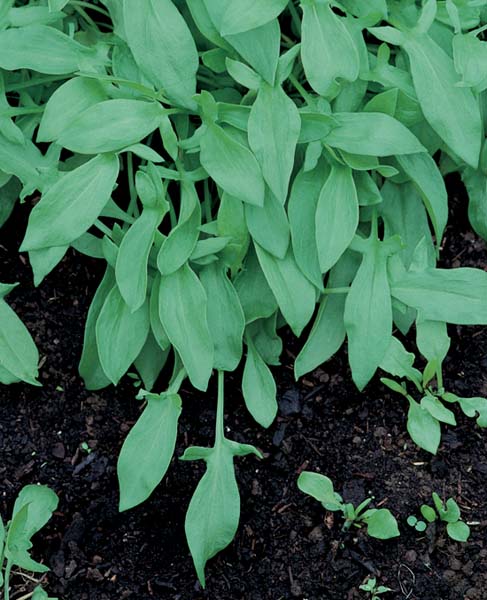
A cluster of sheep sorrel leaves at the prime of their edible life.
Estimated Range

Official Species Name:
-
Rumex acetosella L.
Synonyms (Historical Names):
-
Rumex angiocarpus Murb.
-
Rumex tenuifolius (Wallr.) A. Löve
-
Acetosella acetosella (L.) Small
-
Acetosella tenuifolia (Wallr.) A. Löve
-
Acetosella vulgaris (Koch) Fourr.
Common Names:
-
Sheep sorrel
-
Field Sorrel
-
Red Sorrel
-
Sour Grass
-
Sour-weed
-
Red-weed
-
Gentleman’s sorrel
-
Surette
An herbaceous weed naturalized from the Mediterranean, sheep sorrel is widespread and abundant in North America primarily where humans have invaded and where soil has been disturbed.
Edible Parts:
-
Leaf blades
What fun this plant is. A delight for both kids and adults. Pluck the leaves and taste for an instant kick—a spark to the taste buds, a strong sour-apple flavor. When found in quantity, this plant can provide a great addition to salads, soups, and many other dishes. The key is to know how to find it growing in its rapid leaf phase.
Like its relatives curly dock and broad-leaved dock, sheep sorrel is in the buckwheat family (Polygonaceae). It is unrelated to the wood sorrels (Oxalidaceae) that have similar flavor and some similar chemical characteristics.
Sheep sorrel is rather inconspicuous to the average person who passes it every day. In open fields, its flowering stalks give the impression of patches of red-colored grass. Some people spot the cute arrow-shaped leaves.
Average amounts of calcium and iron are all I can find in the scientific literature for sheep sorrel. And there has yet to be any serious study of the phytochemicals it may provide. Both the nutrients and phytochemicals of sheep sorrel need further study.
Sheep sorrel also contains soluble oxalates. This is not of general concern in the context of a normally diverse human diet.
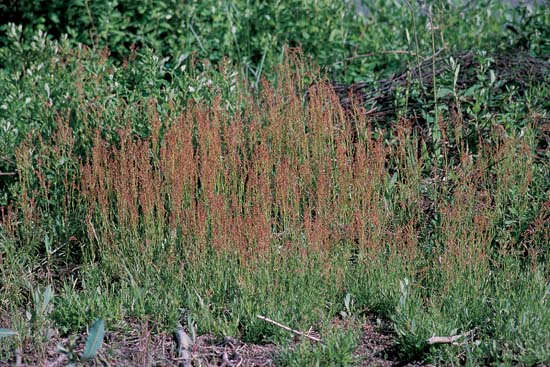
Mature sheep sorrel plants in full stem and flower. This plant often grows in clusters in grassy fields and even resembles grass (from a distance) but with a reddish tinge. This resemblance may be how it got one of its common names—sour grass.
Knowing Sheep Sorrel
Sheep sorrel reproduces in two ways—by seed and by rhizome. A seedling starts out with a pair of oblong cotyledons. Like curly dock, the first few true leaves that appear are egg-shaped and then elliptical; later, you begin to see lobes forming near the base of the leaf blade. Five things happen to the leaves as the plant matures: leaf stems elongate, leaf blades lengthen, and lobes enlarge, lengthen, and flare out to the sides.
Once a seedling establishes itself, the plant produces rhizomes, which are underground stems. Along the length of sheep sorrel rhizomes are buds that give rise to new plants. One rhizome can produce many plants. The photo of sour grass above shows a bunch of adult plants that could theoretically be connected by rhizomes to a single parent plant. When plants come from the same rhizome, they are considered genetically identical clones.
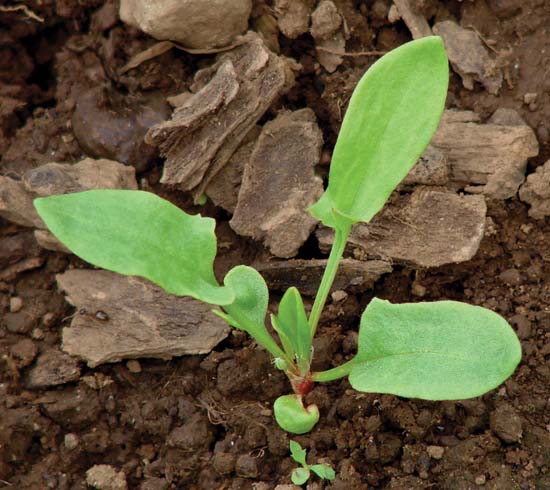
A new sheep sorrel plant whose lobes are just forming. This plant is about 1-1/2 inches tall.
Sheep sorrel rhizomes are a bane to farmers. Normally they till to soften the soil and to kill weeds. But all tilling does with sheep sorrel is break up and spread its rhizomes. New plants can grow from fragments of the rhizome.
People often describe sheep sorrel leaves as being arrowhead-shaped. That description typically means that the main part of the leaf blade is pointed one way, while two lobes at the base of the leaf point back in the opposite direction. Sheep sorrel lobes are unique—not so much like arrowheads. While the main part of the leaf blade is how you would expect it to be, the lobes spread out to the sides. If you imagine them as ear lobes being pulled outward and twisted slightly, you get a better picture of how the lobes are shaped. Sometimes the lobes even curve back toward the tip of the main leaf blade.
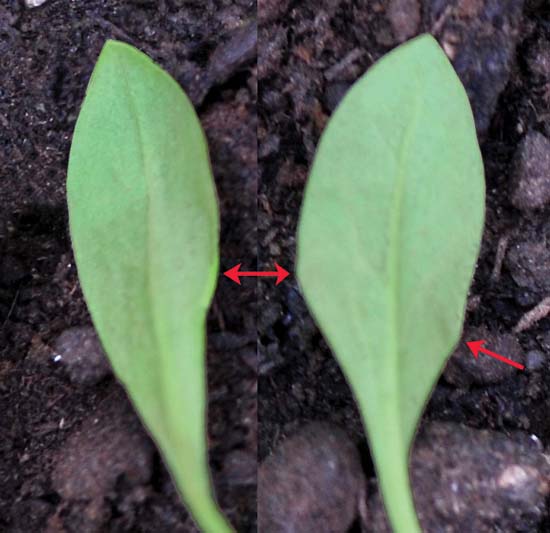
The very first leaves after cotyledons have no lobes, but you can often see pre-lobe angles along the margins.
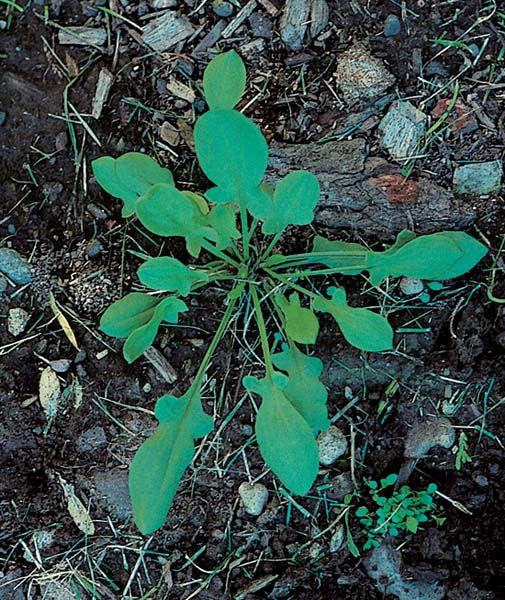
A young plant’s basal rosette of leaves. Individual plants growing alone tend to form a basal rosette prior to stalk development. This plant is about 4 inches in diameter at this stage in its growth.
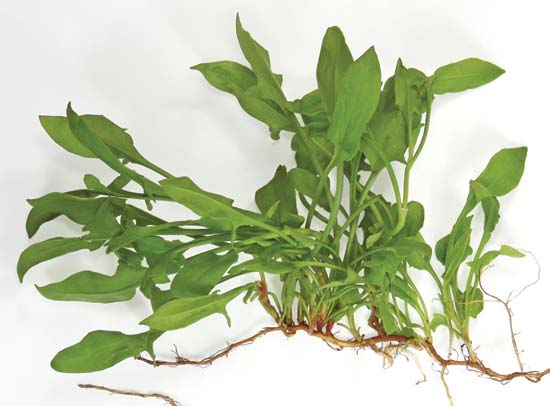
Sheep sorrel rhizome giving rise to many aboveground plants. These rhizomes are the source of the great clusters of leaves that one occasionally sees.
At some point in the spring, you get a rapid proliferation of leaves from older rhizomatous plants. The leaves look like they are growing in big clumps, or they can carpet a whole area. The healthiest, most luxurious, and abundant growth goes on where the soil is soft, fertile, and well-watered. These conditions also result in the largest leaves. See the photo opening the section to see some luxurious growth.
When the plants reach a certain maturity, they begin stalk development. In some respects, their overall form mimics a miniature version of curly dock. The base of each leaf is surrounded by an ocrea; the stem eventually branches, and tiny flowers and fruits are arranged along the tips of long stems.
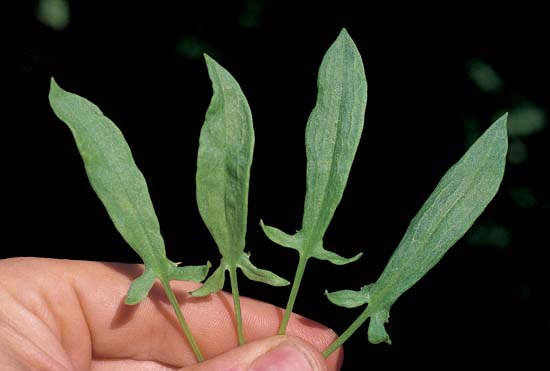
Normally shaped and sized sheep sorrel leaves. They can get much bigger and much smaller than this. I’ve found leaf blades from 1/2 inch (typically on tall stems in dry ground) to 5 inches long (typically in great soil prior to flower stalk development).
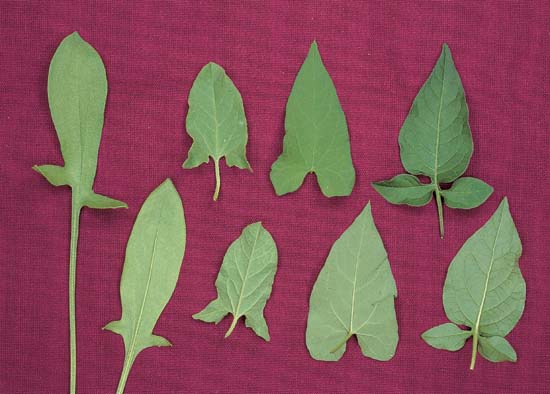
Sheep sorrel leaves compared to morning glory (Convolvulous spp) and bittersweet nightshade (Solanum dulcamara). Both are considered poisonous to eat. While all these can loosely be called arrowhead-shaped leaves, only sheep sorrel will have a strong sour flavor. The two on the left are sheep sorrel, the four in the center show two varieties of morning glory, and the two on the right are bittersweet nightshade. Across the top are the upper sides of the leaves; across the bottom are the undersides.
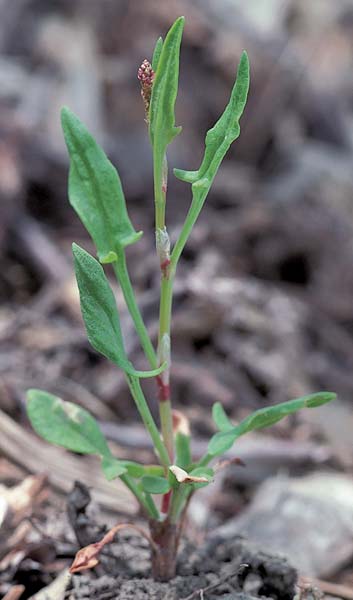
Young sheep sorrel whose stem has just started to bolt. This first-year plant is not yet in a rhizome-connected colony. Note the ocrea membranes surrounding the base of each leaf. This shows a tiny version of the same type of ocrea found on curly and broad-leaf docks.
The adult plants can grow up to two feet tall in ideal conditions. In some instances where support is not strong, stalks may fall over and grow in a mishmash of confusion. The picture below shows the typical upright growth form. Expect to see some variation in nature.
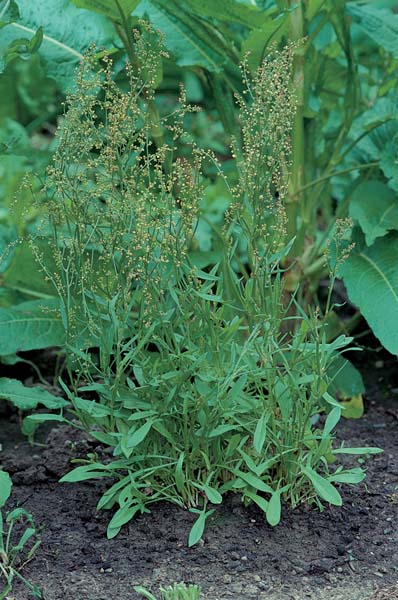
Several mature sheep sorrel clones growing from the same rhizome system. Stem leaves get smaller and narrower, and sometimes lack lobes toward the upper part of the plant. The seed structures eventually take on a reddish coloration.
Harvesting and Managing Sheep Sorrel
Sheep sorrel is always a treat to snack on in whatever form you find it. It is famous as a kid’s treat and as a walk-by nibble. The leaves always have that great sour flavor regardless of the age of the plant.
For meals, I only collect sheep sorrel when I find large leaves (relatively speaking) growing in abundance. I want my food to be easy: easy to collect, easy to process, and easy to prepare. Sheep sorrel leaves are relatively small and stem leaves are even smaller, so large and abundant make a big difference.
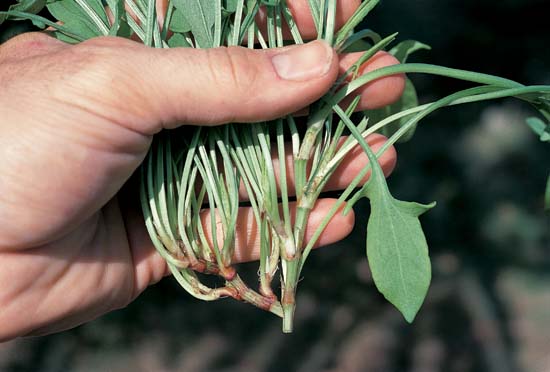
The oft-branching stems of sheep sorrel. Not only does it grow multiple plants from its rhizomes, but the stems themselves can also branch quite generously just above ground level. This branching can produce a huge number of leaves prior to bolting.
I typically gather from healthy patches where the leaves are large and clustered together. This is almost always in the pre-stalk condition, where rhizome-formed clones produce lots of leaves. This growing condition allows me to grab big clusters of leaves with one hand while I snip them with scissors using the other.
Sheep sorrel is of lesser, but still good, edible quality when it is growing in more stressed conditions. Stress in the form of poor dry soils will cause sheep sorrel to bolt quickly into mature stems. In these conditions, sheep sorrel produces fewer and smaller leaves. Only when the soil remains moist throughout its life will sheep sorrel produce large lush leaves in its adult form. Struggling plants are good for snacking but not for gathering on a larger scale.
Like other plants, keep your gathered leaves spray-misted and cool in containers out of the sun until you are ready to use them.
When you are ready to use the leaves, it is time to remove stems. The stems are just as flavorful as the leaves but are too fibrous for polite society. Including stems with the leaves is, of course, the easy way to include sheep sorrel in any dish, but spitballs will ensue, and flossing will be necessary. This is true, raw or cooked. If you are with a bunch of burly survivalists who don’t mind smiling with green matter stuck in their teeth, leave the stems on. But if you are feeding these wild greens to your friends who are skeptical of your foraging prowess, you want to give them a pleasant chewing experience, so remove the stems.
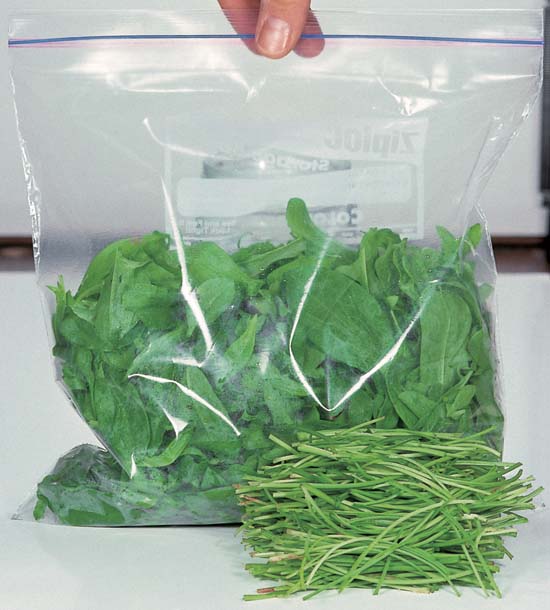
Leaf-stem removal from the leaf blades. This process reduces the size of your take. Here is the amount of stem material produced by a gallon-size bag of sheep sorrel leaves. The bag was full when the leaf stems were attached. The bag only contains leaf blades now.
Serving Sheep Sorrel, Fresh or Cooked
Sheep sorrel is a wonderful addition to any food where a sour or lemony taste is desired. Fresh, it is an excellent salad green all by itself—though a little strong for some. So, you can make a whole salad out of sheep sorrel, or you can use measured amounts of it in more complex salads where you want a variety of flavors. To me, a good base for a combination salad includes roughly a blend of a third foundational greens, a third pungent greens, and a third sour greens, with shredded bitter greens mixed in to suit your individual tastes. Of course there are a million things you can add to this base, and I’m sure you will.
Fresh sheep sorrel is a great addition to any kind of salad. It goes good with greens as well as fruit, meat, and seafood salads. Put it in sandwiches, add some leaves to a glass of iced tea, or use it in homemade salsa or pesto. Sheep sorrel is similar in flavor and other characteristics to French sorrel (Rumex acetosa). Any cookbook recipe you can find that uses French sorrel—also known as garden sorrel—will give you a great guide for inventing recipes for sheep sorrel.
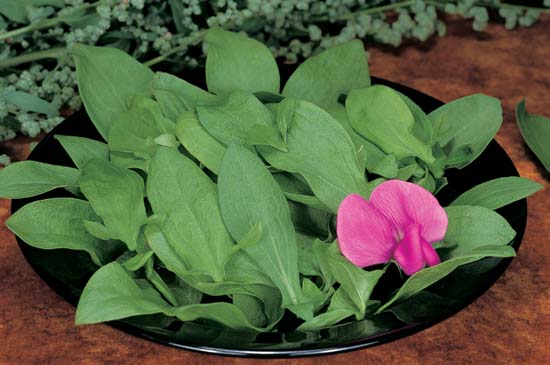
Sheep Sorrel Salad. Garnished with a wild sweet pea flower and topped with your favorite salad dressing or just olive oil and salt to taste. The leaves shown here are larger than typically found.
Like curly dock and broad-leaved dock, sheep sorrel reduces greatly upon cooking. For this reason, I typically do not make a side dish of cooked greens from this plant. It is just too much work for whatever little pile of greens you may end up with. So for me, cooking sheep sorrel is limited to the making of soups, sauces, and flavorings—where a little goes a long way. And because of the intensity of sheep sorrel’s flavor, this strategy works quite well.
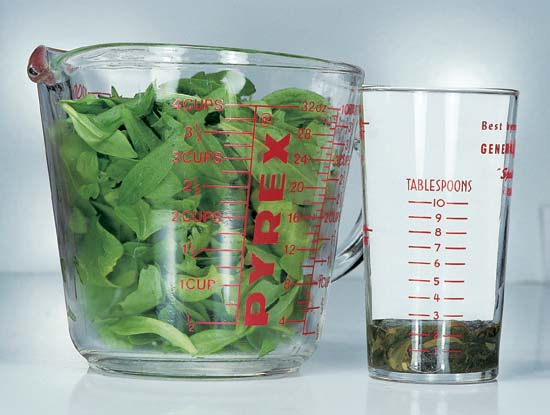
Cooked sheep sorrel reduces greatly in size. Four cups of fresh sheep sorrel leaf blades yield only about 3 tablespoons of cooked material. The color also transforms to an army green.
Another change that occurs during cooking is that the greens transform from bright green to a dark olive green. This color change is a feature caused by the high acid content of the greens. You cannot prevent this change under normal cooking circumstances, so learn to love the new color.
Sheep sorrel is a commonly known wild food that is already enjoyed as a mouthwatering snack by many who use it. Knowing the details on its collection and use will help you get the most out of this plant as a real food and as a contributing part of your diet.
The recipes for soup and sauce found at the end of the wood sorrel chapter also work for sheep sorrel.

Grilled Fish Sandwich. Adding sheep sorrel leaves gives it a lemony flavor.
Sheep Sorrel Pesto
Sheep sorrel pesto (fresh) or sauce (cooked) can be even more varied. Start with this basic pesto recipe and change it to your liking.
Ingredients:
| 4 cups loosely packed fresh sheep sorrel leaf blades |
| 1/2 cup grated Parmesan cheese |
| 1/3 cup pine nuts |
| 2 medium cloves garlic, peeled |
| 1/2 cup extra virgin olive oil |
| Salt and pepper, to taste |
Directions:
Process the sheep sorrel, cheese, pine nuts, and garlic into a rough paste in a food processor. With the machine still running, drizzle in the olive oil. If the paste is not liquid enough add more olive oil until it suits you. Add salt and pepper as desired. Serve fresh with pasta and other dishes.
Sheep Sorrel Tea
The lemony flavor of sheep sorrel translates wonderfully into a tea that can be made from the leaves and stems. Dry them as you would any tea you make yourself. I find that a food dryer set at 95 degrees F works best to keep in most of the flavor. Since you only dip the greens into the water and then pull them out again, there is no need to exclude stems. In fact, this is a great use for the stems you have cut from the leaves. The stems require no tea bags; just bundle them with a string. With sweetener added, iced tea made from sheep sorrel makes a lemonade-style drink.
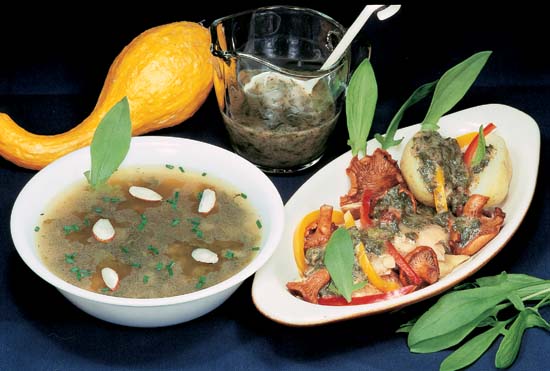
Sheep Sorrel Soup and Roasted Chicken with Sheep Sorrel Sauce. The soup is garnished with bull thistle (Cirsium vulgare) root slivers and fresh chives. The chicken is garnished with chanterelle mushrooms, red and yellow sweet bell peppers, and potatoes, all drizzled with sheep sorrel sauce (center).