Wood Sorrel
A tart-tasting shamrock of a plant
Family: Oxalidaceae
Species: Oxalis stricta
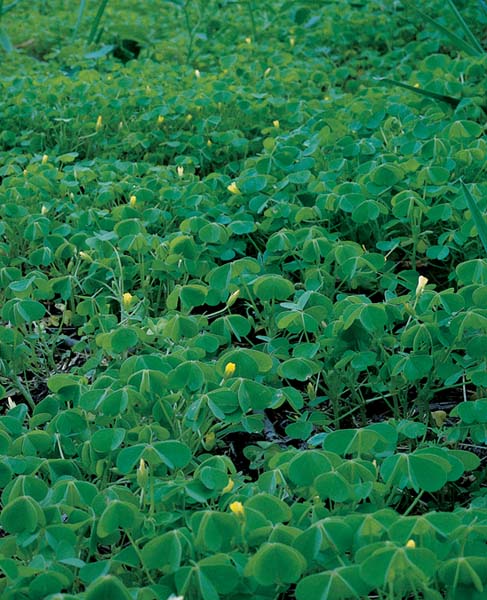
Wood Sorrel—a non-woody low growing plant that would please any leprechaun. The fascinating shape of the leaves reveals the identity of this plant.
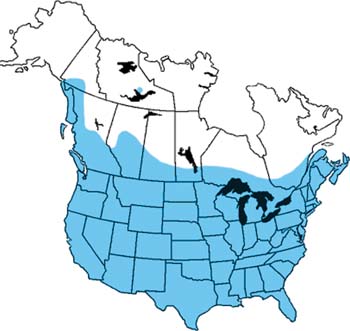
Estimated Range
Official Species Name:
-
Oxalis stricta L.
Synonyms (Historical Names):
-
Ceratoxalis coloradensis (Rydb.) Lunell
-
Ceratoxalis cymosa (Small) Lunell
-
Oxalis or Xanthoxalis brittoniae Small
-
Oxalis or Xanthoxalis bushii (Small) Small
-
Oxalis or Xanthoxalis coloradensis Rydb.
-
Oxalis or Xanthoxalis cymosa Small
-
Oxalis or Xanthoxalis filipes Small
-
Oxalis or Xanthoxalis interior (Small) Fedde
-
Oxalis or Xanthoxalis rufa Small
-
Oxalis corniculata var. dillenii (Jacq.) Trel.
-
Oxalis dillenii Jacq.
-
Oxalis dillenii ssp. filipes (Small) Eiten
-
Oxalis dillenii var. radicans Shinners
-
Oxalis europaea Jord.
-
Oxalis europaea var. bushii (Small) Wieg.
-
Oxalis europaea var. rufa (Small) Young
-
Oxalis florida ssp. prostrata (Haw.) Lourteig
-
Oxalis fontana Bunge
-
Oxalis prostrata Haw.
-
Oxalis rupestris Raf.
-
Xanthoxalis dillenii (Jacq.) Holub
-
Xanthoxalis dillenii var. piletocarpa (Wieg.) Holub
-
Xanthoxalis florida (Salisb.) Moldenke
-
Xanthoxalis stricta var. piletocarpa (Wieg.) Moldenke
Common Names:
-
Wood sorrel
-
Upright wood sorrel
-
Yellow sorrel
-
Yellow wood sorrel
-
Oxalis
-
Shamrock
-
Sourgrass
-
Toad sorrel
An herbaceous weed thought to be native to North America and Eurasia, wood sorrel is widespread and abundant in North America, primarily near human activity but where the soil is relatively stable, particularly lawns, vacant lots, and landscape beds.
Edible Parts:
-
Leaves
-
Flowers
-
Seedpods
Most people walk by wood sorrel all their lives, seeing it as clover. Those of us looking closer notice it is unique—sort of a cleaner version of clover with a well-defined leaf. It wasn’t until I began studying wild foods that I realized it was also a tasty treat. It is a plant that grows anywhere there is moisture and sunlight bathing the soil. It is common in yards, gardens, sidewalk cracks, and driveways.
Also mistakenly called shamrock, the leaf is the classic shape often seen on display at Irish cultural events—particularly to celebrate St. Patrick’s Day. After some research, I discovered that, historically, the true shamrock is believed to be a clover, not wood sorrel—probably Trifolium dubium or Trifolium repens. No one seems to know for sure, but do a search for shamrock on the Web and you will see all the theories. Larger woodland species of Oxalis are often sold as potted plants on St. Patrick’s Day, labeled as shamrocks for marketing purposes.
Oxalis stricta and Oxalis corniculata are the two most common weedy yellow (flowered) wood sorrels. They are edible, delicious, and easily recognizable—nearly identical. For the purposes of this chapter, all the sorrels can be used in the same ways.
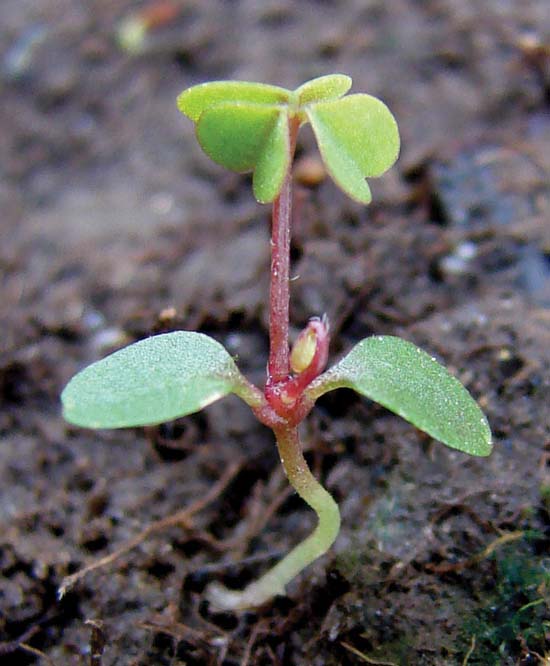
Very tiny seedling of wood sorrel, much enlarged here, soon after germination. It includes two cotyledons, one expanded true leaf at the top, with the second leaf still curled, ready to expand. These seedlings are tiny, about 6mm from left to right—you almost have to have a magnifier to see them.
Wood sorrels are annuals but will struggle and survive into perennial-ness in very moderate winter climates.
Both of the yellow sorrels have high values of iron, calcium, and vitamin C. Even more surprising is the level of iron in Oxalis corniculata, which has been found to have three times the iron of spinach. Spinach currently provides the highest source of iron known from a cultivated leafy green.
Aptly named Oxalis, this genus and its plant family, the Oxalidaceae, were named after the Greek word for sour: oxys. The sourness cannot all be attributed to oxalic acids (oxalates), even though the oxalates are high. The sourness comes from a mixture of acids. In spite of many authors claiming so, oxalates are not a problem for normal healthy humans eating a normally diverse diet.
I couldn’t find any phytochemical data on wood sorrel.
Knowing Wood Sorrel
Leaves/leaflets: Wood sorrel sprouts throughout most of the growing seasons—whenever the soil is disturbed, there is enough moisture, and some sunlight is present to stimulate germination. That is typically in the spring and autumn unless someone is regularly watering the area. The cotyledons and the first true leaves are tiny and difficult to see. The seedlings can be as small as 4mm in diameter.
These plants are very delicate and tiny until the root reaches a critical mass, allowing the leaves to start growing in size. Leaves on a healthy adult plant get to be up to 1 inch in diameter. Leaves grow alternately on delicate stems and give this plant its unique appearance. The leaf is made up of three leaflets, each in the shape of a heart. The three hearts meet at the point where they join the leaf stem.
Each leaflet has a flexible crease along its main vein. The crease gives the leaflets a special talent, an ability to behave differently depending on the whims of nature. During the day, the leaflets are generally spread open in shady areas. At sundown, leaflets angle downward toward the stem and fold along their crease, sort of like a collapsible umbrella. During the day, they fold down if the sun gets too intense or if it starts raining. These behaviors seem to protect the delicate leaves from physical damage brought about by sun and rain.
Wood sorrel leaves and stems range in color from pure green to pink to plum to some reddish coloration of green. Sometimes green leaves will have reds darkening the leaves evenly, or there will be red around the edges. Whatever color it is, it will have a dull (not shiny) surface.
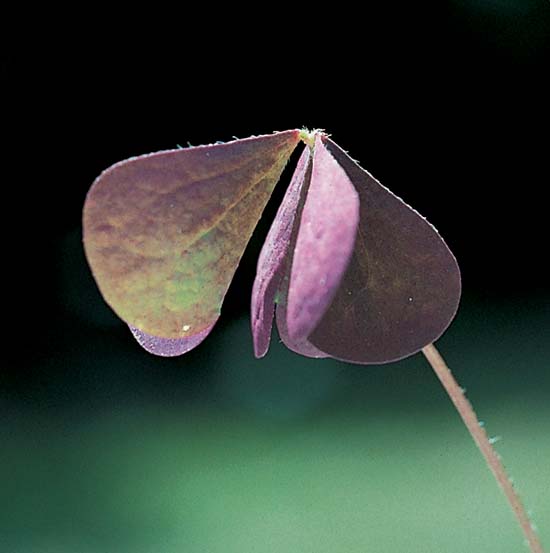
Folded wood sorrel leaf with its three folded leaflets.
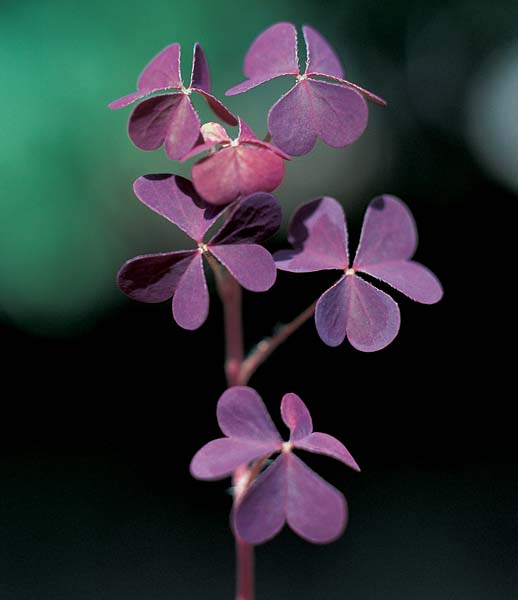
Plum-colored wood sorrel. Its leaves and stems range in color from bright green to pink, to plum, or red. Sometimes leaves will be green, darkened by a reddish hue.
Rhizomes: Once established, wood sorrel can grow into big mats. Oxalis stricta spreads by rhizomes growing just beneath the surface of the soil, similar to sheep sorrel. Oxalis corniculata spreads by aboveground stolons that re-root as they spread. While both wood sorrels develop mats or ground covers, stricta tends to grow upward a little more and is capable of reaching about a foot tall. Corniculata tends to mat more closely to the ground and spread outward.
Flowers and pods: Wood sorrel flowers are small with five yellow petals. They are born on small umbels. They, like the leaves, close up in early evening and reopen some time in the morning. The five petals arranged in a circle easily distinguishes this plant from any of the clovers. Clovers have lots of tiny pea-like flowers clustered together on flower heads.
Flowers eventually develop into five-sided seedpods that resemble miniature okra fruits. Those pods arise off the flower stem at a sharp, almost 90-degree angle. This characteristic angle separates the yellow wood sorrels from all the other members of the Oxalis genus.
Once the pods mature and dry out, they snap open, ejecting their seeds quite a distance from the parent plant.
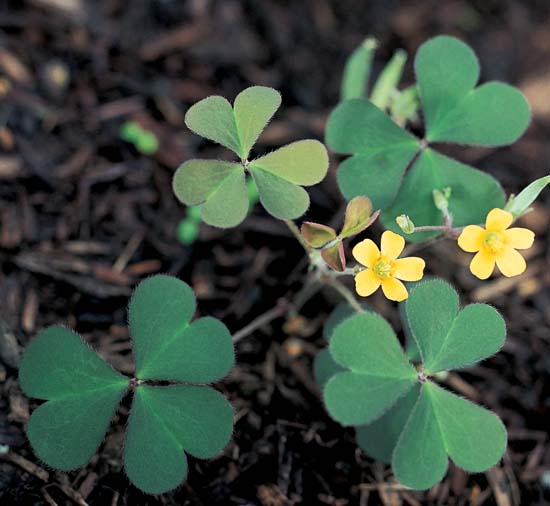
Wood sorrel flowers and leaves on a young plant.
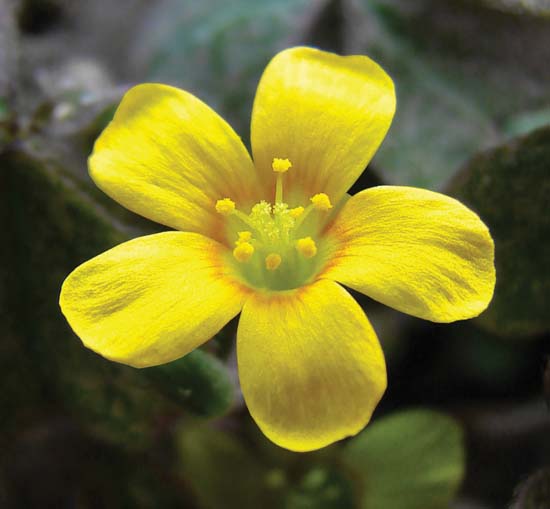
Wood sorrel’s yellow flower, about 3/8 inch in diameter. Yellow flower clusters arise from the ends of branched stems. Several flowers radiate out from one point in a form that is called an umbel.
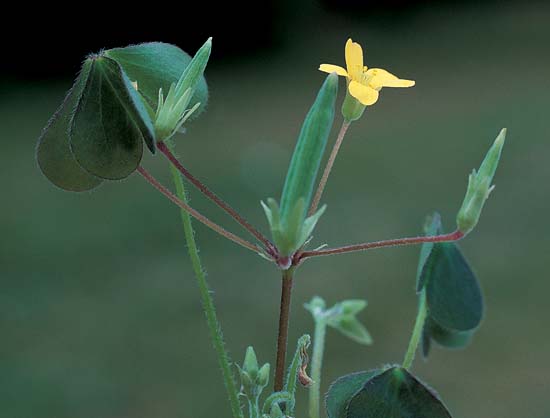
Seedpods and flower on a wood sorrel umbel. The pods angle sharply upward from the stems they are attached to. This is different from other members of the same genus (Oxalis) that have less-angled seedpod attachments.
Wood sorrel or clover?
I am going to generalize here because there are hundreds of clovers. Certain common clovers can resemble wood sorrel because their leaves have three leaflets. Also, depending on the species of clover, they can be roughly the same size as and be weak climbers like wood sorrel, and grow somewhat as a mat or ground cover as wood sorrels do.
With a little attention to detail, the differences become obvious. First, wood sorrel leaflets are truly heart-shaped; and while I’m sure I’ve seen heart-shaped leafleted clover, they are typically not heart-shaped. Clover leaflets tend to be round, egg-shaped, or oblong. Their tips are notched but do not have that sweeping heart shape of sorrels.
Clovers more often than not have a whitish marking on each leaflet. The design differs somewhat from one clover species to another, but all the leaflets on a particular plant have the same pattern.
The veins on clover leaflets are pinnate (Latin for “feathered”), which means that each leaflet has a main vein with smaller ones branching off it. Wood sorrel leaflets have palmate venation—a main vein plus secondary veins, all originating from its base; smaller tertiary veins branch off the main vein.
The other main difference is that wood sorrel has a wonderful sour flavor, sort of like sour apple, whereas clover taste like, well, clover—a mild green well suited for grazing animals.

Clover and wood sorrel leaves compared. Red clover (Trifolium pratense), one of our common clovers (left), is compared to wood sorrel (right). Wood sorrel has three heart-shaped leaflets. Clover leaflets are not heart-shaped.
Gathering and Cleaning Wood Sorrel
A mouthwatering snack or trail nibble can be in the cards anytime you see wood sorrel. But like sheep sorrel, to start incorporating this plant into meals requires that either you have very little need (mixed in a salad with other ingredients) or you find a large patch of it. Preparing a substantial amount of these greens is a bit labor-intensive even under optimal gathering conditions. So get your Zen on and just enjoy working with the plant.
Assuming you find a patch that’s big, healthy, and dense enough to make it worth your while, your strategy will be determined by how you want to leave the plant. If you want it to continue producing leaves for a later harvest, then just clip enough of the upper leaf stems (newest growing tips) to be able to hold them in your hand. To do that, grab the upper parts of a clump of plants and cut the stems with your scissors.
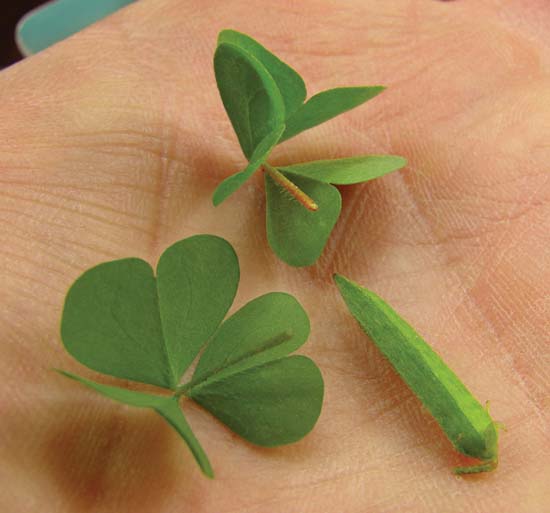
Wood sorrel leaves and seedpod. Leaf stems are cut to about 1/2 inch long for ready use. These leaves were flatter than you see here until they were cut and exposed to the intense bright light and heat from my camera setup, causing them to fold up.
If you do not plan to return to the location and if it’s okay to take the whole plant, gently separate it from the ground. Be careful not to mix any dirt with the greens in the uprooting process. You might want to use your scissors to trim off any parts connected to the soil. Try to keep the branched stems relatively intact, keep the greens cool in the shade, preferably in plastic bags, and spray-mist immediately to get them hydrated. Keep them moist until ready for use. The less happy they are (heat, dryness, long time between picking and using), the more they will start to fold up. Folding makes them less visible and less presentable. So keep them happy!
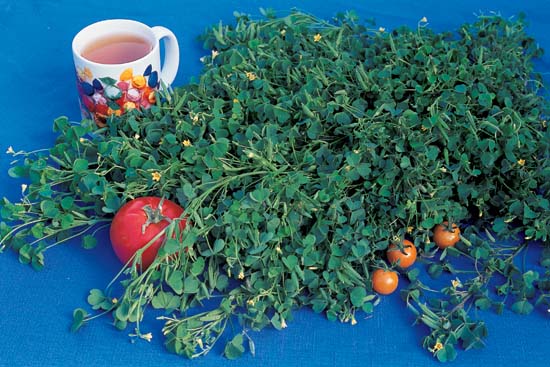
An Oxalis corniculata plant that was easy to harvest. I pulled this up as one big plant that took up quite a bit of ground. The tomatoes and coffee mug are there to show relative size.
Once back in your kitchen, either transfer the greens to the fridge or begin processing right away. To clean wood sorrel, snip off all but about a half inch of the fibrous stem from the leaf. That half inch of stem should be left on to give the leaves some three-dimensionality. The small amount of fibrousness in the included stem will not interfere with chewing.
What do I mean by three-dimensionality? If you remove all of the leaf stem, wood sorrel leaf blades will stack up like playing cards. This occurs whether they are open or folded. The stems, when left attached, prop them up, allowing the leaf blades to stay separated. So why is this important? Conventional salads are very three-dimensional: they contain lots of air. To prevent your friends from asking, “Why are you serving me a flat salad?” leave part of the leaf stems on.
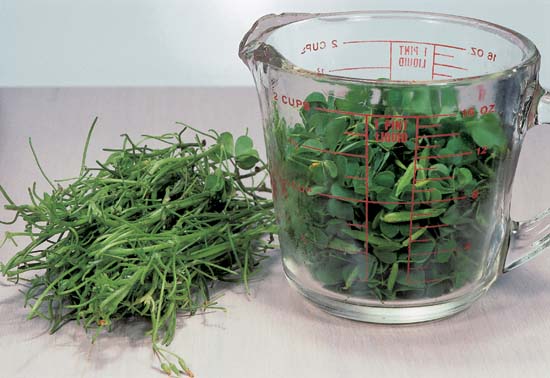
About half of what you collect will be fibrous stem material. Stem material (left) has been separated from the edible leaves, flowers, and young seedpods seen in the measuring cup.
It takes about twelve minutes to separate about a cup of lightly packed greens from the refuse. That comes to about one ounce by weight. Time and weight will vary depending on your efficiency, the leaf size, and your cup-packing prowess. You will find that these light and delicate greens pack a flavorful punch.
Since you are only using the leaves, seed capsules, and flowers, cleaning wood sorrel results in lots of fibrous refuse. Don’t throw it out. Make tea bundles (as opposed to tea bags). Make small bundles out of the stem material and tie them with string, leaving about seven inches of string dangling off the tie. Tie the other end to a paper clip. Dry the bundle/string/paper clip creations in a food dryer. Once dry, dip a bundle in your cup of hot water by holding it at the paper clip end. The paper clip’s weight will prevent the string from falling in the water. Pull the bundle out by the string when the flavor has transferred to the water, much in the same way one dips tea bags.
Serving Wood Sorrel
While you can make a salad completely composed of wood sorrel leaves, it would be a lot of work to clean all those greens and difficult to spear them with a fork. The flavor would be exceptionally tart, which people like myself really enjoy. Wood sorrel leaves and seedpods are most efficiently used in combination salads with several ingredients. A salad using a third part of wood sorrel has excellent sour overtones. Mix wild sorrel with plants in other sections of this book or with conventional greens.
Wood sorrel flowers are edible and can be included anywhere you use the leaves and pods. Unfortunately, they close up almost as soon as they are picked, making their showiness unusable. So eat them closed.
You can use wood sorrel leaves, seedpods, and flowers any way you can use sheep sorrel—raw or cooked. Due to the acids in wood sorrel, the greens change color as soon as they are heated, becoming a darker army green. Learn to appreciate the color in whatever you make.
Like sheep sorrel, wood sorrel reduces tremendously upon cooking, so just making cooked greens is too much work for most people, unless you like very small portions. The flavor is intense enough to use in soups and sauces with reasonably small amounts of greens. Here are some recipes I created. See if you like them.
Wood Sorrel Soup
Yields 12 to 13 ounces, enough for 1 large or 2 small servings.
Ingredients:
| 2 cups chicken stock or vegetable stock or bouillon |
| 1/4 cup diced bull thistle root, or potato or celery or broccoli |
| 1/4 tablespoon extra virgin olive oil |
| 1/4 cup finely chopped onion |
| 2/3 cup packed wood sorrel (roughly = 1-5/8 cups loose = 1 ounce by weight) |
| Salt and pepper, to taste |
Directions:
Begin heating the chicken broth and bull thistle root (or potato) in a pot.
Heat a saucepan separately until hot; add olive oil and onion; sauté until the onion becomes soft and translucent and then add it to the broth pot. Keep at a mild boil for 10 minutes.
Add wood sorrel, regain boil, and then simmer for 10 minutes.
Use salt and pepper as desired.
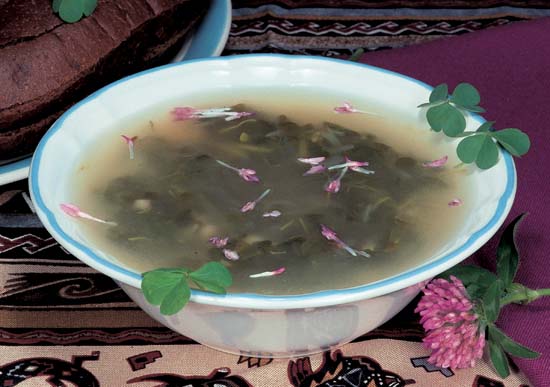
Wood Sorrel Soup. Garnished with red clover flower petals (Trifolium pratense) and wood sorrel leaves.
Wood Sorrel Sauce
The sauce has a good lemony flavor and is great on chicken, fish, veal, potatoes, rice, and quinoa. Yield: 2/3 to 3/4 cup, enough for 1 to 3 servings, depending on how much is used per serving.
Ingredients:
| 1 tablespoon olive oil |
| 1 tablespoon flour |
| 1/3 cup tiny diced fresh mushrooms |
| 3/4 cup salted chicken stock or vegetable stock or bouillon |
| 1/2 cup packed wood sorrel |
| 1/2 teaspoon dried dill |
| 1/2 tablespoon fresh chives |
| 1 tablespoon cooking sherry |
| 1/8 teaspoon salt |
| Pinch pepper |
Directions:
Heat saucepan until hot; add olive oil, gradually stir in flour, and cook until medium brown.
Add mushrooms and slowly stir in stock. Bring to a boil and then turn down heat; cook at a low boil for 5 minutes.
Add sorrel, dill, chives, and sherry, and continue cooking at low boil for 3 to 8 minutes, until the sauce begins to coat the spoon. Season to taste with salt and pepper.
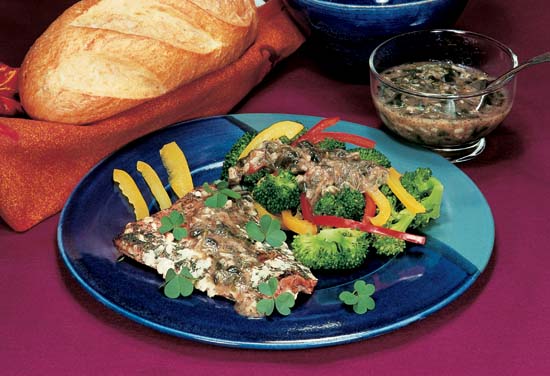
Wood Sorrel Sauce. Poured over whitefish and a broccoli dish with extra sauce at upper right.
Wood Sorrel Dessert Topping
When used on ice cream, puddings, cakes, and pastries, what you get is a buttery lemon-honey flavor. It is a sweet dessert with mild spinach undertones, genuinely quite good but completely unconventional in its greenish-yellow color and flavor. If you use salted butter (the wrong thing to do), the flavor is more like sweet lemony spinach. There is a mild roughness to the teeth after eating because of the oxalates in the greens. Makes 1 to 3 servings, about 3-1/2 ounces.
Ingredients:
| 1/2 cup water |
| 2 cups loosely packed wood sorrel |
| 2 tablespoons honey |
| 2 tablespoons unsalted butter |
Directions:
Bring water to a boil in a saucepan and add the sorrel leaves; cover and continue boiling, then turn down heat to just boiling. Check regularly, stir, and keep leaves from riding up the sides and drying up.
While that’s cooking, melt butter in honey in a separate pot, stir, and put aside.
Cook the sorrel for 10 minutes and then uncover. At this point, the sorrel should be moist but not in standing water. (If you tilt the pan, about a tablespoon of water will seep out. That is good. If there is more, keep it on the heat until it gets to the right stage.) While still hot, stir in the butter-honey mixture and mix well.
Pour mixture into a blender and purée until smooth. Use hot, or let cool for a thicker sauce.

Wood Sorrel Dessert Topping. Poured over vanilla ice cream and garnished with fresh sorrel leaves.
So get out there and find your shamrocks—er, I mean wood sorrel—and experiment like you’re a kid again. It takes a little work, but your efforts will be rewarded.