The greens in this chapter have mildly pungent and/or peppery and/or acrid flavors. These are greens and vegetables that are suitable for occasions where you want to add some character to the dish you are making. Greens with these flavors are often added to milder greens (foundational greens) or complex dishes to add interest and nuance. They are edible raw and cooked, but their best uses depend on your flavor goals for whatever you are preparing. They have the potential to greatly improve a dish by using just the right amount or to destroy it by adding so much that it overpowers. At certain stages of growth, some of these greens are mild enough that you might even be able to make a whole salad with them. But many will prefer to use them as a flavor enhancer for other foods.
Not all mustard family plants taste alike. Each has its own characteristic flavor and texture. When fresh, some are excellent in combination salads, added to sandwiches, used as garnishes, and made into pesto and other green-based sauces. Cooked, their flavors vary tremendously—some remaining pungent, others transforming into foundational flavors.
The plants covered in this section include field mustard, wintercress, garlic mustard, and shepherd’s purse. All these plants happen to be in the mustard family (Brassicaceae). Broccoli, cauliflower, brussels sprouts, kale, collards, and cabbage are all mustards. All mustard plants have flowers with four petals, four sepals, and six stamens. The stamens are arranged in such a way that four of them near the pistil are long, and the remaining two near the petals are short.
Flavors offered by mustard greens are an excellent addition to the gourmet’s arsenal of tastes. Mustard greens can be nutritional powerhouses packed with nutrients and phytochemicals. Garlic mustard, for instance, is one of the most nutritious leafy greens ever analyzed, according to our nutrient charts. Mustards in general have many phytochemicals in common. Phytochemicals found in mustard family plants include glucosinolates, sinigrin, progoitrin, goitrin, glucobrassicin, indoles, and isothiocyanates. These compounds are thought to fight cancer and heart disease through a variety of mechanisms.
In addition to pungency and pepperiness, garlic mustard and wintercress are typically bitter in the raw state. If you love bitter, that is great; if not, I’ll show you ways to prepare these greens that you will enjoy.
The mustards are cold-weather plants—growing most robustly in early spring and autumn. If they are growing in your garden and you nurture them, you can extend their stay somewhat and increase their yield tremendously.
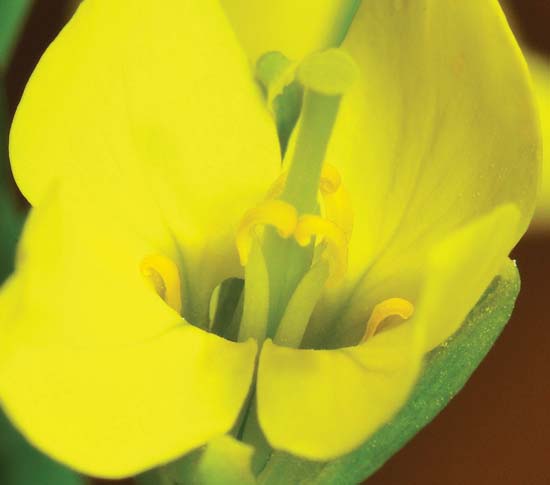
Mustard flowers are easily identified. While shape, size, and flower color may vary, the number of petals is always four and the number of stamens is always six. All mustards have four tall and two short stamens. Here you see the four center stamens hugging the pistil, with five and six leaning off to the side.
Mustard Seeds
Three of the four plants covered in this section (all but shepherd’s purse) produce seed in enough quantity that they can have their own food uses. So a cautionary note is warranted. Mustard seed oils are known to contain relatively high amounts of erucic acid, a natural fatty acid typically found in small quantities of the fats of many foods we eat. All mustard condiments contain them. Who knows, in small quantities it may even have some health benefits we have not yet discovered.
The cautionary note has to do with excessive consumption of erucic acid that you will probably never approach. I mention this only because certain animal studies have raised some concerns. But, for the vast majority of you who will not eat a third cup of prepared wild mustard (the yellow condiment) every day, this may be a nonissue.
Excessive amounts of erucic acid fed over time to certain animals, particularly their newborns, developed fatty deposits in their heart muscles and experienced slower growth rates than controls. So what’s new? Excessive amounts of many nutrients and phytochemicals are toxic. When individual food substances are isolated and given in high concentrations, you can often show damaging effects. There is no evidence that reasonable amounts of this oil in the context of a normal diverse diet are harmful in any way to humans. (Mattson, 1973.)
In my opinion, the benefits of the diverse nutrients and potential phytonutrients, which come along with eating the mustard seeds occasionally within the context of a healthy diet, outweigh any potential danger from small amounts of erucic acid. Just eat reasonable amounts of the seeds for fun and flavor, on occasion, and stop worrying. I would recommend that you do not feed wild mustard seed preparations or store-bought mustard to newborns. Wait until they are old enough to eat hot dogs with chili. (Boy, talk about fattening the heart muscle!)
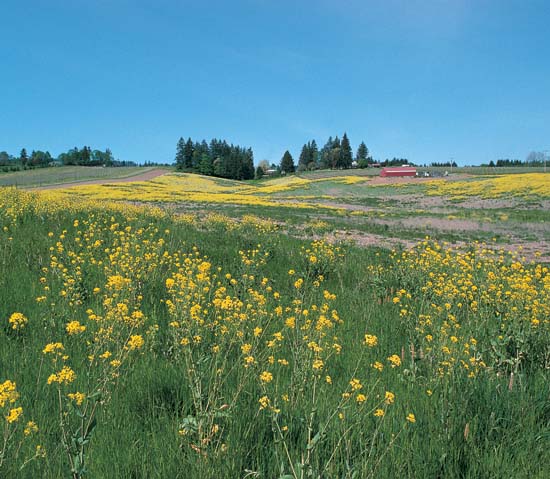
Farmland widely covered with adult field mustard. This is in the early spring sometime between early April and early May, depending on where you are in North America. These plants typically get their start in the fall, store energy in their root, overwinter, and bolt into quick growth in the spring.