Field Mustard
A fantastic mustard green, better than the one you can buy in the supermarket
Family: Brassicaceae
Species: Brassica rapa
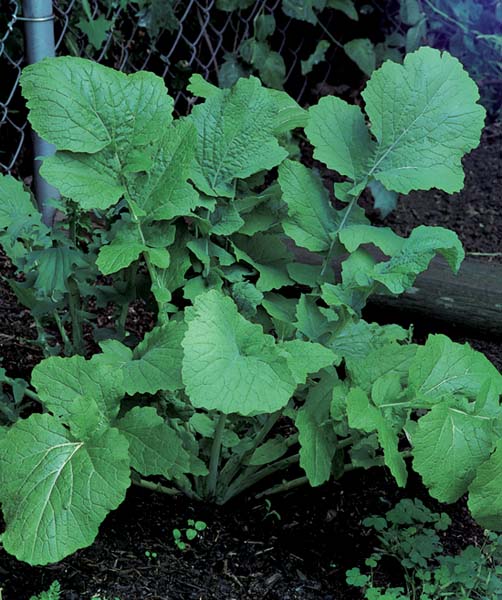
Field mustard, a prolific, great-tasting plant that is fond of cultivated fields and your garden. It has two forms at different stages of growth: a rosette of leaves at ground level (shown here) and, later, a reproductive stalk producing flowers and seeds.
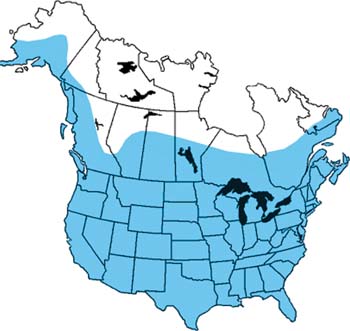
Estimated Range
Official Species Name:
Brassica rapa L.
Synonyms (Historical Names):
Brassica rapa var. campestris (L.) W.D.J. Koch
Brassica campestris L.
Brassica campestris var. rapa (L.) Hartman
Caulanthus sulfureus Payson
Common Names:
Field mustard
Wild mustard
Bird’s rape
Rape
Wild turnip
Turnip rape
An herbaceous weed naturalized from southern Europe, field mustard is widespread and abundant in North America, primarily where humans have invaded and where soil has been disturbed.
Edible Parts:
Leaves
Growing tips of leafy stems
Buds
Flowers
Seeds
Pre-stalk root
For a plant that is so common, you would think that it would get more attention than it does. In fact, the few times it seems to be mentioned, it is as the less-loved brother of black mustard (Brassica nigra), a domesticated plant that grows wild in North America. Black mustard shares field mustard’s range.
Other common large-leaved wild mustards you might find are charlock (Sinapis arvensis), black mustard (Brassica nigra), and brown mustard (Brassica juncea). Brown mustard and black mustard are cultivated for their seed. In addition, brown mustard is cultivated for greens. Cultivation helps expand the wild spread of seeds beyond the farmland they are planted in. Field mustard, black mustard, and charlock are more common than brown and share similar ranges.
Brassica napus, the source of canola or rapeseed oil, is nearly identical in appearance to field mustard. It is less widespread than the other wild mustards. We’ll talk about napus later in this chapter.
I believe the greens in the produce section of the supermarket are probably brown mustard (Brassica juncea). Of course, the packaging never specifies the species or variety used. Whatever they are, the mustard greens I’ve purchased can have a harsh flavor relative to field mustard. You can also buy turnip greens, another mustard that, confusingly, is one of the cultivated forms of Brassica rapa. Turnip greens have a stronger pepperiness than field mustard.
As far as I can tell, the nutritional value of field mustard is unknown. The USDA has values for two different mustard greens: mustard spinach (a Japanese cultivar of Brassica rapa) and domesticated brown mustard (Brassica juncea). Because of their close relationship, field mustard might be somewhat comparable to mustard spinach, brown mustard, or turnip greens for conventional nutrients. Those three have their nutrients listed in the USDA nutrient database. In addition, because it is in the mustard family, field mustard is likely to have indols, isothiocyanates, glucosinolates and other phytochemicals.
Field mustard is commonly found along roadside embankments, waste areas, farmland (growing amongst crops), and anywhere else the soil has been disturbed. Being a cold-weather plant, it is possible that field mustard could be found anywhere within the range of the maps I’ve designed. The range I’ve shown does not account for deserts and mountain ranges—which will have little field mustard only because humans aren’t bringing it in and making the habitat (gardens, farms, etc.) for it.
The mustards, in general, have a rich history and a variety of uses. While I focus on greens, mustards are most known for their seed, which is made into the yellow or brown condiment that people squirt on their hot dogs. For an interesting and comprehensive overview of the uses of mustard plants, check out Cheatham, Johnston, and Marshall’s book, The Useful Wild Plants of Texas, Volume 2. They cover many of the uses as foods, spices, food additives, preservatives, medicines, effects on livestock, weaponry, use as cover crops, spiritual uses, history, and more—a fascinating read.
The major use of field mustard is to add varying degrees of pungency to a dish of other foods. Some people might like it enough to make it the featured food of a dish.
Knowing Field Mustard
The first sighting you’ll have of field mustard will probably be from your car in the spring. In a field, by the roadside, or on farmland, you’ll see bright yellow flowers towering above the grass, crops, or other weeds. These are the flower stalks of the adult plants.
If the plants you locate are indeed field mustard, try some, take some home, experiment with it. If it is already producing seed, throw some in your garden.
As an annual
Field mustard that germinates in spring or summer can grow a stalk and go to seed within a couple of months, which makes field mustard an annual. The summer heat and/or the long days cause mustard to bolt (grow a stem). This is likely to happen in a garden or on a farm, where the soil is turned over throughout the year and watered. Field mustard can only germinate in the summer if the ground is disturbed and enough sustained water is available.
As a biennial
Without summer watering, field mustard seed will wait in the soil until the fall rains begin. By that time in the year, the days are shorter and the temperature is cooler. Field mustard will then sprout and grow its basal leaves but will not bolt. Winter’s arrival has several effects on the plant. First, the leaves stop growing and eventually die from the cold. Second, its root goes through physiological changes to survive winter’s freezing temperatures. These plants will come alive again in the spring.
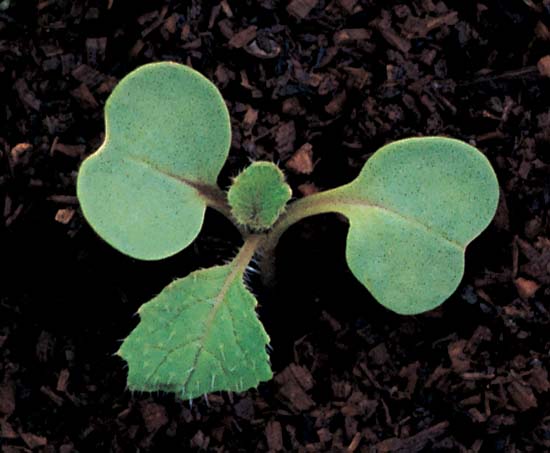
Field mustard seedling with its two fat embryonic leaves (cotyledons). The first two true leaves are just beginning to emerge. Outside of a frozen winter, field mustard seeds germinate anytime where the soil is turned and watered.
Germination and life patterns
Leaves: As with most plants, the first two leaves that emerge from within the seed (embryonic leaves = cotyledons) do not appear like the older leaves. The first two leaves of all members of the Brassica genus, including field mustard, tend to look like a person’s posterior pressed against a pane of glass. (Sorry for the image, but if you can come up with a better description, let me know.)
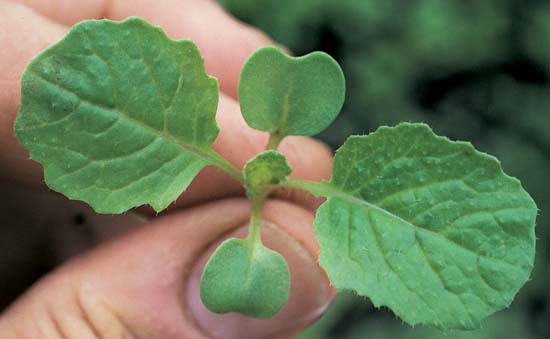
Young field mustard. Here, the first true leaves have overtaken the cotyledons in size and are still growing.
Field mustard grows quickly after germination. The first true leaves differ from the cotyledons in both shape and size. They begin taking on characteristics of the leaves that follow.
As more leaves develop, they begin to show much more character. The margins are irregular and often wavy. Leaves start dividing into lobes. Bumps occur all over the leaves.
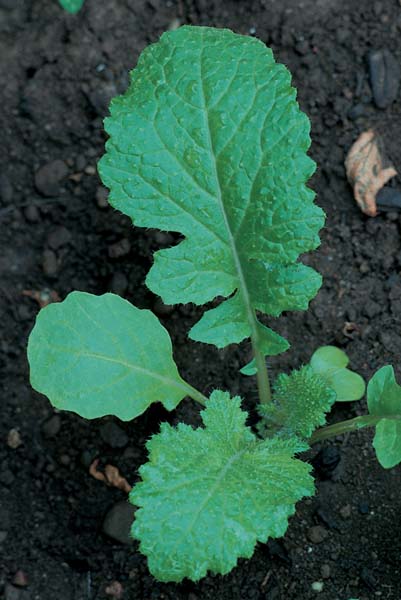
Young field mustard. The largest leaves here are about 5 inches. Note how the later leaves are different from the first and second pair. More character is expressed from the fifth leaf onward. At this point, the leaves start to show their dimples—bumps on the surface that are characteristic of field mustard.
Taking on a decidedly mustard family appearance, the leaves eventually crowd around the growth point of the root in what is called a basal rosette (basal referring to base or ground level and rosette referring to all the leaves radiating out from a single point, like petals on a rose).
Once the plant is established, its leaves can be anywhere from eight to twenty inches long, depending on soil moisture and competition from other plants. The photos here only represent good healthy growth. Stunted growth produces smaller, fewer, less-luxurious, slower-growing leaves.
Taproot and corm: As the leaves develop, so do the taproot and the corm. A corm is an enlarged base of the stem just below the ground and above the taproot. The corm is barely noticeable most of the time, barely thickening at all. But, at other times, it can get rather fat. Whatever size the corm and root are, they store energy and provide support for the plant.
If the plant germinated early enough in the year, it will send up a flower stalk within the same growing season. If it germinated in the fall, the plant will overwinter.
As winter ends and spring arrives, the root and corm use their stored energy to produce a new basal rosette of leaves. This new set will not be as grand as those from the previous autumn, perhaps only about fifteen inches long as opposed to twenty in great conditions and as small as six inches in poor conditions.
Stem: As the days lengthen and temperatures warm, a stem emerges. That stem grows quickly, producing three types of leaves. At the base are the larger, deeply lobed leaves—so deeply lobed that they appear to be compound leaves with leaflets. Farther up the stem are unlobed irregular leaves. Near the top are teardrop-shaped leaves.
All three of these leaf types clasp the stem where they are attached; that is, they wrap around the stem, or embrace the stem. That embracing part has the additional feature of being shaped like earlobes.
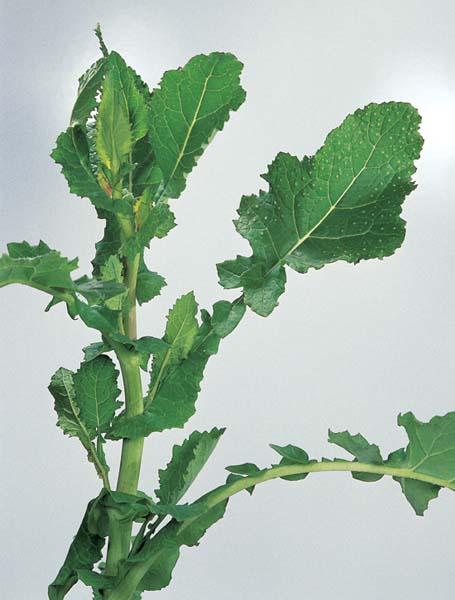
Stalk development. Shown here is the upper 15 inches of a plant that is about 20 inches tall. This plant is growing in good soil conditions. It’s too young to have formed the upper teardrop-shaped leaves.
The stem itself is round and covered with a fine, almost imperceptible powder that can be rubbed off. New stems (branches) can form anywhere a leaf is attached.
Field mustard plants can vary in color from a pale cyan-green to a dark green.
As with the first-year plants, if there is a lot of competition or if the ground dries up, wild mustard’s growth will be stunted. This second-year plant can grow anywhere from only a foot to six feet tall, depending on soil conditions.
If field mustard is growing in dense undergrowth with competition from other plants, the leaves at ground level will deteriorate and wither away, leaving only stem leaves. In the open, those basal leaves will last well into flowering.
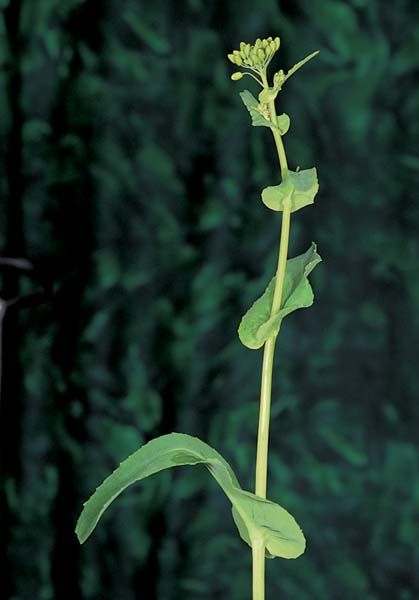
The top 8 inches of a young, but rapidly growing, 30-inch-tall stem. Teardrop-shaped leaves only grow near the top of the stem. The closer to the top of the plant, the more pointed the teardrop-shaped leaves are. Flower buds top this stem.
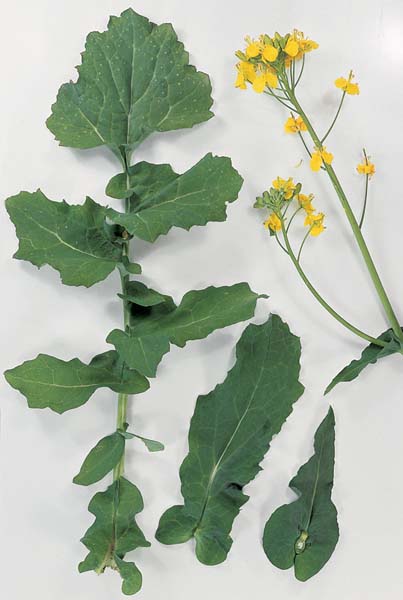
Three kinds of leaves on adult field mustard plants: (left to right) large bottom leaves, unlobed leaves midway up the stem, and smaller, upper teardrop-shaped leaves. All of these leaf types wrap around (clasp) the stem.
Buds and Flowers: Field mustard buds form in clusters at the tip of each stem. As new baby buds continue to form at the tip (the center of the cluster), older enlarging buds get pushed to the side. By the time the buds blossom into flowers, they are at the edge of the cluster of buds. As the stem elongates to form new buds, the flowers move down the stem. As the flowers are fertilized, the petals fall away, allowing the seedpod to form, enlarge, and elongate. Once a plant starts flowering, the better the growing conditions, the more it branches. Every branch will produce a new flower cluster at its tip.
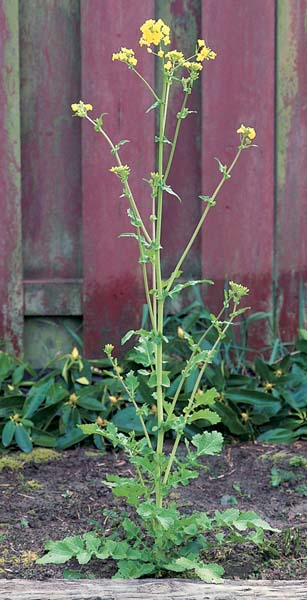
Adult field mustard in April. The upper older stems have blossoming flowers. Younger stem branches have still-developing flower buds at their tips.
Field mustard flowers, like other mustard family flowers, have four petals, four sepals, and six stamens (pollen-holding structures). Four of those six stamens are tall and two are short. The flowers on this particular mustard are yellow.
The newly opened flowers of field mustard reach up and over the newest (center) buds. This becomes more obvious as the flowering stems elongate. After a while, new buds become hidden under overtopping flowers. This is one feature that makes field mustard distinguishable from canola (Brassica napus). Canola flowers do not overtop their buds but grow to the sides. Brassica rapa and Brassica napus are easily confused. The good thing is that both are used as food in similar ways.
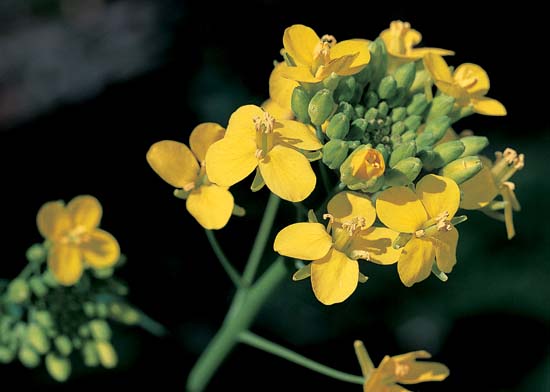
Field mustard flower cluster with unopened buds at the center.
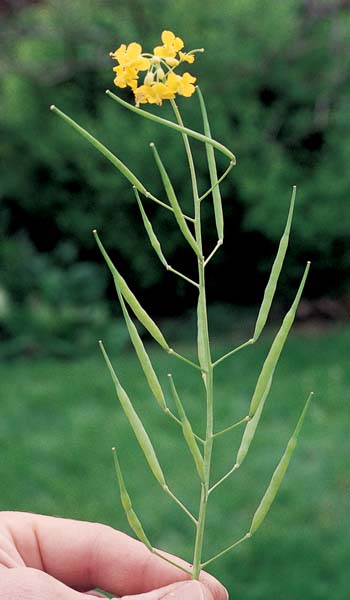
A flowering stem with pod development. As the stem continues to grow from the tip and elongate, seed pods (called siliques) mature down the stem. These stems can get very long, typically supporting 20 to over 100 pods.
Harvesting Field Mustard
All harvested greens and stems of field mustard dry out very quickly. So before you do any collecting, make sure you have the tools to make and keep the greens moist until you use them. In fact, the best thing you can do is crisp them right away; that is, immerse the greens in a tub of very cold water as soon as you pick them. Let them absorb the water until they are as firm as they can get. Drain well, wrap them in a paper towel, place all that in a plastic bag, and put it in your fridge. Short of that, the spray-mist technique works well. Keep your take out of the sun.
Sprouts: If you have access to thousands of sprouts in newly disturbed soil, you can wait till they are a perfect size, then harvest the tops with scissors for use as baby greens. This means you are taking the whole aboveground plant when it is young enough to fit in your mouth. It may have anywhere from two to four leaves. You pinch it somewhere along the stem to extract it. This, of course, kills the remaining plant (lower stem and root). Typically this is okay because you are thinning the population. You leave the remaining sprouts to grow and produce plants that can be harvested later.
Leaves: From the basal rosette to the adult flowering plant, field mustard is continually producing leaves. Any leaf on this plant that looks beautiful enough to display in the produce section of your supermarket is good to use.
Growing Tips: Any growth tip will be tender enough for eating. On healthy plants, that includes the top four to six inches of leafy stem, new branches, and bud tips. You can go as far down the stem as will easily snap free. If you are pulling and/or tugging, and there is no clean “snap,” then you’ve gone too far down the stem. And while growing tips are not as fragile as the leaves, it is still important to keep these parts moist before using. On occasion, the stem will snap but will still be fibrous when you cook it, so experiment a little to get the hang of it.
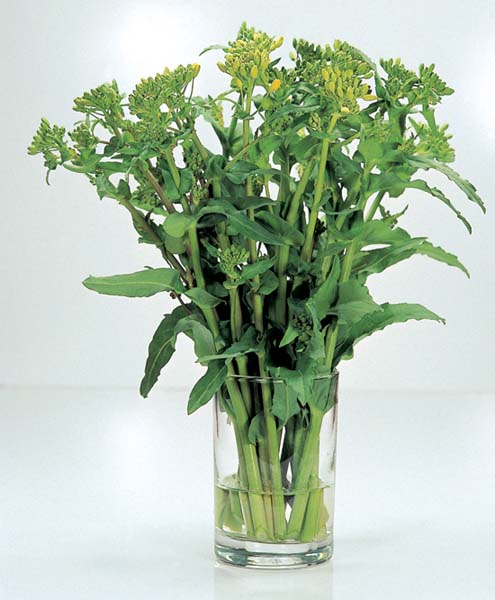
Growing tips of field mustard in bud. Of the 12 inches of plant stem here, only the top 4 to 6 inches will be tender enough to use. All you have to discard here is the fibrous lower 6 to 8 inches of that stem. All of the leaves coming off the stem are tender and delicious.
Flower Clusters: These are great for food and are a wonderful garnish for salads and dinner plates. You can take part of the stem below the clusters, but once these plants are in flower, the stem begins to toughen up. So instead of harvesting the flowers with four inches of stem, you might be able to take one or two inches. Flowers do not take so well to submerging in water, so freshen them by spray-misting.
Young flower stems produce great-tasting flower heads. Once the flower stems are really long with lots of seedpods, the flower clusters lose some flavor and develop a paperiness, and their bases get tougher. So, younger flower clusters with buds still on them are the best.
Seed Pods: Only the very upper immature seedpods are tender enough to use as food. The older ones get tough and stringy. I use the few immature pods that come along for the ride with the flower clusters but usually not more than that.
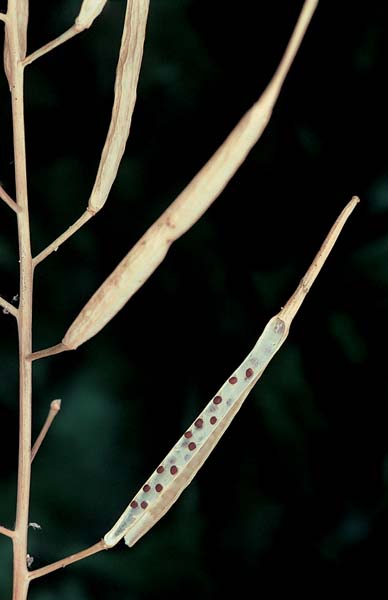
Mature seed pods are brown. Each holds 36 to 46 seeds. A papery membrane holds the seeds in the center of the pod.
Roots: While many biennials typically have tender first-year roots, I do not remember ever doing much with field mustard root. So I leave it to you to make some new discoveries here. By the time the stalk has begun to form, the root becomes too tough for any practical use.
Seeds: The best way I’ve found to harvest seeds is to take the whole pod-bearing stems indoors where they can continue to mature in controlled conditions. Mustard seedpods mature progressively from the bottom of a stem to the top. Maturing pods are tan in color, and immature ones are still green. They are not all ripe at the same time.
Take whole stems that are already dropping seeds from their lowest pods. If the lowest pods are dropping seeds, this means that many more pods just above those are almost mature enough to drop their seeds. If you take stems that are too green or young (not dropping any seeds), the pods on it will not be able to mature, and you will not get many seeds.
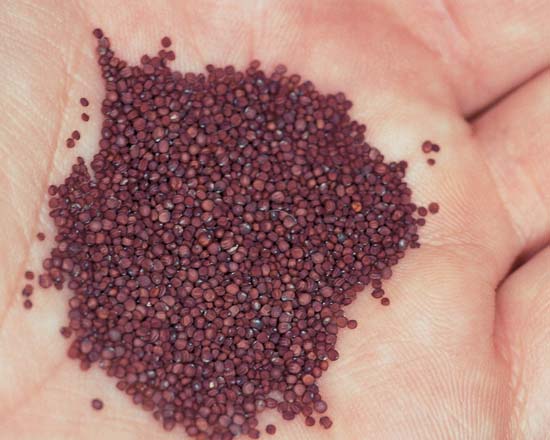
Reddish-brown seeds of field mustard. Each of these seeds is about 1-1/2mm in diameter.
Lay the stems directly on a clean old bedsheet in a dry, well-ventilated location. As the stems dry, seeds will continue to mature inside the pods. Once the stems are totally dry, compress them into a tight bundle and wrap them in the sheet they were resting upon. Use fasteners to tightly and securely seal the sheet closed. Use your weight to crush the sheet-enclosed stems. Take out your frustrations: dance on them, hit them with your broom, mash them to smithereens. This causes the pods to break open and release the seeds inside the sheet casing.
Once the pods are sufficiently smashed, open the sheet and pour out the seeds. There will be plenty of chaff and pod remains mixed with the seeds. To get rid of the large debris, pour the seeds through a sieve with holes just big enough for the seeds to pass through. To get rid of the dirt and small particles, pour the seeds into a sieve with holes smaller than the seeds. Pour the seeds into a big bowl and shake it until the seeds settle to the bottom, allowing you to physically pick off or blow away much of the remaining chaff. To finish clearing the chaff from the seeds, winnow the rest.
Winnowing is the process of using the movement of air to blow away the light chaff and debris while the heavy seeds drop down into a collection container. On a day with consistent wind speed, you can throw the mixed material up into the air from a big bowl with the intent of catching the seeds. As you do so, the chaff gets blown away in the wind. Another option is to pour the seeds and chaff from one container into another—varying the drop distance so that most of the chaff gets blown away. To control wind speed in the drop method, you can use an electric fan. All of these methods take practice and a mild, controlled wind speed.
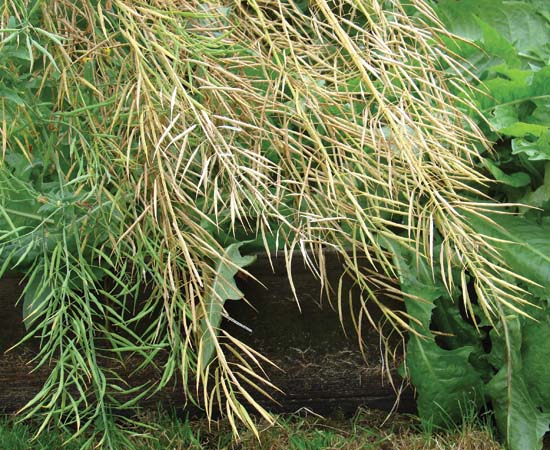
When field mustard growth is lush, the seedpods weigh down the stalks and arch over. The browning pods here are mature enough for their stems to be harvested for seed collection. The still-green pod-laden stems are too immature to collect.
Processing Field Mustard
Young first-year leaves and upper stem leaves are small and tender enough to put in a salad as is. Mid-level leaves need to be chopped or torn into bite-size pieces. Large basal leaves have a main vein and leaf stem that are too fibrous to use as is. To remove them, pluck the lobes off the central vein into bite-size pieces, slice out the vein, or squeegee (pull and strip) the blade from the vein. Discard the veins or juice them. This is really no different from what one would do with kale or collard greens bought from the store. Kale and collards are also in the mustard family.
Cooking and Serving Field Mustard
Fresh greens
Field mustard is the source of one of my favorite flavors. I love adding the leaves to salads and sandwiches as well as to cold vegetable and fruit dishes. Remember that anywhere you are adding mustard greens, you are adding mild pepperiness and pungency, so here are some general tips to better eating:
Generally make mustard greens only about a third to a fourth of the mass of a salad. You want to add character, not overpower the salad. Since everyone is different, you may find yourself adding more or less than this over time. My culinary preference is to make bite-size pieces. Don’t grab a whole large leaf on a fork unless you’ve got some really mild greens or you really love the pungency. The exception to this is the baby greens and leaves from the really young plants, which are always mild and bite-size.
Sandwiches heavy with other ingredients, particularly meat, cheese, and sauces, will welcome mustard greens. Use the mustard in place of lettuce.
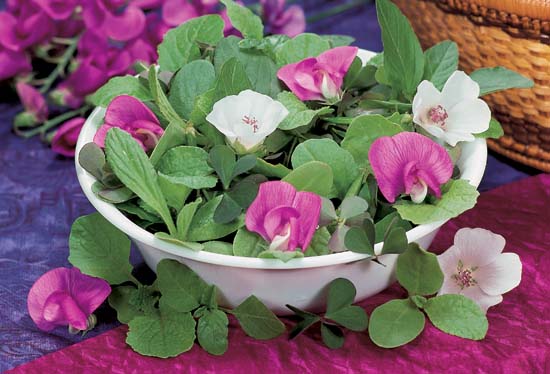
Wild Greens Salad. Includes field mustard baby greens, green amaranth leaves (Amaranthus retroflexus), wood sorrel, borage leaves (Borago officinalis), wild sweet pea flowers (Lathyrus latifolius), and marsh mallow flowers (Althaea officinalis). Absolutely delicious. Cut pieces of the leaves from older plants would work just as well as the baby greens; they would just have more of a pungent bite.
Cooked greens
The pungency in field mustard can sometimes get overpowering if that is all you are eating. This is true of both fresh greens and cooked greens. In fact, when you cook greens, you concentrate them physically, concentrating the pungent and sometimes acrid flavor.
Boiled: If you just want fine-tasting, good-for-you, regular cooked greens, then use the boiling method. Preheat a pot of boiling water. To save energy, keep the top on while bringing the water to a boil. Use enough water so that the greens can freely move around—you do not want them to be tightly packed in the pot. Once the greens are added, boil with the top off. The acrid flavor that sometimes haunts mustard when cooked will partially escape into the air. Fresh leaves should be boiled for two to six minutes. This range takes into account that each plant may have different amounts of acridness. Once done, drain and serve as is, or add salt and a little olive oil, or use your favorite dressing. You can add these cooked greens anywhere you would use cooked spinach.
You can boil the buds, their stems, or the flower clusters in the same way. Sometimes the flowers take a minute or two more than the leaves; sometimes they don’t. The key is to taste the greens or flowers or buds as you go along. To make them delicious, do not boil any of these foods any longer than you have to. If they are good in one minute, take them out of the water. If you want them to stop cooking, dunk them in cold water for later use or to serve them cold. The cooking water of any of these boiling techniques works fine as a soup base.
Stir-fried: If you are going to cook fresh greens in stir-fries or stews, gauge carefully how much you use. Start conservatively and add more or less as you develop your recipes and your taste for mustard. Try mustard green recipes you find in your cookbooks.
If you like strong greens, try stir-frying them. They will retain some pungency and a little acridness, but the hot oil you cook them in will both temper the acridness and add some character to the greens. You might enjoy eating them like this or using them as an ingredient in an omelette or a stir-fry. Mustard greens cooked this way might be too strong for some unless used as a minor ingredient in a larger dish.
If you want milder mustard greens in a stir-fry, boil them first for a few minutes before adding them. After boiling, drain and dry them on a towel or they will spatter when placed in the hot oil.
Steamed: I have never enjoyed any mustard parts steamed. Steaming just retains and concentrates too much of the acridness. Due to the flavor, I find the steamed greens difficult to work with. But don’t give up on my account. Experiment on your own. You might love them steamed.
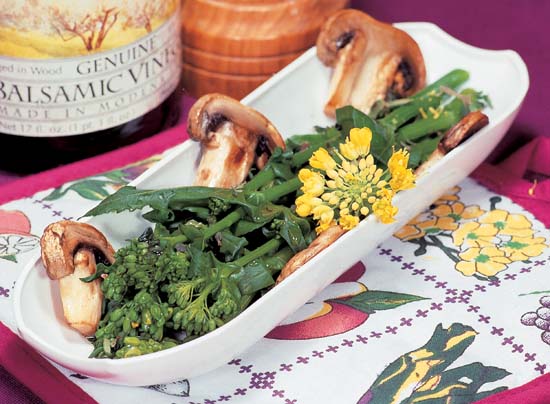
Mustard flower bud stems, ready for eating. These stem tips were boiled for about three minutes, drizzled with olive oil and balsamic vinegar, seasoned with salt and pepper, and garnished with sautéed mushrooms and a mustard flower cluster.
Field mustard seeds
Mustard seeds, in general, are used as a spice, for pickling, to make mustard (the condiment), and for much more. Commercially, seeds mostly from black (Brassica nigra), brown (Brassica juncea), and white (Brassica hirta) mustard plants have a long history of use and well-documented recipes for making the condiment we know as mustard. Commercially, mustard seeds are mixed in different proportions to create certain unique mustard flavors. Search the Internet or any number of old cookbooks, and you will find recipes for mixing ground mustard seeds with vinegar and other ingredients to make a variety of condiments. In fact, there are hundreds of recipes. Field mustard seed is typically not an ingredient in those recipes but is certainly worthy of kitchen experimentation.
One fun option is to put the seeds into a clean pepper mill and grind them into foods of your liking. Mustard seeds are about a sixth the size of peppercorns, so if you do this, make sure the grinder can take the smaller seeds.
Mustards and Mustard Sauces
Here are a few mustard recipes I found with little effort. If they are too runny for your liking, you can add a thickener like flour, tapioca, or cornstarch. If they are too pasty, you can add a mixture of 50 percent water and 50 percent white wine vinegar until it meets your needs. Add these dry or liquid ingredients in tiny amounts—slowly and cautiously. Additions may not be necessary, as some recipes will thicken as they set, and others will thicken when refrigerated. Some sauces work better for certain uses because they flow more easily than the mustard paste you are used to. All of these preparations should be refrigerated.
Be aware that field mustard seed produces hot mustard, so a little goes a long way. Some may want to dilute it with regular yellow mustard or mayonnaise, or to soften its kick with sweetener. Be aware that trying these prepared mustards in a sandwich or somewhere else that mustard is appropriate is a whole different experience from tasting these strong condiments directly. If you want a yellower color, add turmeric.
Euell Gibbons’ Prepared Mustard
From his book Stalking the Wild Asparagus.
“Put some flour in a pan and toast it in the oven, stirring occasionally until it is evenly browned. . . . Mix this browned flour, half and half, with ground mustard and moisten with a mixture of half vinegar and half water until it is the right consistency . . . vary the amounts of mustard and flour to suit your taste.”
Simple Prepared Mustard
Adapted from various sources.
Ingredients:
1 cup field mustard seeds
1/3 cup water
1/3 cup white vinegar
1/3 cup brown sugar (optional)
Directions:
Grind mustard seeds in a well-cleaned coffee grinder or a compact small-capacity food processor. Pour into a bowl and add water. Let stand for 15 minutes so the enzymes in the mustard can develop their flavors. Then stir in the wine vinegar and brown sugar (omitting the sugar will make the mustard hotter).
Fancy Mustard Sauce
Adapted from Chef Michael Smith’s Homemade Mustard Recipe.
Ingredients:
| 3/4 cup field mustard seeds |
| 1/2 cup white wine vinegar |
| 1/2 cup extra virgin olive oil |
| 1/2 cup chardonnay |
| 1 tablespoon ground turmeric |
| Juice and zest of two lemons |
| Salt and pepper, to taste |
Directions:
Use a coffee grinder to grind the seeds until they resemble coarse meal. Pour the meal and remaining ingredients into a food processor and blend until mixture is smooth. Use salt and pepper as desired. Let this age a few days; it will become smoother and less sharp to the tongue.
Mango Mustard Seed Sauce
Adapted from The 1997 Joy of Cooking. This sauce is designed to go with grilled chicken or fish.
Ingredients:
| 1-1/2 tablespoons field mustard seeds |
| 2 ripe mangos, peeled and cut into small cubes |
| 1 medium ripe banana, chopped |
| 2 tablespoons peeled and finely minced fresh ginger |
| 1 teaspoon finely minced garlic |
| 1/2 teaspoon curry powder |
| 1/2 cup grapefruit juice |
| 2 teaspoons sherry vinegar |
| 1-1/2 teaspoons hot chili oil |
| 1 teaspoon honey, or to taste |
| Salt and ground black pepper, to taste |
Directions:
Place mustard seeds in a small dry skillet over medium heat and toast until they just begin to pop. Remove from heat and combine with remaining ingredients in a blender; process briefly to produce a smooth sauce. Serve immediately, or cover and store in the refrigerator for up to 3 days.
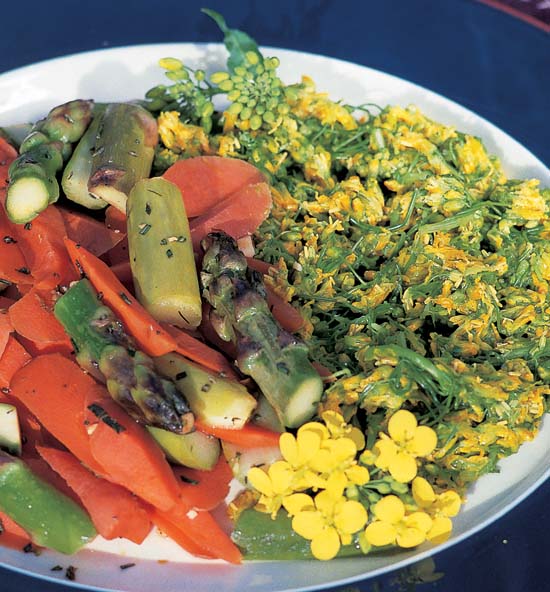
Field mustard flower bud clusters, boiled and served as a side dish to a stir-fry and garnished with a fresh mustard flower cluster.