Garlic Mustard
A nutritious wild green—eat it to control its spread.
Family: Brassicaceae
Species: Alliaria petiolata
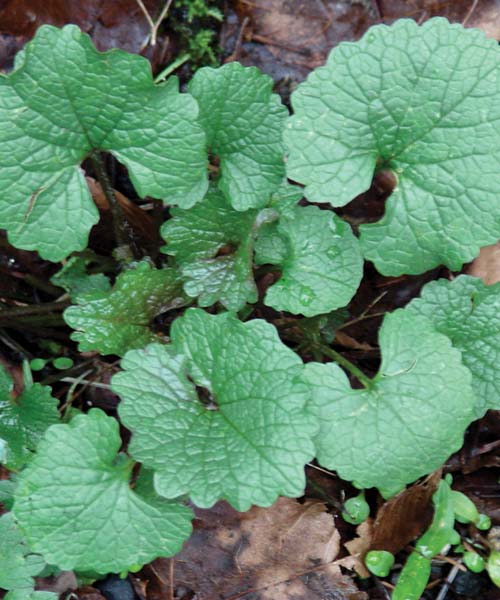
Young garlic mustard plants flourishing in the spring before stalk development becomes obvious.
Estimated Range
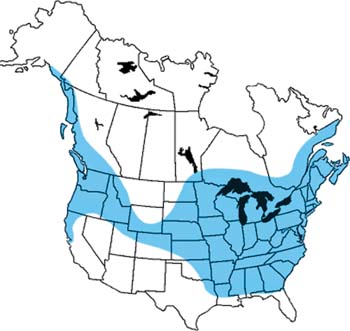
Official Species Name:
Alliaria petiolata (Bieb.) Cavara & Grande
Synonyms (Historical Names):
Alliaria alliaria (L.) Britt.
Alliaria officinalis Andrz. ex Bieb.
Erysimum alliaria L.
Sisymbrium alliaria (L.) Scop.
Common Names:
Garlic Mustard
Hedge Garlic
Jack-by-the-Hedge
Sauce Alone
An herbaceous weed naturalized throughout Europe, garlic mustard is widespread and abundant in North America, primarily where humans have invaded, and is spreading fast. It loves partially shaded areas, particularly soft forest floors, roadsides shaded by trees and shrubs, floodplains, shading fences, and trail sides. It will even grow in open fields.
Edible Parts:
Growing tips of leafy stems
Leaves
Buds
Flowers
Seeds
This is a mustard family plant with the smell of garlic, so garlic mustard is a good name. The genus Alliaria is a reference to the genus Allium, which contains the true garlics and onions. Petiolata refers to the long leaf stem. A leaf stem to botanists is known as a petiole.
Garlic mustard is beloved by many rural people in Europe, where it has natural predators that keep its populations in check. It is considered a noxious weed in North America. A search for garlic mustard on the Internet brings up a noxious weed alert and informational piece from nearly every state and province. Why is this weedy vegetable such a problem here? The big answer is that we are not eating enough of it. If we ate more of this plant, its spread would be severely limited.
But what makes this one special? It has phytochemical weapons. Here’s the scoop: Garlic mustard, like any other weed, spreads by seeds. Unlike dandelion with its paratroopers (seeds floating around on parachute-like fluff, which can travel long distances), garlic mustard seeds typically fall within a few feet of a plant. On its own, it moves very slowly. With the help of passing animals and humans, it hitchhikes a little farther each season—on shoes, animal fur and paws, car tires along roadsides, and bicycles.
In their first year, garlic mustard plants often go unnoticed. They are small with inconspicuous leaves, mixed among the native plants. It can look like violet leaves, wild ginger leaves, or a number of other plants. The second year, the plant sends up a flower stalk that drops thousands of seeds. Thousands and thousands of seeds are spread along a general area after a few years. Animal traffic expands the spread.
This biennial sounds pretty normal, but there is a point at which these plants reach a critical mass in numbers. They outcompete all the native plants by using a diabolical strategy: Their roots exude chemicals that kill beneficial mycorrhiza in the soil (underground fungi that are good for many native plants) and inhibit other plants from germinating. The result is whole areas being overrun with garlic mustard plants.
This is particularly bad for forests that contain native plants. Garlic mustard can take over the forest floor—good if you like to eat garlic mustard; bad if you like mushrooms and the great natural diversity of a native forest. So my priority when foraging for garlic mustard is to check my local native forests first. Upon finding the plants, I pull them up by the roots. The forest wins, and I win by gaining some great greens.
In Maryland, they have taken this harvesting to a new level. The Patapsco Valley State Park, which has a huge garlic mustard problem, sponsors an annual Garlic Mustard Challenge. This is a fair they put on with live music, nature displays, storytelling, plant hikes, a garlic mustard pull, and a garlic mustard cooking contest. The contest is for cooks of all ages: kids, amateurs, and professionals. This kind of event only works well if there is enough garlic mustard around for all the cooks to use. When the park has succeeded in eradicating its garlic mustard, the park will have to retire the event.
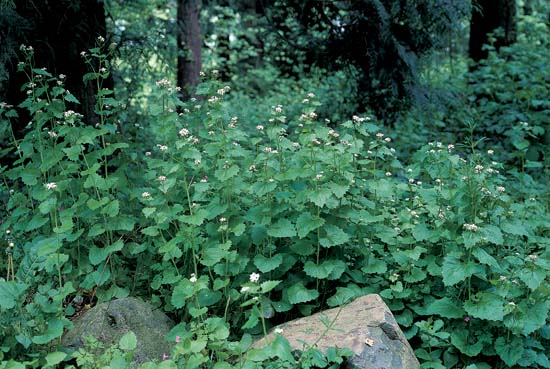
Garlic mustard invading a natural area. On the well-shaded edge of this area, these garlic mustard plants slowly spread into the woods. They are 12 to 36 inches tall, in flower, and not yet producing seed pods.
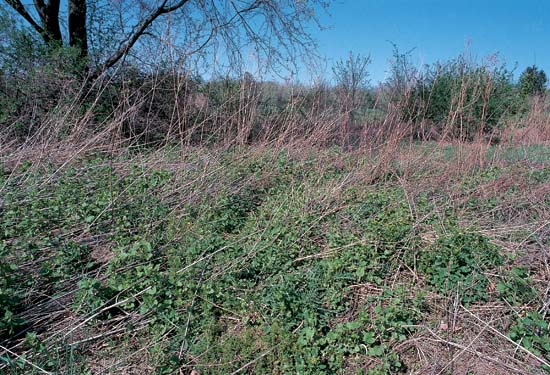
Young garlic mustard growing in a large open field. This is only one part of a 2,000-square-foot area of garlic mustard in this field with full sun.
Garlic mustard is good for you
Garlic mustard is one of the most nutritious leafy greens ever analyzed. In fact, of all the leafy greens in my two nutrient charts, garlic mustard finds itself at the top of the list for about a third of all the nutrients listed. There are no greens higher in fiber, beta-carotene, vitamin C, vitamin E, and zinc. Just to hammer in the point—garlic mustard beats spinach, broccoli leaves, collards, turnip greens, kale, and domesticated mustard for all these nutrients, and it is very high in omega-3 fatty acids, calcium, iron, and manganese.
And what about phytochemicals? Many plant chemicals that were originally considered toxins are now classified as good for you when found in the amounts in plants we eat. Phytates and selenium are good examples. Both were historically thought to be bad for you. Selenium was considered a toxin and phytates were considered anti-nutrients. Now selenium is considered a nutrient, and phytates are being investigated for potential health benefits. Too much selenium and you get poisoned. Too much phytates and you will start having mineral deficiencies. Eat just enough of both of these and you may benefit from them.
Many of the phytochemicals discovered recently have roles in protecting plants from their enemies. Some plants use these chemicals to protect themselves against viruses, bacteria, and fungi. Some use plant-inhibiting chemicals to keep other plants from growing too near. Some have bitter, acrid, or astringent flavors to protect themselves from being eaten by herbivores.
Garlic mustard is bitter and pungent, with chemicals in it that work as natural herbicides. It is known to have isothiocyanates and glucosinolates like other mustards. It is clear that garlic mustard is filled with phytochemicals yet to be discovered. So, while much needs to be done, it is not unreasonable to assume that garlic mustard is really good for you on a variety of levels.
Knowing Garlic Mustard
In the early spring, before the daffodils have flowered, you will find garlic mustard leafing out from overwintering roots. Small roots produce smaller and fewer leaves. Larger roots produce more and larger leaves. All of them, small and large, begin flowering in April to early May. Around the same time, before the flowering plants can set seed, a new crop of seedlings emerges.
Let’s cover garlic mustard from seed and follow it throughout its life. First, let me say that different authorities have labeled this plant an annual, biennial, and even a perennial. I have seen all three forms, but mostly annuals and biennials.
I’ve seen some biennials transform into perennials if they have a taproot and their tops keep getting clipped before they can go to seed. Areas that are mowed regularly could theoretically produce perennials for garlic mustard. But I am speculating here.
As garlic mustard grows from a seedling, it puts down an underground stem-like root. Aboveground, leaves are growing, but no stem develops in this first year. The leaves are rounded to kidney-shaped with rounded teeth along the margins. The leaf stems (petioles) are long, relative to the size of the leaf blades, and have hairs. Plants sprouting in April or May tend not to grow a noticeable stem, at least through the warm summer months.
The upper root is intriguing. While it may or may not be made up of root cells, it acts and looks like a stem. Its apparent purpose seems to be to get the true root deep enough to have access to water, even under dry surface conditions. This underground stem sports two characteristic bends. The first bend is at the base of the leaves; the second is just above the true root. At the base of the leaves, this stem curves to the side at almost a right angle, then slopes gently downward. It bends again just above the root. This uniquely shaped underground stem helps to clearly identify garlic mustard. A true botanical morphologist is needed to tell us if this part is really a modified stem or just looks like one.
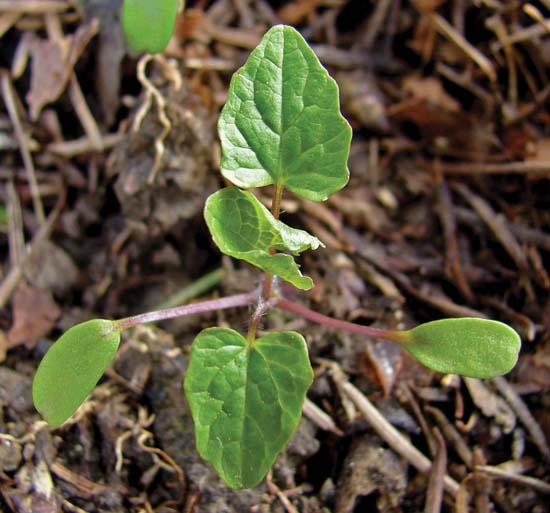
New sprout of garlic mustard, life-size. The cotyledons are to the left and right of the true leaves.
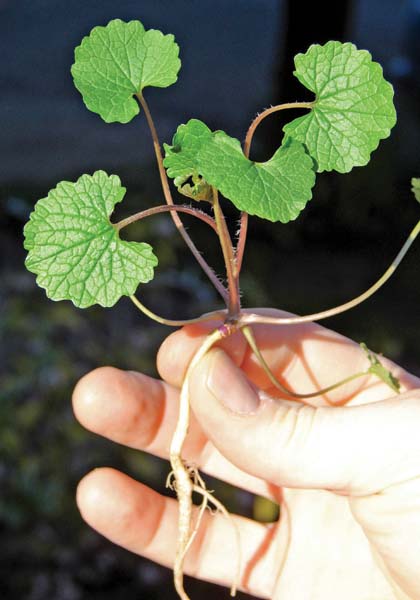
Spring garlic mustard. One way to identify garlic mustard is by a unique underground stem-like structure that is twice-curved and leads to the root. The first curve is just below the leaves, bending the stem to almost a right angle; the second curve is less dramatic, occurring further down where it looks like the true root begins.
As their roots grow, these plants produce more and larger leaves. The first leaves are about an inch wide or smaller; later leaves can be three or four inches wide. Those early leaves can be rounded, kidney-shaped, or almost arrowhead-shaped. After a period of study, garlic mustard leaves should be easy for you to identify. Until that time, you can always check for that garlic odor (crush the leaves and smell), or investigate the unique stem-like root.
As winter arrives, garlic mustard adjusts to cold and freezing conditions. Like other cold-tolerant plants, it loses some moisture and produces sugars and alcohols to survive freezing temperatures. In extreme cold, it loses all its leaves. In moderate climates like the Pacific Northwest, the leaves remain either static or slow-growing. I have harvested good healthy garlic mustard leaves in the middle of winter here in Oregon. I cannot imagine doing that in Michigan, where the winters are much more severe.
As winter ends and spring begins, overwintering garlic mustard comes back to life, producing new sets of leaves. Different patches of garlic mustard may have different-size leaves, suggesting that different microclimates promote germination at different times of the year. So some plants get a head start over others.
Almost as soon as garlic mustard leaves appear in the spring, the plant begins growing a stalk (stem). That stalk goes mostly unnoticed at first. Most people trying to gather garlic mustard before the stalk appears don’t realize that the stalk is already there, mixed among the leaves and not obviously overtopping them.
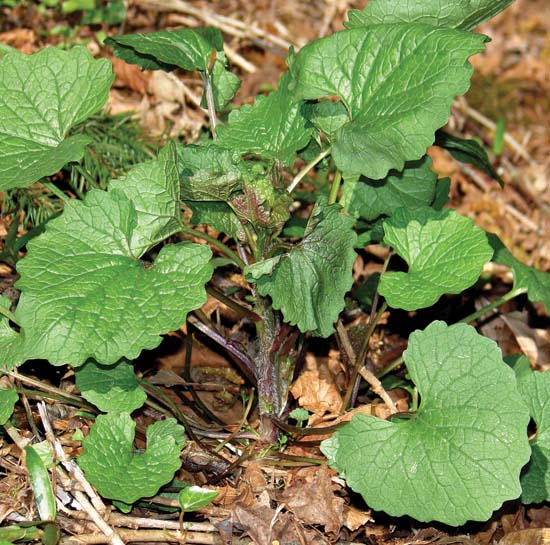
A young second-year plant sporting a hairy stem. The stem is about 2 inches in length. Some stems (like this one) are hairy, some are not.
As spring progresses and the days get longer, the high temperatures warm into the 50s and the stalk elongates suddenly. The larger the root, the faster the aboveground stem growth, the more a multitude of stems will arise from that root. Smaller roots will produce fewer stems, often only one. I’ve seen spring roots anywhere from an eighth inch to a full inch in diameter.
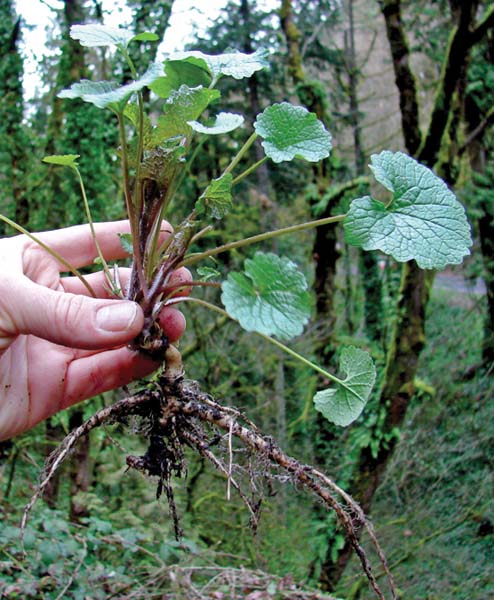
Vigorous early growth of overwintered garlic mustard. This more-developed plant was found at the same time as the last two photographs. Note the curves in the underground root stem and the branching root system. A couple of upper stems have begun to grow.
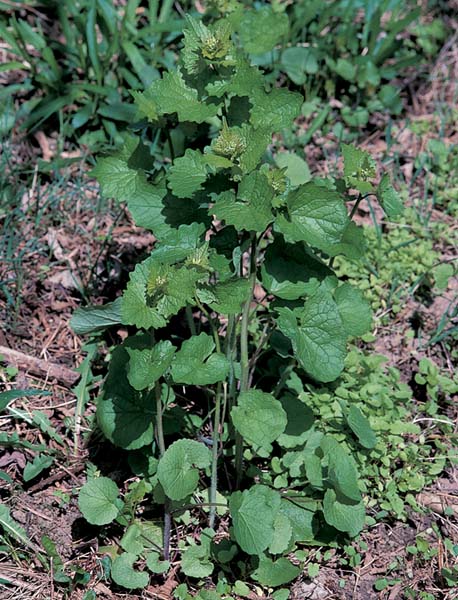
Several garlic mustard plants that have bolted. At about 18 inches tall, these plants have not quite reached their flowering stage. You can see the newly formed buds at the tips of each plant and the triangular leaves in their upper growth.
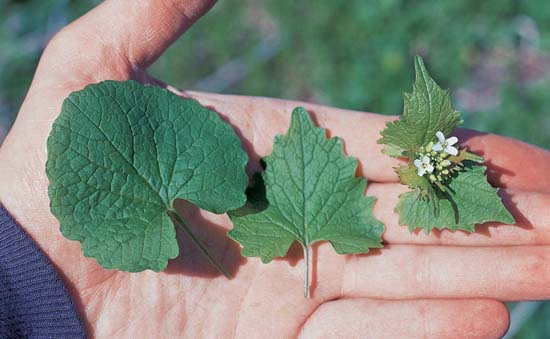
Garlic mustard producing different-shaped leaves. The leaves vary in shape, from rounded at the base to triangular at the top of the plant.
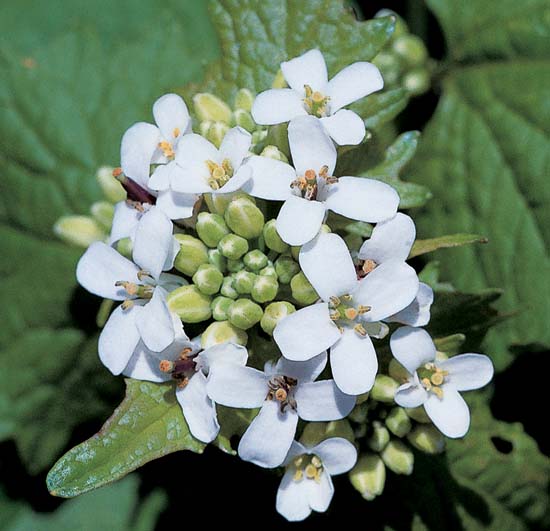
Clusters of flower buds and white flowers at the tip of a stem.
Once the stem gets tall enough for buds and flowers to form at its tip, differences in leaf shape become apparent. Basal leaves (leaves growing from the stem at or near ground level) have a rounded heart or kidney shape. As you travel up the stem, the shape changes progressively to triangular at the top.
Flowers are in clusters at the tip of stems. Each flower has four white petals. And, like other mustards, they have the characteristically odd six-stamen configuration: four long and two short. Stamens are the male reproductive organs containing the pollen.
As the flowers are fertilized and the plant ages, the stem eventually stretches upward. Long pods develop on elongated stems where the flowers used to be. The pods go from green to brown as they age. The pod snaps open when the seeds are mature and the pods dry, ejecting the seeds around the base of the plant. Seeds must go through a freezing process before they will germinate, so all germinating seeds have lived through at least one winter.
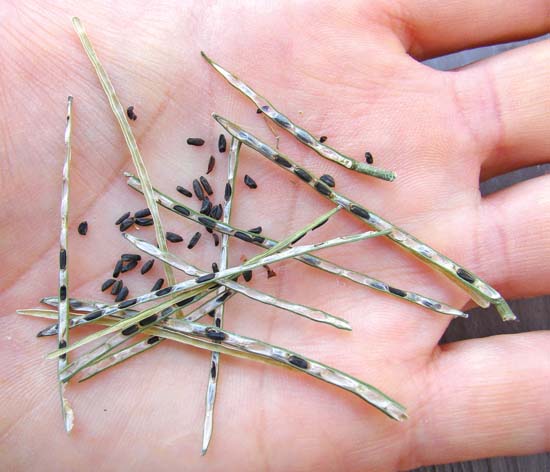
Opened garlic mustard pods and seeds in hand. Mature garlic mustard seedpods split open and release their seeds, which drop close to the base of the plant.
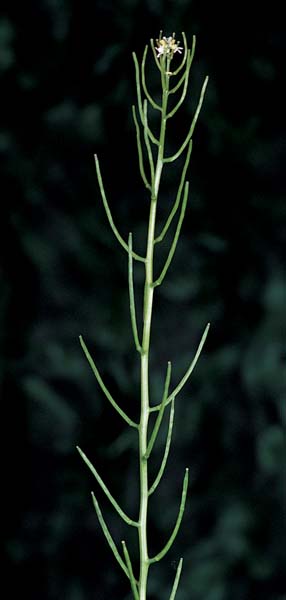
Flower stems elongate, transforming into seedpod stems.
Harvesting Garlic Mustard
There are two considerations when gathering garlic mustard: first, the size of the leaves, and second, the quantity of the leaves available to you. Larger roots produce more and larger leaves.
When I have a choice, I prefer to focus on more vigorously growing, larger-rooted, second-year plants because they produce more food for less work. See how much bigger the leaves are for the larger-rooted plants in the photo above.
The leaves really begin multiplying when the temperatures range from the mid-50s during the day to the mid-30s at night, just around the time that daffodils start blooming in your area. Perhaps this, or just before this, is the time to go harvesting.
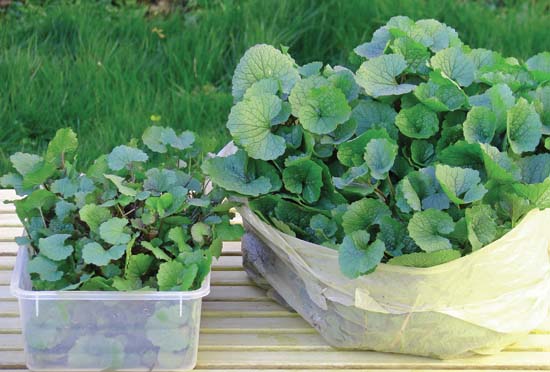
Size variations of spring garlic mustard. While the climate in some areas of North America may produce a consistent size of leaves in the spring, mild winter climates like those found in the Pacific Northwest and the Southeast may allow more than one germination season. The plants on the left were young, as defined by small roots and small leaves. The plants on the right had clearly overwintered, had larger roots, and had produced more and larger leaves. Both containers contain intact plants, roots and all. They were spray-misted to keep them moist and carefully positioned to keep the dirt from hitting the leaves.
If you are harvesting in a natural area that you are trying to save, take a digging stick or pick-shovel to help you and uproot every plant that you can. Take their roots and all, even if you only want the leaves. Try to be careful to keep the roots and their dirt separate from the leaves. This can be done with some success by stacking the plants in a container with the roots facing downward (see photo above). Gathering them when the ground is somewhat dry will make this job less messy because much of the dirt will fall away and not stick to the leaves.
If you only have a few healthy plants in an old field where you want to continue producing leaves, then do not uproot them. Instead, use scissors to harvest the leaves. Pull all the leaves upward and, with one snip, cut the cluster of leaf stems. Place the leaves in a plastic bag, spray-mist, and take the harvest home. The lower-leaf stem stubs and the root system remain undisturbed in the ground. The larger the root system, the more likely the plants will survive to produce more leaves. Return regularly to harvest the returning leaves. If this is a safe place to let them grow, as in your garden, let them go to seed. If it is a sensitive area that you want to protect, uproot them after several harvests before they can go to seed. Never, never let them go to seed where you do not want them spreading!
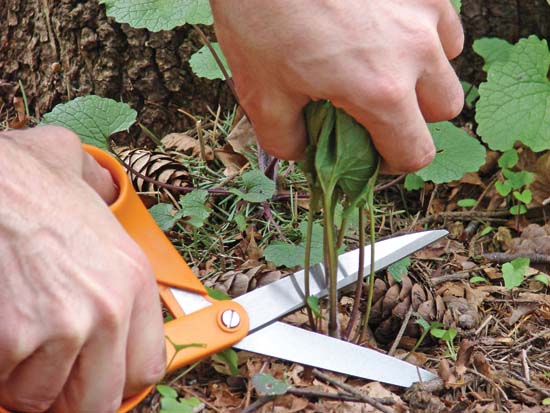
Harvesting leaves without uprooting the plant. A cut like this allows the plant to send up more leaves for future harvesting. Repeated harvests are possible as long as the root produces new leaves. Do not allow the plant to go to seed unless the plant is in a controlled area. Uproot any plants that are growing in or near natural areas with native plants.
WARNING: Throwing the discard roots into the compost might be a mistake. The roots can often regrow into new plants and spread uncontrollably. Unless you are a great composter who knows how to cook the compost, dispose of the roots in some other way. You can shred them in a food processor or briefly cook them (the microwave is good for this) before composting them. Some noxious weed organizations bag them and take them to the landfill—but I hate that idea. Of course, if you want them to grow in your garden, just throw the old roots out there, rake them under, and water.
The upper few inches of the rapidly growing plant stems are edible. The thicker the stem, the better. As the plant gets taller and goes to flower, the length of the upper stem that remains tender will shrink to zero. Pre-bud plants will have longer usable stems than plants in bud. These upper plant stems (rapidly growing tips) are less bitter than the leaves and are tender in texture.
As the plants grow tall, the new triangular upper leaves that develop are increasingly bitter in raw form. They are still edible and great to eat, but you need to manage the bitterness. The raw leafy stems, flower buds, and flowers are also edible, just bitter. So collect whatever you want to work with. If you love garlic mustard’s kind of bitter, you’ll love this plant as is. If you hate bitter, stick with me—the foods you can make are delicious.
By the time the plant is in bud and flower, an interesting thing happens: the lower round leaves begin losing some of their bitterness. So consider gathering them over the triangular upper leaves.
Some people gather the seeds for various uses, but I have not yet tried to do anything with them. The seeds are pretty hard.
Garlic mustard should be well hydrated (spray-misted and/or soaked in water until crisp) and used right away or placed into your fridge. Because garlic mustard is cold-tolerant, refrigeration will preserve it well for up to ten days.
Processing Garlic Mustard
Leaves: Besides cleaning, the only processing that garlic mustard requires is the removal of the leaf stems (petioles). This is a Zen kind of activity that takes some time, depending on how much of the greens you need. Larger leaves make this less work. Relax, sit down, and pluck the leaf blades from the leaf stems.
The leaf stems of garlic mustard are stringy even on the young leaves, so discard them. Usually with other plants, you can keep about a half inch of a petiole and get away with it; that is, you will not notice the fibrousness. But garlic mustard petioles are just too stringy, unless you inhale your food rather than chew it. I suppose the stringiness can also be managed by chopping the petioles into thousands of tiny pieces, which mix into the other mass of food you are eating and go unnoticed. I tend not to use them.
If you plan on eating the bigger leaves fresh (bigger meaning greater than 1 1/2 inches wide), you might want to chop them up. Most of the time, garlic mustard will be bitter to the extent that you do not want to get a whole huge leaf in a fork full of mixed salad at one time. The bitterness would be too much. This, of course, makes more of a difference in some dishes than others.
Upper Main Stems: These will be tender as long as the plant is still growing rapidly. Doing the snap test like you would use with asparagus does not seem to work with this plant. The fibrous segment just below the good stuff still snaps cleanly, so try the following: find where the stem snaps cleanly, then cut off an additional inch; what remains should be tender. Since the leaf stems of the regular leaves will be tough and stringy, remove all leaf stems attached to the plant stem except for the baby leaves at the very top.
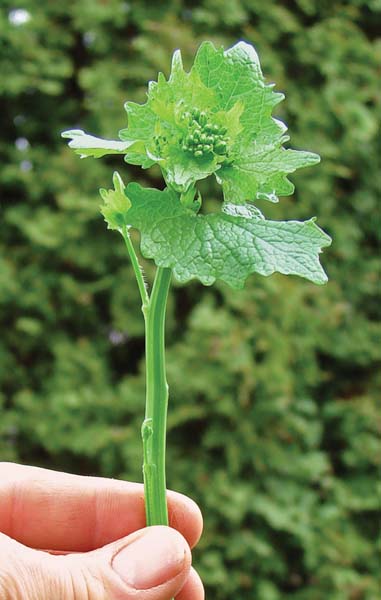
Upper 4 inches of main stem topped with flower buds and the uppermost baby leaves. This is an edible upper stem, though bitter when raw. In preparation for cooking, all leaves with petioles (leaf stems) over 3/8 inches long were pulled off due to fibrousness, exposing a tender naked stem.
Roots: Those large enough to make it worth your while will have a central fibrous core throughout much of their length and tributaries. I have not spent enough time figuring them out to give you any good advice. The core can be either woody or crunchy. For the most part, the outer rind is sweet and mildly pungent. The core, when I find it chewable, is crunchy and very peppery. Its pepperiness stays on the tongue for a while after eating. If it is typical of other biennials, the first-year roots will be tender. The second-year roots will become more and more woody, particularly after the flower stalks begin developing.
Seeds: I have not worked much with the seeds. They may have potential for making condiments or being used as spices.
Serving Garlic Mustard
Eating garlic mustard fresh out of your hand is not for the faint of taste. Garlic mustard is pretty bitter most of the time. And while its winter greens, its very early spring greens, and its lower leaves at the flowering stage are less bitter than other parts, they are all still bitter. If its brand of bitterness goes to the pleasure centers of your brain, then you are all set to eat garlic mustard any way you want. If its bitterness is not your cup of tea, then we have great ways of managing it.
Garlic mustard has three flavors in this order of strength: bitter, garlic, and pepper. Being peppery is consistent with the mustard family, of which garlic mustard is a member, but this pepperiness is usually mild. When you manage the bitterness in different dishes, you are also managing the other two flavors at the same time. Temper the bitterness and you temper the garlicky-ness.
If you search the Internet for garlic mustard recipes, notice that most of them add copious amounts of garlic. That is the curse of the garlic mustard name. Even though this green has its own fine flavor when the bitterness (and concurrent garlicky-ness) are muted, people still expect it to taste garlicky, so they add garlic. And while you are encouraged to prepare garlic mustard any way you want, none of the examples I give include garlic. Please note that I am not a chef. These recipes are simple and designed to show you how to work with garlic mustard. They will not win any recipe contests.
On a personal note—I do not smell or taste much garlic in garlic mustard. Others I know experience it as a strong odor and flavor. So your experience with the taste of garlic mustard may be different from mine.
Most people today are not very tolerant of bitter foods, so the raw and cooked recipes included here are designed to temper that bitterness. Here, I will tell you how I prepared the foods. To know more about the hows and whys, read the introductory section of the Bitter Greens.
Garlic mustard is a great addition to any salad; for most of us, it should be the only bitter green included. To use garlic mustard fresh in a salad, I recommend making it about a fourth of the total amount of greens; a 100 percent garlic mustard salad would be very hard to eat. You can always adjust the amount to suit your individual tastes. Chop the garlic mustard into shreds so you can spread them evenly throughout the salad. Experiment—add foundational and sour greens to this mix. Adding other strong-tasting greens that are pungent, peppery, or bitter will make the salad a little overpowering for some.
The bud heads and particularly the flower heads and their surrounding leaves can be used just like the leaves, although they are the most bitter part of this plant. Consider that bitterness when using them in any of these recipes.
The bitterness of garlic mustard is muted by the macronutrients: protein, fat, and carbohydrates. The greens can be added fresh or cooked in dishes containing these things. Add chopped fresh garlic mustard to pasta, bean, cheese, or egg dishes.
Raw: A turkey sandwich benefits from garlic mustard when used in place of lettuce. Amid the meat, bread, and tomato, bitterness is a welcome nuance in the mix of flavors. Garlic mustard would also work well with other meat sandwiches.
Beans with Garlic Mustard
This is a simple cold plate recipe. Makes 4 servings.
Ingredients:
| 2 cups of drained and rinsed canned red kidney beans |
| 1/2 cup chopped garlic mustard |
| 1/3 cup raisins |
| 2 tablespoons extra virgin olive oil |
| 2 tablespoons balsamic vinegar |
| Salt and pepper to taste |
Directions:
Mix all ingredients. No cooking required. Add other herbs and spices to really make this sing.
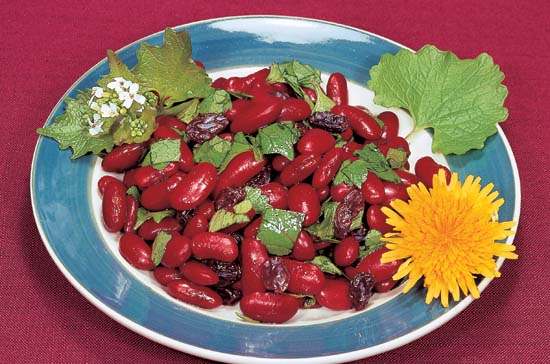
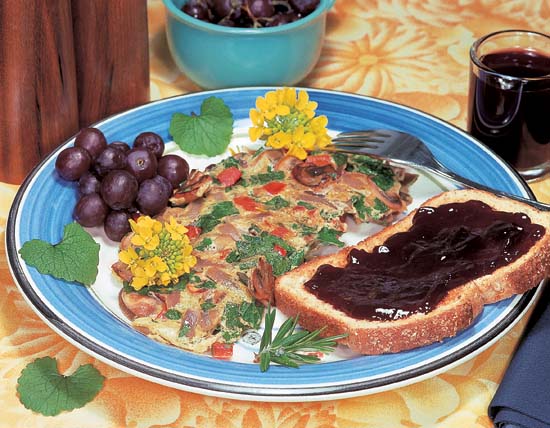
Recipe shown garnished with a garlic mustard flower head and leaf as well as a dandelion flower head.
Boiling: For a basic cooked green, preheat a pot of rapidly boiling water with the top on to conserve fuel. Use enough water so the leaves can move around freely during boiling. Once the water is boiling, remove the top and throw in the leaves, buds, or flower heads. After about six minutes, you have a fine cooked green with a small amount of its three initial flavors remaining. It can now be eaten like spinach. Just add a little oil, some lemon juice, a pinch of salt, and you are all set. If you want more of its initial flavors, boil it less. If you want to remove all vestiges of its bitterness, boil it longer. Boiling garlic mustard transforms it into a foundational green; that is, it can then be used in almost any recipe where a spinach-like green is required. It will have a nice cooked green flavor but no bitter, garlic, or pepper flavor. And the cooking broth remaining from boiling the leaves makes a fine soup stock.
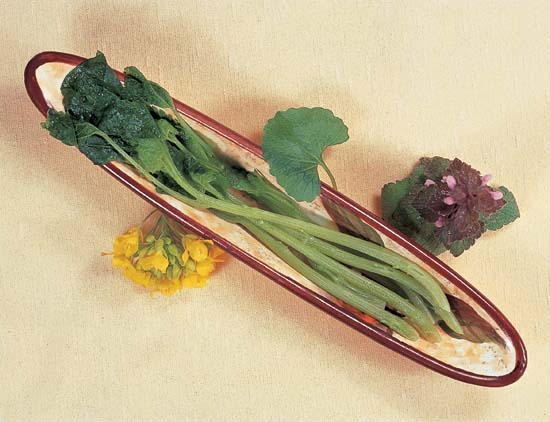
Young garlic mustard main stem tips, boiled for about 8 minutes. I like to cook the stems a little longer than the leaves because they contain the uppermost, most bitter leaves of the plant. Treat like asparagus.
Steamed and Sautéed: These techniques remove most of the garlic flavor and only a fraction of the bitterness. Even after 10 minutes of steaming, there is not much change in the bitterness. Sautéing is not much better. In either of these cooking methods, if bitterness is a problem for you, you might want to treat the steamed greens like you would the raw plant to mask the bitterness.
Cooking, in general, seems to remove most of garlic mustard’s garlic flavor. Since I like to appreciate whatever flavors come with a plant, I tried an experiment. Rather than make my typical omelette, where I sauté or steam a bunch of vegetables before I add the eggs, I chopped the raw garlic mustard into about half-inch-size pieces and mixed them in with my beaten raw eggs. Then I made my omelette. It worked because the egg part of the omelette is not cooked very long, the egg somewhat insulates the garlic mustard from the heat, and the protein and fat in the egg seem to mute the bitterness but retain the garlicky-ness, which is never very strong for me. But this technique works fairly well to maintain whatever garlicky flavor there is.
Garlic mustard is a nutritious and often plentiful green whose potential as a food is tremendous. Help out your local natural area by harvesting their garlic mustard. Invent some innovative recipes. And if you want, add garlic.
Garlic Mustard Omelette
Add 1/2 cup chopped garlic mustard leaves and 1/4 cup diced sweet pepper (red in this case) to 2 beaten eggs and set aside. Put 1 tablespoon olive oil in a preheated skillet, sauté 1/2 medium-sized red sweet onion and 1 cup sliced mushrooms (wild or store-bought) until the onions have caramelized. Add 1 heaping teaspoon of finely chopped fresh rosemary to the pan, stir quickly, and add the egg mixture. Cook until desired doneness. Gently flip or fold the omelette. Salt and pepper to taste.