Shepherd’s Purse
A small, unassuming, nutritious plant—few know its true virtues.
Family: Brassicaceae
Species: Capsella bursa-pastoris
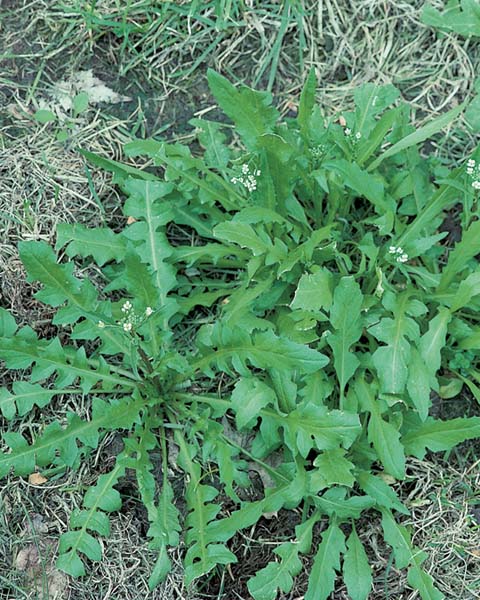
Young healthy shepherd’s purse plants with short stems, just beginning to flower.
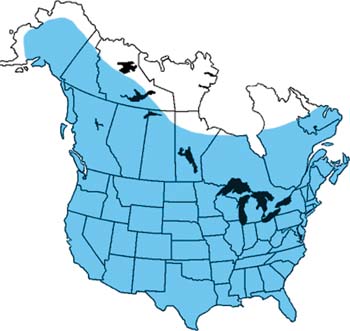
Estimated Range
Official Species Name:
Capsella bursa-pastoris (L.) Medik.
Synonyms (Historical Names):
Capsella rubella Reut.
Bursa bursa-pastoris (L.) Britt.
Bursa bursa-pastoris var. bifida Crépin
Bursa gracilis Gren.
Thlaspi bursa-pastoris L.
Common Names:
Shepherd’s purse
Shepherd’s heart
Shepherd’s pounce
Toywort
Bolsa de Pastor
Pickpocket
An herbaceous weed naturalized from the Mediterranean, shepherd’s purse is widespread and abundant in North America, primarily where humans have invaded and where soil has been disturbed. It also grows in more stable soil, like lawns, vacant lots, old fields, and landscape beds.
Edible Parts:
Growing tips of leafy stems
Leaves
Buds
Flowers
This plant is easily identified when mature. Unfortunately, prior to the appearance of the mature pods, the leaves can be mistaken for all those other basal-leaved dandelion-like plants. How can you identify this plant prior to seed production? We’ll try to solve that problem in this chapter.
This is a prolific plant that can be the bane of farmers, who, as a result of crop losses, called this plant pickpocket. But for you, this plant should be called great benefactor, since it will give you free food as long as you can find it in good enough condition.
Shepherd’s purse leaves are a nutritional powerhouse, very high in omega-3 fatty acids, calcium, iron, and zinc, with vitamin C and manganese levels as good as our most nutritious domesticated greens.
Knowing Shepherd’s Purse
Shepherd’s purse loves moisture, loose fertile soil, and cold weather. That being said, as long as the seeds have enough moisture to germinate and the plant can get established, it can grow just about anywhere, even in poor soil, hot weather, and dry conditions.
Shepherd’s purse seeds may require two winters of conditioning before they will sprout. After that, they can germinate in any nonfrozen growing season. They prefer sprouting when temperatures fluctuate around 60 degrees F. But if the soil is disturbed and moisture is present, it has a wide latitude beyond that temperature. The major sprouting time is in the spring, with a secondary sprouting in the fall. It can sprout in the summer if the soil is turned and watered.
Earlier sprouts will have a longer vegetative growing season before producing a flower stem; that is, they will produce a lot more leaves, particularly if the weather is cool and there is plenty of moisture. Later sprouts, like those germinating in the summer, will have a shorter vegetative life, though with enough water, great leaves can still develop. With summer heat and drying conditions, shepherd’s purse will ignore leaf production to put all of its energy and focus on generating a seed-producing stem.
If shepherd’s purse sprouts late enough in the year, perhaps in a late-autumn warm spell into the 60s, and then temperatures dip below freezing, growth will slow but continue until temperatures reach into the low 20s. At that point, the plant goes into hibernation for the winter.
Leaf shape varies somewhat. Some leaves are more pointed than others, some are more lobed. But there is an overall look that will become clear to you after awhile. First, shepherd’s purse leaves are consistently smaller than dandelion, cat’s ear, and sow thistle. Second, they are very regular in design. Look at the leaves of the plants below; note how consistent in shape the shepherd’s purse leaves are to each other. There is a tapered leaf stem (petiole) leading to regular lobes on each side of the leaf. The top third of the leaf is larger than the middle or the lower third.
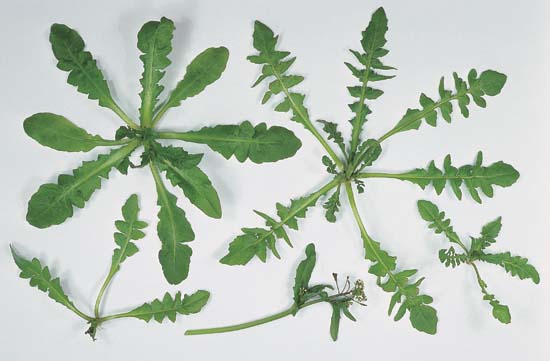
Leaf shapes commonly found in shepherd’s purse basal rosettes. Some leaves are more deeply lobed then others. At the lower center is a flower stem.
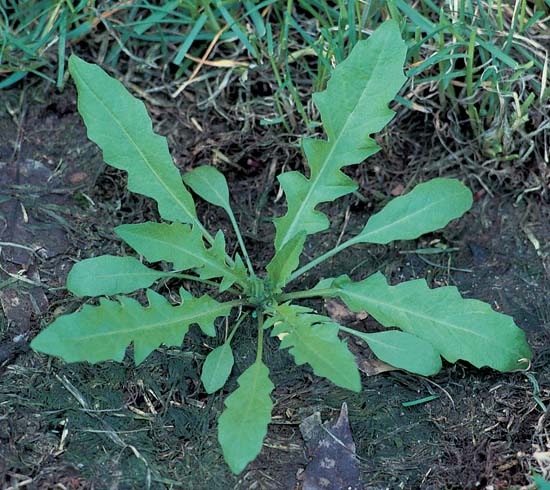
Young shepherd’s purse. To gauge size, the largest leaves in this photograph are just less than 3 inches long.
Another trait to look for are the tiny leaf spines. If you look closely at the margins of the leaves, you will see tiny hair-like spines arising from edge angles of the leaf blade. These spines are miniscule. To see them, hold the leaf up to the light. Look for the angles, then look for the spines at their tips. You might need a hand lens or a magnifier to see them. In contrast, dandelion will have smooth margins with obvious lobe tips or teeth tips. Its tips are typically brown, but you might have to use a magnifier to see them. Cat’s ear will just have hairy margins—much larger conspicuous hairs and about five times the number of hairs you see in shepherd’s purse.
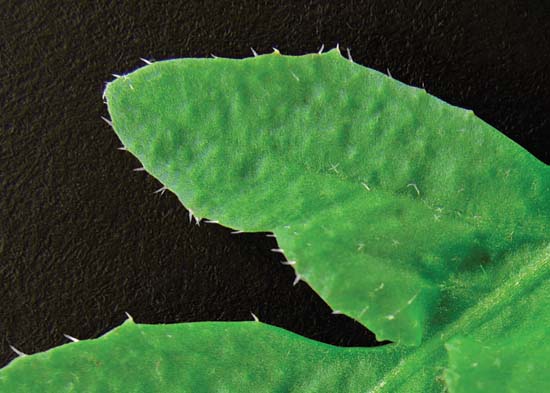
Tiny hair-like spines are found on the leaf margins. This shows an extreme close-up of the margin of one of the tiny lobes of a shepherd’s purse leaf. This lobe is about 1/4 inch long in actual size. It has been magnified so you can see the tiny hair-like spines at the tips of tiny leaf angles along its margin. There will also be a few to lots of scattered hairs found randomly around the leaf’s edge that are not related to the angles.
If leaf shape and spines are not enough for you, there is also the core string of each leaf. If you grab the leaf about at its center and then pull the leaf apart, a core string will remain. That string will either be attached to the base of the leaf stem (petiole), as in the adjacent photograph, or it will protrude from the upper leaf you just pulled off.
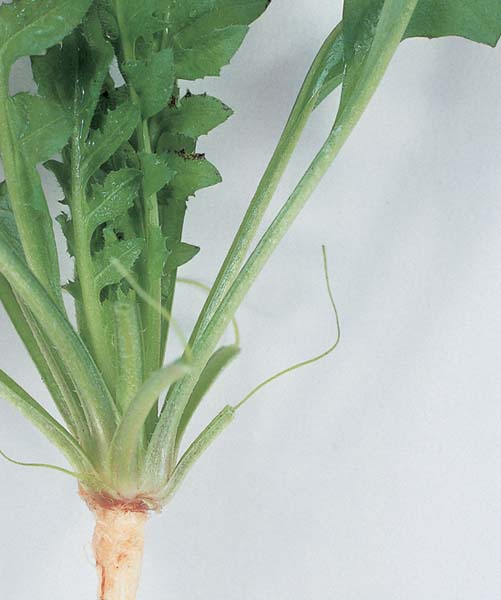
Tough stringy cores are inside the leaves. If you stretch a leaf until it breaks, it will leave a tough core string. Cat’s ear (Hypochaeris radicata) and plantain (Plantago major) have a similar attribute.
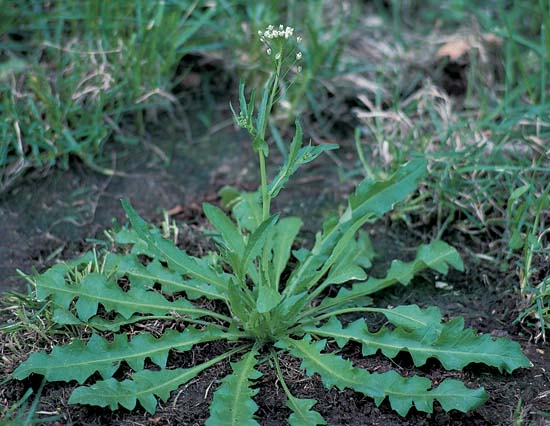
Young shepherd’s purse with about a 5-inch stem. Note that even though the stem is still forming, it already has flowers at its tip.
At some point—depending on the season, environmental factors, or the age of the plant—shepherd’s purse sends up a flower stalk, typically one at first, then sometimes more. Like many of our plants, the more lush the growing conditions, the more leafage will be formed relative to flower and stem production. The harsher the conditions, the less leafage. So habitat has a lot to do with how much greenery there is on these plants.
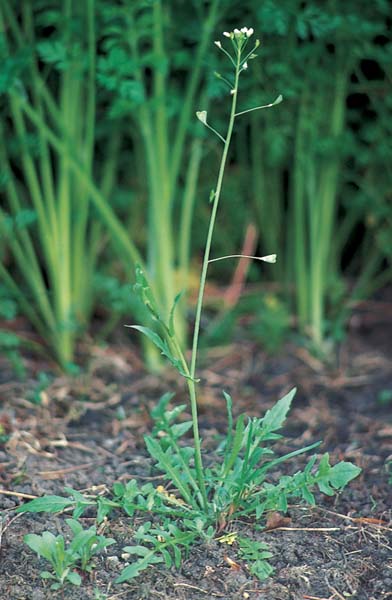
A mature but still-growing plant showing its characteristic elongated stem. Flowers are found at the top, and heart-shaped seed capsules form along the stem. Over time, this will continue to elongate, branch, grow more stems, and produce hundreds of seed pods (purses). Note the new branch arising from the base of a stem leaf. That branch will soon look just like the main stem.
The stem of this plant is how most people identify shepherd’s purse. It has a characteristic look: tiny white flowers at the top, heart-shaped seedpods along its length, and small leaves below the pods. Stem leaves are typically small and get smaller as they travel up the plant.
Flowers are tightly clustered at the tops of all stems, tiny and closed most of the time. They open in the middle of the day when the conditions are right. Sometimes they have a reddish coloration, but mostly they are green parts with white petals. Like all other mustards, there are four petals, four sepals, one pistil, and six stamens.
The pistil, once fertilized, transforms into a pod. When this happens, all the other flower parts fall away. The heart-shaped pod is green and is divided into two halves, each half containing a number of seeds. The distinctive shape of shepherd’s purse pods helps distinguish this plant from close relatives like pennycress (Thlaspi arvense). The longer the stem gets, the more pods develop along its length.
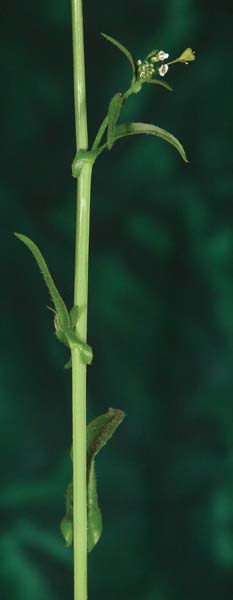
Stem leaves are small and shaped differently from the basal leaves. The stem leaves are narrow, unlobed, get smaller as you travel up the plant, and have bases that clasp (wrap around) the main stem. New branches emerge from where the stem leaves meet the main stem.
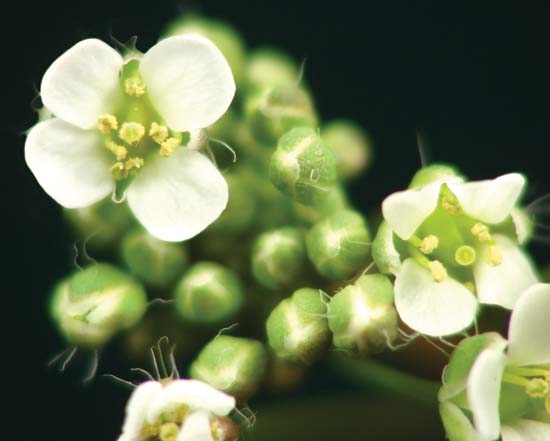
Shepherd’s purse buds and flowers. In the middle of a sunny day, you might be lucky enough to see shepherd’s purse flowers opening—they are typically closed most of the time. Deep within the flower, the pistil (female flower part) is in the form of a heart-shaped purse. This photograph has been magnified many times to show the tiny 3mm-wide flowers.
Gathering Shepherd’s Purse
Leaves: These will be larger, more tender, and flavorful if you gather them from excellent habitats—moist rich areas with soft soil like gardens, landscaping, and farmland. You will find more of these conditions in the very early spring and late fall. Either uproot them for later leaf extraction or snip off the rapidly growing leaves.
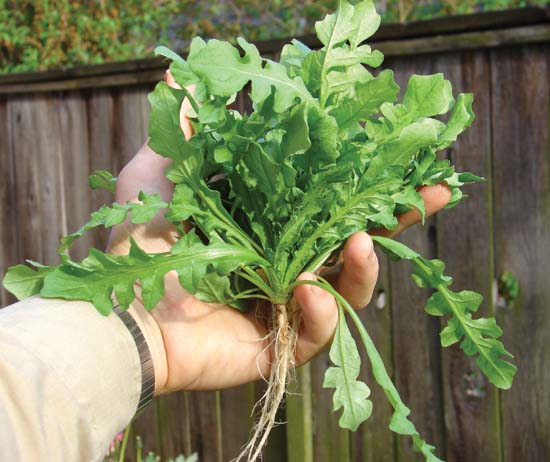
Six healthy young plants held as one bunch. These are young basal rosettes prior to any significant flower stalk development. Clustered like this, it looks like one plant. Note how lush the leaves are. This kind of growth is found in healthy well-watered soil in landscaping, adjacent to a garden, or on a farm. Shepherd’s purse roots are typically thin and insubstantial.
Like most mustards, shepherd’s purse dries out very quickly, so keep all parts moist and cool until ready to use. If they wilt, crisp them by immersing in very cold water for fifteen minutes. Once hydrated, they will last well in the refrigerator.
Shepherd’s purse leaves are a little chewy, particularly those with long thin petioles (leaf stems). Before I use the larger, longer leaves, I chop off their lower 40 percent, which is mostly petiole.
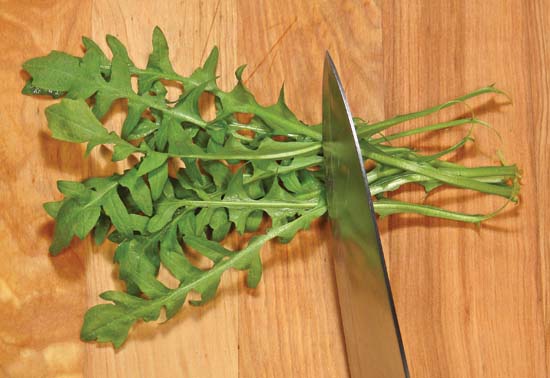
Trimming shepherd’s purse leaf stems. Large shepherd’s purse leaves typically have long leaf stems (petioles). I usually cut off and discard the fibrous leaf stems. Leaf stems on smaller, younger leaves are not as fibrous and can be used whole.
Flower Stalks: The short, very young, just-forming flower stalks are edible and delicious. At first, all you see are a cluster of leaves arising from the center of the basal rosette of leaves. Then the flower stem emerges. Eventually new stalks branch off the main flower stalk. On younger plants, the upper few inches are chewable. On older plants with long flower stalks, only a small part of the uppermost stem is chewable but not very tasty.
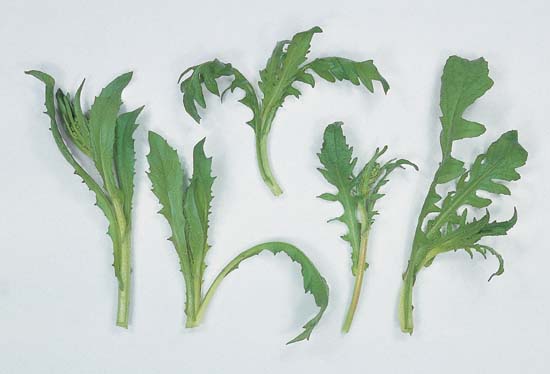
New shoots (flower stalks) that rise from the basal rosettes of shepherd’s purse.
Seeds and Seedpods: These are just too fibrous for any use I can find. Even when they are green, there is not much to like about them. The seeds are the most-talked-about part of this plant in wild food literature, but they are tiny, tough, and generally disappointing. I do not see any practical use for them.
There have been repeated reports that Native Americans collected and used the seeds for a “nutritious flour.” These reports stemmed from a single reference in a 1902 book by Victor Chestnut called Plants Used by the Indians of Mendocino County, California. Here is what Chestnut said under one of the old Latin names for shepherd’s purse, Bursa bursa-pastoris: the seed “is used to a slight extent to make pinole.” That is all Chestnut said. Pinole, if I understand it correctly, is a food made from seeds that are roasted and ground into a meal. Typically associated with corn, it can refer to any grain. Chestnut’s information is really too vague to be useful. Was shepherd’s purse seed, along with whatever other grains could be added, used to extend the corn? To flavor the corn? What does slight mean? Was it ever used on its own to make shepherd’s purse flour?
It is difficult to imagine gathering enough shepherd’s purse seed to make even a small amount of flour. I could not find any peoples in Europe or the Mediterranean (its native growing areas) who used the seeds at all. My guess is that the seeds have never been seriously used. I believe this not only because they are tiny and would take a lot of work, but because there are so many more useful and efficient grain alternatives. If you try doing something with shepherd’s purse seeds that is worth doing, let me know what you discover.
It is not clear from the literature but it seems like both the pods and the seeds are recommended for use to spice up soups and stews. I do not remember reading about anyone who had actually tried this. I’ve tasted the green pods raw, and they do not have enough flavor to make them worth using as a spice.
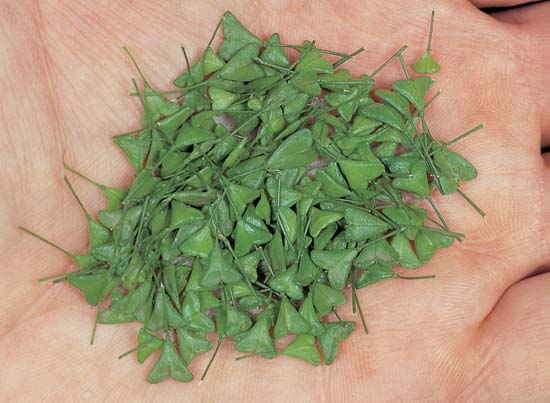
Seedpods collected while still green. When they fully mature, they turn light brown, break open, and release their seeds.
Cooking and Serving Shepherd’s Purse
Leaves and Stem Tips, Fresh: When lush and fast-growing, shepherd’s purse leaves and emerging stem tips are delicious and can be very mild. In fact, it can be so mild that it could be used as a foundational green in some circumstances. Sometimes you get a little more of the pepperiness. It is excellent in salads, sandwiches, and anywhere you would use lettuce or spinach. Occasionally the leaves are just a little chewy—particularly leaves over four inches long. If so, remove the petioles and chop them into smaller pieces before putting them into whatever you are serving.
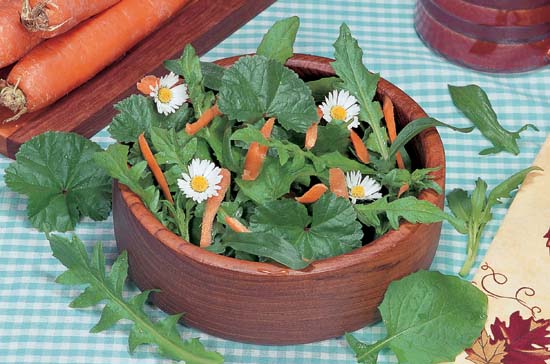
Wild Shepherd’s Purse Salad. Included are mallow, nipplewort, sheep sorrel, English daisy flowers (Bellis perennis), and some domesticated carrot slivers. Shepherd’s purse makes up about 1/4 of this salad’s greens. Both leaves and shoots are included here.
Years ago, a major hotel restaurant in Seattle hired me to take a master chef, whom they were trying to recruit, on a wild food tour of Washington. It was November, so I could only show him the cold-tolerant plants. Even though there was frost covering everything, we found some shepherd’s purse looking lush and still growing. They were at the stage where they were just sending up the first few inches of stem. After tasting both leaves and stem, this master chef (did I mention he was a master chef?) declared that it was one of the best-tasting greens he had ever eaten.
The flower heads at the tips of the tall mature stems are edible and can be added fresh anywhere you add the leaves. I have heard they are super peppery, but I’ve often experienced mild flavor in rapidly growing plants. I do not consider the flower heads to be choice, but they are edible; if you want to add diversity to your diet, they can easily become part of a larger dish, and you won’t even realize you are getting the added diversity. For me, they are not pretty enough to be used as a garnish, but you might disagree.
Leaves and Stem Tips, Cooked: Shepherd’s purse leaves and rapidly growing stem tips are excellent greens whether steamed, boiled, stir-fried, or baked with some dish. Its mildness works wherever spinach is used.
But be forewarned: shepherd’s purse leaves reduce down tremendously when boiled. It takes about ten servings worth of fresh greens to make one serving of boiled greens. While this amount of greens is not out of the ordinary for me, eating this much concentrated shepherd’s purse gave me a five-hour low-level headache. Frankly, I do not know what the cause was. The headache could have been unrelated to the shepherd’s purse. I could have been having a unique physiological reaction to something in the greens. Or perhaps there is some chemistry in shepherd’s purse that is harmless until you consume a certain quantity. Who knows, it could be an overdose of beneficial phytochemicals. Dandelion flowers in large quantity have the same effect on me.
I believe shepherd’s purse greens to be nutritious and good for you. But due to my limited experience eating it boiled in this quantity, I caution anyone from eating that much in one sitting. So if you cook shepherd’s purse, make sure that the finished greens are spread throughout a larger dish. And try not to eat the equivalent of more than five fresh servings in one sitting.
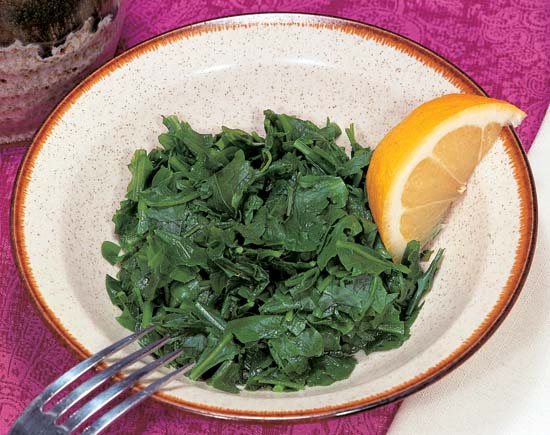
Shepherd’s purse greens are powerful. This innocent-looking serving of shepherd’s purse is actually about 10 hefty servings of fresh greens that boiled down to a fraction of its original size.
Root: It has been reported often that fresh or dried ground roots of shepherd’s purse have been used as a substitute for ginger, and that they have been candied by boiling them in a rich sugar syrup. I’ve chewed on the roots of both young and old plants to search for that ginger-like flavor. None was to be found. And to top that, young and old roots are absolutely woody—not making them suitable for grinding. I have no use for the root.
Shepherd’s purse is an excellent addition to the diet. It’s nutritious and delicious, and is found all over North America. The key thing is finding lush plants with large, healthy, rapidly growing leaves. It is easy to find old struggling plants growing in hard dry ground, but wait for the good stuff. Go visit a local organic farm or possibly your own garden.