Dandelion
A nutritious, delicious vegetable: great if you know what you are doing—a disappointment if you don’t.
Family: Asteraceae
Species: Taraxacum officinale
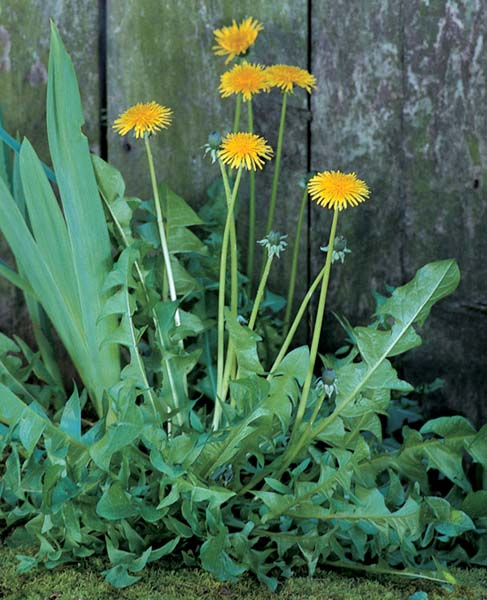
Spring dandelions in a growth stage that is great for gathering leaves, buds, and flowers.
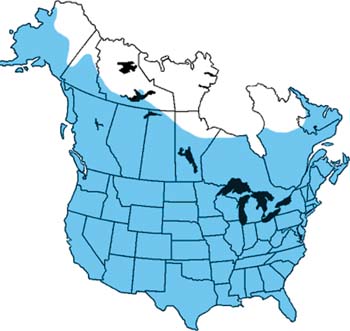
Estimated Range
Official Species Name:
-
Taraxacum officinale G.H. Weber ex Wiggers
Synonyms (Historical Names):
-
None
Common Misspelling:
-
Taraxacum officinalis
Common Names:
-
Dandelion
-
Dent-de-lion
-
Diente de león
-
Blowball
-
Pissenlit
An herbaceous perennial weed naturalized from Europe, dandelion is widespread and abundant in North America, primarily where humans have invaded and where soil has been disturbed.
Edible Parts:
-
Rapidly growing leaves of any size
-
Buds and bud stalks
-
Flowers
-
Flower petals
-
Heart
-
Young roots
One summer when I was a kid, my grandmother walked to the vacant lot next to our house and gathered dandelion greens—greens our Greek ancestors have eaten for centuries. A second-generation, fully American suburban kid, I had never seen such a thing. My mom washed the greens, boiled them for about 10 minutes, poured off the water, and served them with a little olive oil and lemon juice. Everyone at the table began eating the greens, suffering at every bite. It was an excruciatingly bitter experience. But my mom did not want to hurt her mother-in-law’s feeling and was dragging us along for the ride. After much torture, my mom took pity and allowed us to leave the rest. It is a good thing that I could ignore this common and unpleasant experience in my adult life, or I would never have learned to enjoy dandelions.
Popular and wild food literature is filled with inaccurate and misleading information about the use of dandelions for food—making it almost impossible for the novice to have a really enjoyable dining experience. Articles are commonly written by people who are intrigued with wild foods but have little practical experience. Even people with experience do not seem to have the ability to give practical advice. And worse, there are many wild food authors/proponents/cheerleaders who give the impression that every wild food is delicious no matter how it is prepared.
There is also a long history of dandelions being used by health-care practitioners to aid in digestion, to stimulate bile secretion, to clean the liver, to purify the blood, and to help manage insulin. Before you start eating raw dandelion, be forewarned that the leaves are considered mildly diuretic and laxative, the roots can be mildly laxative, and the milky juice is used to kill warts. Educational papers found in libraries and on the Internet describe all the potential health and medicinal benefits of dandelions. Because medicine is not my area, neither am I an herbalist, I will not try to summarize this information for you except to say that, in the end, dandelions are a great food in the context of a healthy diet. I can eat a great deal of it without any pharmaceutical effects that I know of—as do millions of other people. Dandelion leaves are packed with nutrients and are generally considered one of the more healthy vegetables. Try giving it a chance. In this chapter, I’ll lead you through the natural history of dandelion and describe the points of greatest opportunity. With a little experience, you may learn to love dandelions as much as I do.
Knowing Dandelion
Dandelion sprouts from seed whenever the soil is moist. It will emerge in your garden when you turn the soil and then water the area, or it will show up in your yard if you continually water to keep your grass looking fresh. It is a cold-loving plant that seems to prefer moist springs and autumns. This plant will continue to grow more and longer leaves as time progresses, and it sends down a taproot that thickens with age.
First-year development
How much leafage and root that a first-year dandelion produces is totally dependent on growing conditions. Great growing conditions—lots of water, rich soil, and no cutting back—will produce lots of leafage. The more leafage, the larger the root and the deeper it digs. As far as I can tell, dandelion is capable of flowering before its first winter, but it takes energy to flower. Through photosynthesis, the plant must build up a storehouse of enough energy in the roots to support flower and seed growth.
Dandelion is a perennial, a plant that survives for two or more winters. Like other winter-tolerant plants, dandelion adapts to survive the cold in a variety of ways. Water content decreases while sugar and alcohol content increases. These are protective measures that reduce the damage from ice forming in the cells during a freeze.
I’ve seen dandelion leaves survive several days of 20-degree temperatures during several cold blasts in an otherwise moderate Pacific Northwest winter. They look all shriveled and dead during the freeze, only to recover when the temperature warms again a few days later. Surviving, however, is not thriving. In northern regions, dandelion leaves have been known to survive under the snow. But months of below-freezing temperatures tend to kill all the aboveground growth.
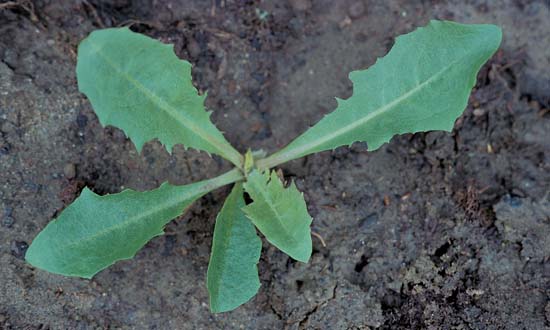
Dandelion seedling.
Second-year development
The second-year dandelion is the one that most people are familiar with. Once winter passes, the aboveground leafage grows rapidly, fed by overwintering roots and watered from rainy springs and snowmelt. The number and size of the leaves are roughly proportional to how big the root is. Overwintered dandelion plants tend to burst into flower around the same time, typically in April or May, depending on where you are in North America.
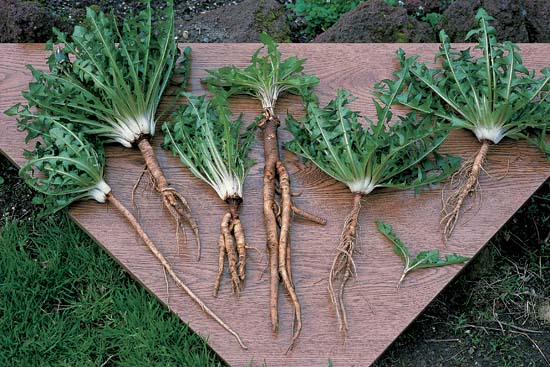
Dandelion plant and root size. This display shows dandelions in early March that grew wild in my garden. The soft, rich, well-watered soil allowed them to flourish more than the dandelions growing in the lawn. The roots here are up to 2 feet in length. Unless the top of the plant is damaged, like the center plant here, leaf growth is generally proportional in size to the root size.
Leaves: These are extremely variable in shape. This variability causes dandelion to be confused with other plants that have similar-shaped but variable leaves. Cat’s ear, chicory, and shepherd’s purse are plants with similar leaves. Dandelion apparently got its name from the teeth on the leaf blades. Many people say it comes from the French name dents-de-lion, referring to “teeth of the lion.” This may be true, but before that, the Latin name was dens leonis.
Dandelion leaf stems are almost white where they attach to the base of the plant. That base is often called the root crown, where leaves are attached to a short compact stem above the root. There is often a reddish tinge somewhere on the leaf stem. The leaves are variably lobed, and those lobes are pointed, mostly downward; sometimes they point outward. Some of the lobes divide the leaf all the way to the central vein; other times the lobes are shallow, not cutting deeply into the leaf. Look at the leaves in all the pictures in this chapter to get an idea of the variation you are likely to see. The leaves can range from just a few inches to over eighteen inches long. What few hairs they have are tiny and barely noticeable.
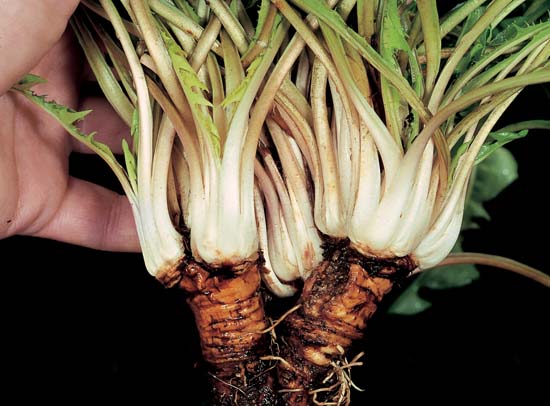
Several dandelion root crowns growing from a single large root. The root crown is that area created by the bulge of the leaf bases down to where the root begins. Younger plants will have a simpler structure—a single straight root leading to a single crown.
Dandelion leaves can look like a variety of other plant leaves. To help you distinguish between them, I’ve taken side-by-side comparison photographs. Those comparisons will focus on shape and hairiness differences. Dandelion is compared to cat’s ear (Hypochaeris radicata) and wild chicory (Cichorium intybus); all three have edible leaves.
In summary, dandelion is virtually hairless on both sides, cat’s ear is quite hairy on both sides, and chicory is hairy on its bottom side, often with little or no hair on its top.
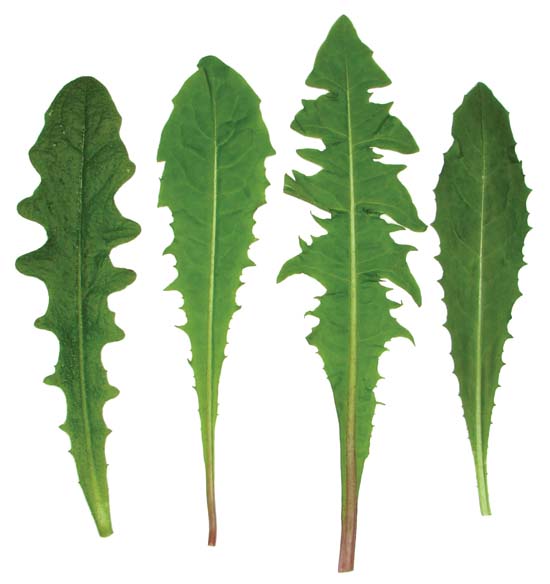
Dandelion leaf (center two) compared to cat’s ear (left) and chicory (right). These represent common shapes, but many variations exist for all three species. Much more detail will be given in the chapter on cat’s ear. Chicory will be covered in another book. While you cannot see it here, chicory leaves often twist instead of lying flat. Check this chapter for more dandelion leaf variation.
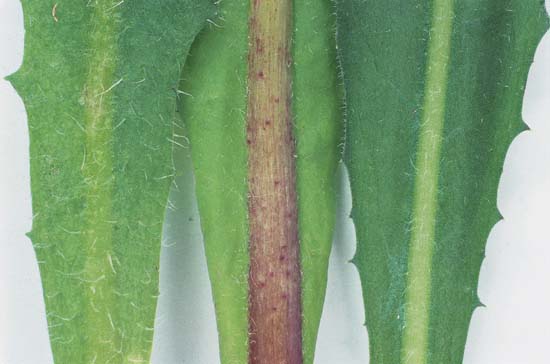
Leaf surface comparison of cat’s ear (left), dandelion (center), and chicory. Cat’s ear has coarse hairs all over its upper surface; dandelion and chicory are mostly hairless. If they have any hairs at all, they are small, sparse, and inconspicuous. Note also that the main veins on cat’s ear and chicory do not stick up from the blades’ surface. Dandelion’s main vein does stick up above the blade and is more likely to have some redness to it than the other two species.
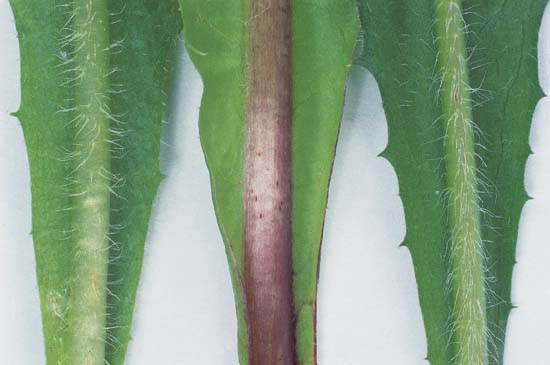
Leaf underside comparison of cat’s ear (left), dandelion (center), and chicory. Both cat’s ear and chicory have coarse hairs all over the undersides of their leaves. Hairs are particularly evident on the main veins, which stick up/out from the underside of the leaf blade. Dandelion leaf undersides have no obvious hairs.
Flowers and Seeds: Like all the other plants in this section of the book, dandelion has what is known as a composite flower. That means that what looks like one flower is in fact a cluster of flowers, also known as a flower head. Each petal you see is actually the tip of a separate individual flower. Each flower results in the development of a single seed on the seed head. So a head of flowers results in a composite or cluster of seeds on the seed head.
What most people call the flower bud on dandelion is actually a flower cluster bud surrounded by green bracts. An opened flower head is cradled/subtended by those bracts. The flower head opens and closes once each day for about three days before transforming into a seed head. By the fourth day, the closed head appears white at the top before opening. The fully open seed head is sometimes called a puffball, blowball, or faceclock. The puffball has generated lots of folklore. I’ve heard of two ways to tell time over the years. The first view says that the number of puffs it takes to blow off all the seeds tells you what time it is. So, if it takes four puffs to blow off all the seeds, it’s four o’clock. The second view is that after three puffs, a count of how many seeds remain on the head tells you what time it is. Einstein would love this method, as time would be relative to each puffball you picked up.
New leaves and flower stalks arise from the top of the root crown. Flower stalks can reach a length of up to two feet under excellent growing conditions.
After spring’s massive flowering, dandelion will continue to flower sporadically and infrequently throughout the rest of the year. A small upsurge in flower blooming occurs again in the fall.
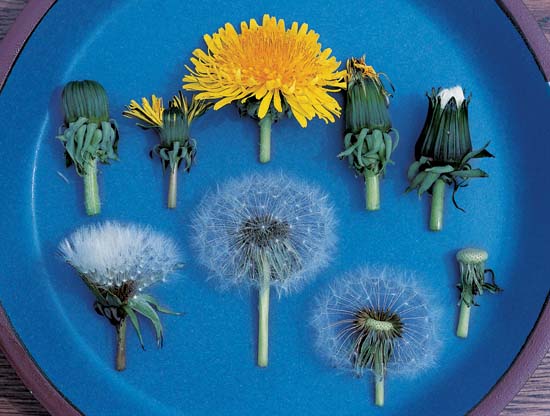
Developmental progression from dandelion bud to seed dispersal. Progression goes from upper left to upper right, then lower left to lower right: (upper) bud, bud opening, fully opened flower head, flower closed, seed head closed; (lower) seed head opening, seed head fully open (puffball), seed head releasing seeds, flower/seed receptacle denuded.
Edibility
Dandelion has six edible parts: leaves, flower buds, upper bud stem, flowers, heart, and roots. Flavor and texture are highly dependent on growing conditions, your ability to choose the best specimens at the appropriate stage of growth, and your management of the bitterness.
Leaves: In much of popular wild food literature, you are often told to gather dandelion leaves before the flower stalks appear. This is limited advice since dandelion can be collected and enjoyed during all the nonfrozen seasons. But there is some reasoning behind the idea. Non-bitter or less-bitter dandelion is “possible” to find in the early spring because a variety of environmental factors create conditions that allow it to be that way. In my experience, dandelion bitterness is caused by the following three factors: excessive sun, slow growth, and possibly root storage of bitterness. Since I am not a plant physiologist, the following discussion is speculation based on observations I’ve made.
The first and most important source of bitterness is sunlight. Dandelion’s bitter chemicals are made in proportion to the amount of sunlight the leaves receive. The more intense and longer the duration of sunlight baking a leaf, the more bitter it will be. Conversely, less bitter greens are produced during a period of rapid spring growth; the plant receives low amounts of sunlight since the sun is still low in the sky and the days are short. At this time, dandelion has less stimulation from the sun to produce bitters.
The second source of bitterness is slow growth, primarily caused by a lack of moisture; but it can also be caused by a lack of growth-promoting nutrients like nitrogen. Slow growth means that whatever bitters are produced will concentrate as the leaf sits there stagnantly, baking in the sun. Conversely, plentiful soil moisture left over by winter and prolonged by spring rains, nonfreezing temperatures, and energy stored by the roots result in explosive spring growth. Rapid growth means that whatever bitter chemicals the sun stimulates in the leaf gets spread out (diluted) as the leaf expands.
The third source of bitterness may be root storage. During the longest days in the year, the sun is at its strongest. This results in bitterness buildup in the whole plant, including the roots. So my theory is that bitter roots feed and produce more bitter new-leaf growth. Conversely, the winter root that feeds spring growth may not be packed with stored bitters as a summer root might be. When spring rolls around, the root has little bitterness to pump back into the rapidly growing spring leaves. In addition, the root’s chemistry has otherwise changed to adapt to survive winter’s harshness. Like the leaves, there has probably been an increase in sugars, alcohols, and other chemicals to survive freezing temperatures. So spring roots feeding spring leaves should have less bitterness than they will have at any other time of the year.
Early spring, therefore, creates the best possible conditions for the leaves to have little or no bitterness. But don’t be misled; bitter-free dandelion leaves are still difficult to find, even in the spring. But that is the time you are most likely to find them.
Of course, warm hot summers are when most people are enjoying the out-of-doors without the chill of spring, and that is when most novices try dandelions for the first time. The result is bitterness so tenacious that you cannot easily cook it out; hence, all the recipes asking you to boil dandelion leaves into oblivion (two or more changes of water).
Most people do not think of eating dandelion leaves in seasons other than spring. But, under the right conditions, dandelion is manageably great during the non-winter months—what I call the growing seasons. They can be found at various degrees of bitterness—some tolerably bitter (manageable), others excruciatingly bitter (too bitter to manage). So the question becomes, How do you identify the manageably bitter dandelion leaves?
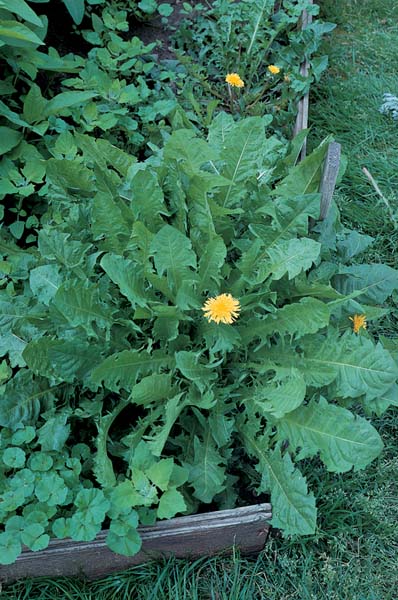
Dandelion gone wild. Here is a robust dandelion plant in late May with almost full sun. Very rapid growth in rich well-watered soil tempers the bitterness enough to be perfectly useful. Too bitter for me raw, unadorned, and eaten by itself, but it’s fine if managed well. It would be just a little less bitter and have fewer leaves if growing in the shade. Direct sunlight produces rapid growth and a greater number of leaves when adequate water is present.
As I’ve said, you are looking for rapid growth. The more rapid, the less bitter the greens, even in the summer. Rapid growth becomes even more important in the summer because you have longer days; and the sun is higher in the sky, causing more intense rays; and the roots are no longer sweet. Rich soil, abundant moisture, lack of competition, and shade are the most important factors for the leaf growth to keep pace with the production of bitters. Non-spring dandelion will always be bitter. Rapidly growing dandelion leaves will, however, be manageably bitter.
After spring, the sun is a double-edged sword. On the one hand, it becomes a potent source of the plant’s growth energy; on the other, it is a potent dryer of the available soil moisture. This drying out stresses the leaves during the day and is the source of the plant’s bitterness. So the indirect sun that a plant gets in the shade allows for the best summer dandelions, assuming other rapid growth factors are working to give you a thriving plant.
Soil and leaves dry out less when dandelion is growing in the shade. Whatever moisture is there can stay on the plant and in the soil instead of evaporating into the dry air. This protected moisture allows the leaves to grow more rapidly using only ambient light. Look for dandelions shaded by tall surrounding plants, rock features, topography, and other natural features.
Man-made settings for shade include buildings, fences, and other structures. Fences are sometimes the best unnatural locations because where there are fences, there are often landscape plants that are being watered or maintained. Dandelions getting this additional moisture can continue to thrive throughout all the growing seasons.
So how do you identify leaves undergoing rapid growth? Look for luxuriant growth where the leaves look so good they could be sold in the produce section of a supermarket. No marks, no insect damage—just beautiful-looking leaves. These leaves can be big, anywhere from three to eighteen inches long. Also check the habitat for signs that the area you are picking from is regularly moist.
Center leaves are younger and grow more rapidly then the outer leaves. Younger rapidly growing leaves are a bright green. Slower growing leaves or end size leaves tend to be a darker green.
You’ll find authors suggesting that you cover actively growing dandelion plants in your yard with large bowls to shield them from sunlight. Come back weeks later and you’ll have blanched (white) dandelion leaves growing beneath that are not bitter. You can also transplant large dandelion roots into the dirt in your cellar. Water these and they will produce white non-bitter leaves until the roots become depleted. If this is correct (I have not tried either technique), this proves that sunlight drives some sort of chemical pathway in the plant that produces bitterness. The lack of photosynthesis will also mean the lack of production of many nutrients and potentially beneficial phytochemicals.
If you have a yard, you can enjoy “manageable” bitterness throughout all the non-winter months if you can find or encourage dandelion in areas and conditions that promote rapid growth.
Dandelion Heart: The dandelion heart is a new concept I use to describe an edible part of the dandelion. It overlaps with and therefore replaces what people have called the root crown. According to Euell Gibbons in Stalking the Wild Asparagus, the root crown is “on the top of the root,” and reaching up to “where the leaves start getting green.”
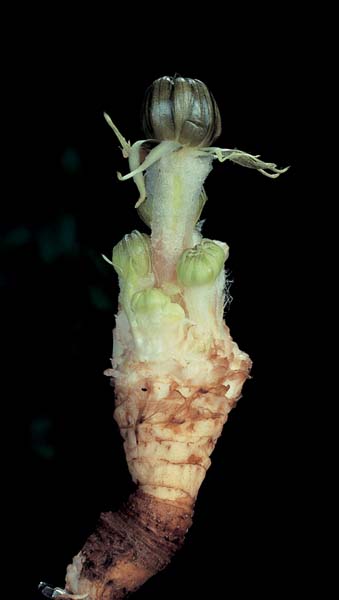
Dandelion heart. One or more dandelion hearts can emerge from a single dandelion root. This includes all emerging flower buds and the naked stem all the way down to the top of the root. The root starts at the very bottom of this photograph and is brown in color and fattened. All the leaves and long flower stalks (ones over an inch) have been peeled off.
I have always had misgivings about including leaf bases in the crown. In my experience, they have always been chewy, tough, and bitter. I find myself removing them, revealing the tender underlying stem. I call this the dandelion heart, sort of like an artichoke heart—where you have to peel off fibrous parts to reach the tender core.
In the past, you often saw recipes of the root crown battered and fried. Frying probably helped to tenderize the fibrous leaf bases. If you remove the leaf bases, the remaining stem with buds is tender, manageably bitter, and quite delicious if prepared properly.
Bud stems of four inches or less are typically tender enough to eat. Those longer tend to be fibrous anywhere below that upper four inches of stem. For easier handling, bud stems over an inch are too long to be considered part of the heart, so I remove them.
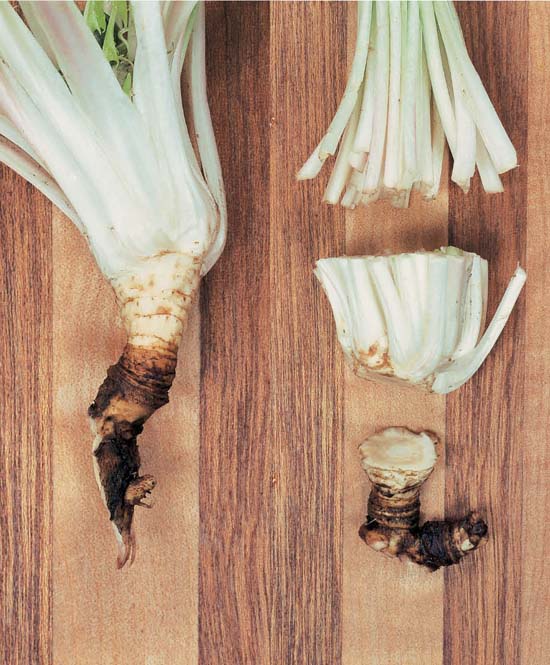
The Euell Gibbons version of a root crown. What I used to call the root crown (right center) was a smaller piece for cooking than Gibbons’ version. His root crown would have included much more of the leaf stems and more of the stem leading to the root. My smaller version allowed me to have a somewhat-uniform size when working with several crowns for cooking and presentation.
Buds, Flowers, and Stems: The buds are found on straw-like stalks that arise from the top of the dandelion stem. Collect the buds with the first three to four inches of their stalks. They are more tender and less bitter if you get them before the stalks have elongated. If you search down into the leaves of a dandelion plant, you can often find the emerging buds. In rapidly growing plants, there is very little bitter in the bud and its adjacent stem when that stem is still short. Below that first three to four inches, the stem is too fibrous to be worth your while.
The more mature the buds—that is, buds ready to open into flowers—the more bitter and powerful they become. By powerful I mean that overeating them can cause a headache; at least, they cause me to have a headache (perhaps I am unusual and you are different). So keep the number of mature buds down to ten at a time unless you are boiling them and pouring off the cooking water. This headache thing is true for me, even if I am eating them mixed with other foods. The bitterness is caused by the green bracts that surround the unopened flower. The flower petals tightly packed inside the bud do not contribute any bitterness.
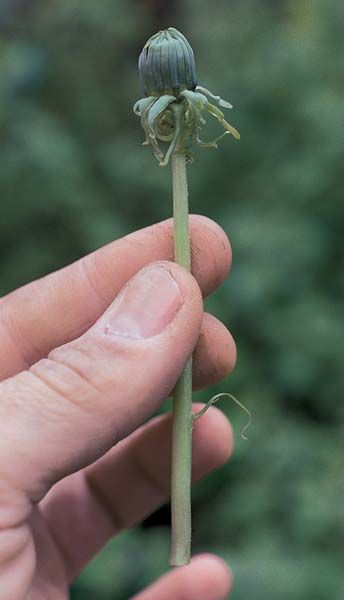
Dandelion flower bud with edible upper 4 inches of stalk. Before the bud stem elongates fully, this whole thing is edible.
Open dandelion flower heads are one of the great foods from this plant. They are decorative and flavorful. Arising from long stems, they open and close three times over three days. They are best if you can get them on the first day of opening but are still great on days two and three. The flowers—actually the flower petals—have the same headache issue for me as the buds if I eat more than twenty in one setting. Twenty is a lot of flower heads. Try not to eat more than ten at a time.
The straw-like stalks leading to the flowers are too fibrous to eat once its flower opens.
If you have some dandelion near your house (and who doesn’t?), you can increase the plant’s production of flowers, extend the flowering season, and prevent seed production. Just keep plucking the flowers and using them before each flower stem can go to seed. This stimulates the plant to keep producing flowers because it wants to reproduce and spread its seed. I tend to pluck the flower stem as close to the base of the plant as I can, in the hope that that will stimulate even more growth.
Seed Heads: One seed head is produced for every flower head. The seeds are found at the center of the puffball. The filamentous structure attached to the seeds and creating the fluff is called a pappus. The pappus is light and works like a parachute to catch air and help the seed fly to a distant location.
I have not heard of any food uses for the seed. But should a use turn up, I have come up with a way to gather it or any other similar seed and fluff. The problem with these seed heads is that by the time the seed is mature enough to be released, it floats away—making it difficult to gather. The solution? I took my trusty shop vac, strapped it to my back, hooked it to a long extension cord, and went hunting. The secret to this technique is to put a mesh filter at the end of the suction tube. The mesh traps the seed and pappus on the way in so it does not end up in the large cavity of the shop vac. The other secret is to have a long extension cord or portable power supply.
This collection technique can be used to collect the seed for some use or just to prevent more dandelion seed from spreading without killing the plants you are enjoying. Once collected, you would still have to separate the seed from the pappus.
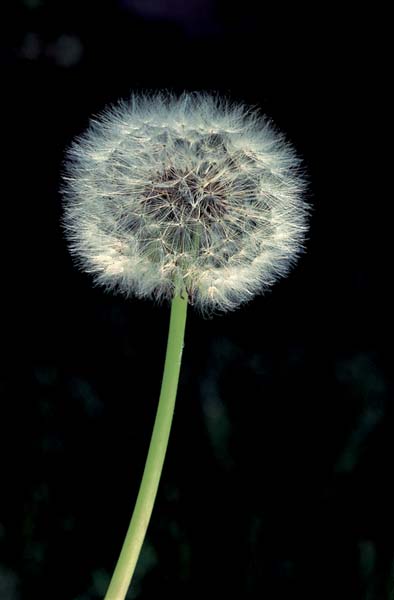
Dandelion seed head. Blow it away to wish for new plants to feed you. One seed head is produced for every flower head.

Dandelion seed head collector. A shop vac is strapped to my back and powered by a long extension cord. A red mesh material I taped to the end of the vacuum tube folds inwards about six inches to create a cavity for the seed to collect.
Roots: I have had little experience with the roots. I’ve eaten them and know others that have eaten them sporadically throughout the years, but I have not figured them out yet. The problem is that since dandelions are a perennial, you may be digging roots that are one year old or roots that are several years old.
Then there is the issue of rapidly growing conditions vs. slow-growing and highly competitive conditions. I’ve eaten roots that were potatoey in texture, and the bitterness was manageable. I’ve eaten others that were woody, and there was no way to remove the bitterness. I can only guess that the same principles involving bitterness in the leaves and other parts also apply to the roots. New roots are probably tender and old roots are not.
Harvesting and Serving Dandelion Leaves
Harvesting involves finding leaves that look great (like you would find them in the produce section) and selecting the center-most elevated leaves (those not touching the ground around the perimeter of the plant). These lower outer leaves are older, more bitter, tougher, and they have more dirt to clean off. The less dirt you bring with you, the less you have to clean.
Harvesting the leaves requires attention to two things: keeping the leaves fresh in transit and managing the milky juice that will bleed from the cuts. To keep the leaves fresh, gently pull together the ones you want and use a pair of scissors to cut them within a couple of inches of the base. Take this bunch and carefully aim them, cut stems first, into your collecting bag. This keeps all that milky juice in one corner of the bag so it does not stain the leaves. Spray-mist these leaves and move to the next plant. Keep the bag in the shade if at all possible. Repeat this technique from plant to plant until you have all the leaves you want. As long as the root is left in the ground, harvested plants will grow all new leaves for a later culling.
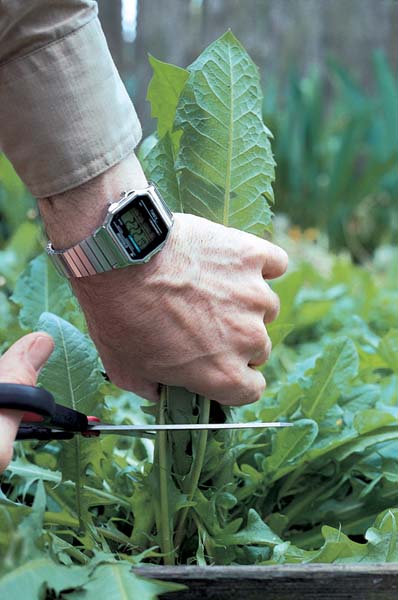
Harvest from the center of a rosette of dandelion leaves. Those leaves will be the most tender, the fastest growing, and the youngest of all the leaves.
Once you get the leaves into your kitchen, wash and crisp them. This involves soaking them in cold water for about five or ten minutes and then draining them. The leaves are now ready to use fresh, to cook with some dish, or to store in the fridge. For storing, put them in a clear plastic bag. They will keep in the fridge for a week, but try to use them while they are still fresh.
Before you decide on any particular recipe, taste them first so you don’t go through the work of making some elaborate dish, only to find out that the leaves are too bitter for normal humans to eat. If the dandelion you have is truly not bitter, you can use it in any dish from any cookbook that requires lettuce, spinach, endive, or broccoli. Just estimate an equivalent mass of dandelion to whatever you are replacing. Or better yet, experiment using dandelion in dishes you typically make for yourself—omelets, salads, lasagna, etc. If they are normally bitter, you’ll have to manage that bitterness.
One issue that is annoying to some is the fibrousness or chewiness of the lower leaf stem on larger leaves. Just before you are ready to use dandelion leaves, lay a stack of them together and chop off the lower third of the leaves. Either put that third in the compost or chop them into tiny pieces and include that in the dish you’re making. If you compost this part, you are not losing much of the leaf—this third of its length includes very little of the leaf blade. Smaller and younger leaves are not as much of a problem.
Managing bitterness
Many people today want to eat fresh raw foods. In order for that to work with dandelion, you either have to love their bitterness, or you must work it into other foods that can dilute the bitterness. The ideal mix is when the dandelion you include adds character to the dish rather than overpowers it with bitterness. If you have selected your leaves well, here are some general recommendations:
A lettuce-style salad with somewhere between a third to a tenth part of dandelion greens is a good mix. Try a fifth first; you can always add more dandelion. Don’t just add the whole leaves, chiffonade them into narrow ribbons so that any one forkful will not have a large bitter leaf to contend with. Unless you really love bitterness, you want to spread these greens throughout the mix. As explained in detail in the introduction to this section, oil and additional flavors that add sour, sweet, salt, and umami will help temper the bitterness.
Fresh narrow dandelion leaf ribbons can be added to fruit, fish, bean, or ethnic salads as well as vegetable medleys, sprouted grain medleys, cold soups—you are only limited by your imagination.
Cooking the leaves
There are three basic cooking methods that I will talk about here: boiling, steaming, and sautéing. These were selected because experience with them will give you a basis to move on to other options.
For all three of these techniques, I like to chop the leaves into one- to two-inch-long pieces. This allows them to move easily in and out of pans and to move freely in water. Do not chop them until just before cooking. Chopping them too early will result in the milky juice that bleeds from them, drying and staining the cut ends.
Boiled: This is the best method for removing most of the bitterness. If the greens you’ve gathered are good, it takes anywhere from four to eight minutes for them to go from strongly bitter to not being bitter at all. But do not depend on that time! Taste the greens at four minutes, six minutes, eight minutes, ten minutes. If they are good for you before eight minutes, take them out. They may take longer than eight minutes. Bitterness is somewhat unpredictable.
The bonus of boiling is that dandelions have a fantastic underlying flavor that is masked by the bitterness. By lowering the bitterness, you reveal more flavors. The greens are now ready to be eaten just as greens or added to any dish requiring greens. Unless you’ve done a poor job of selecting the plants you gathered, you do not have to boil the greens in two or three changes of water, as some of the wild food literature suggests.
When I say boiling for eight minutes, the proper timing technique is to start the water boiling before adding the greens. This gives you a full eight minutes of boiling without a variable/unpredictable warming-up time. It is also important to use a large pot with plenty of water. For boiling to work properly, the greens need to move freely around in the water. If there is only a small amount of water, the bitterness has nowhere to go. To save energy, put a lid on the pot while warming the water. Once the greens are added, remove the lid so any volatile bitters can evaporate away.
The cooking water makes a fine broth for soups and stews.
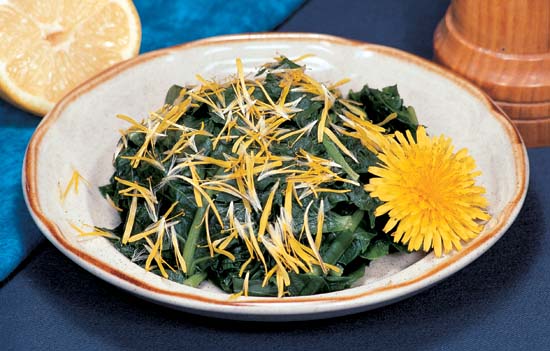
Dandelion Greens. Boiled for 8 minutes, drizzled with extra virgin olive oil and a spritz of lemon, sprinkled with a touch of salt and dandelion flower petals, and garnished with a dandelion flower.
Sautéed: By itself, sautéing provides only a small degree of relief from bitterness before the greens get overcooked. But if you mix them with other foods during the cooking process, there is a much better result. Folding them into a still-cooking stir-fry works surprisingly well. Sautéing them with caramelized onions and mushrooms before adding egg makes a marvelous omelet. Stir-frying them with non-leafy vegetables works great. Add enough dandelion to suit your own tastes.
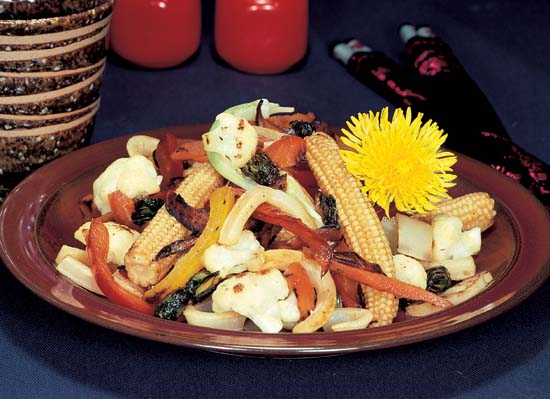
Vegetable Stir-fry. Any stir-fry can include chopped dandelions. This one is garnished with a dandelion flower.
Steamed: The process of steaming dandelion has never really worked for me because it seems to trap most of the bitterness. I encourage those of you who are fans of steaming to experiment. Perhaps you will have more success then I did.
Harvesting and Preparing Dandelion Heart
Harvesting the dandelion heart will put a temporary damper on the production of leaves for a dandelion root. It will take time for the plant to recover and form a new stem, the benefit being that you can have a lawn clear of dandelions for a few weeks! Before harvesting the dandelion heart, consider collecting the upper leaves first, using the techniques discussed earlier. Harvesting the upper leaves from all the plants before going after the dandelion heart will help keep those leaves clean.
To harvest dandelion heart, grab all the remaining aboveground leaves that you can, pulling them upward as if to stretch the plant, and cut the root just below the ground. Lift out the heart. Cut off the still-attached leaves and long flower stems, leaving their bases still attached to the heart. As soon as possible, soak the heart in water, which washes away the milky juice and helps soften any attached dirt. Don’t let it soak more than fifteen minutes before refrigerating it or moving on to the next cleaning phase.
To clean, work on only one stem at a time. Pull off any remaining leaf bases and flowering stems over an inch long. Use a soft brush to remove any dirt. Once clean, place it in a bowl of clean cold water and start on the next one. Continue until you are done. Doing these one by one allows the stem to hit the water soon after the leaf bases have been torn off and before browning can occur. Once cleaned, dandelion hearts are ready for eating raw, boiled, sautéed, or baked.
Raw: Serving dandelion heart this way is not very pleasant if this is all you are snacking on. The milky juice and bitterness will result in a bitter sticky feeling in the mouth. Raw dandelion is fine if you mix it in with other foods. To do so, slice it into thin pieces directly into cold water to slow browning. After about five minutes, those slices can be sprinkled onto any food.
Boiled: This is a good solution. Once boiled, they can be used in any dish as a vegetable. Use the same technique here as for the leaves.
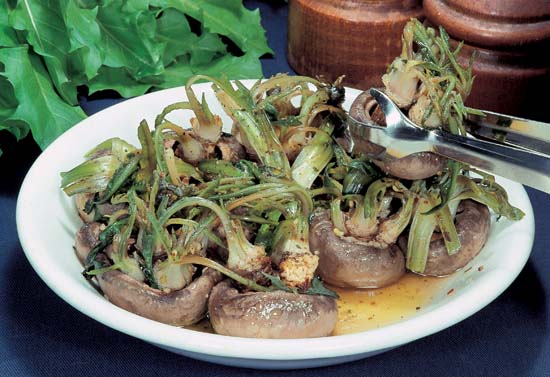
Mushrooms Stuffed with Dandelion Hearts. Baked, drizzled in rosemary-marinated extra virgin olive oil, and sprinkled with salt and pepper to taste. Boiling the hearts and mushrooms separately for 5 minutes prior to baking will reduce bitterness and moisten the mushrooms. Once assembled, oiled, and spiced, stuffed mushrooms can be steamed instead of baked for a different result.
Sautéed: This process works better with the heart than with the leaves. If the stems are thick, slice them lengthwise just before cooking so they will cook evenly. Always sample for bitterness as cooking progresses.
Baked: You can also bake the stems, which will not remove much of the bitterness. Make sure you cook them with other foods that will neutralize some of that bitterness. Always sample before and during the cooking process to determine when the stems are tasty and cooked to perfection.
Harvesting and Preparing Buds, Flowers, and Stems
Flowers can be plucked directly from the plant to garnish dishes or to add to sandwiches. If you want to eat them fresh, I suggest separating the petals from green bracts supporting them. Independent of the bracts, the petals are dry but sweet to the taste. The bracts are bitter.
If it will be a while before you use the buds or flowers gathered, take your scissors and cut the stem down to about ten inches. Or if stems are shorter than ten inches, cut them as long as you can. Immediately put these in cold water, just as you would put flowers in a vase. Spray-mist liberally and keep them in the shade. You might have to change the water they are sitting in if it gets too cloudy from all the milky juice. Try to use them within three hours; they will last longer then that, but their quality will deteriorate with time.
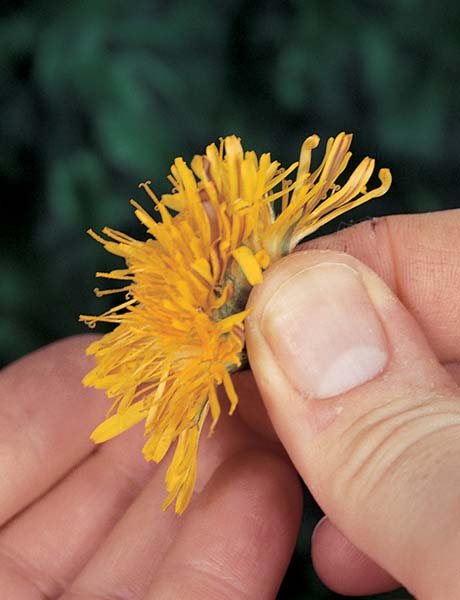
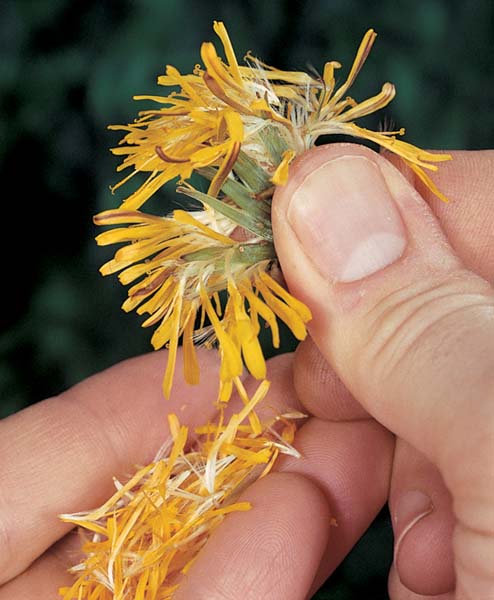
Separating the sweet petals from the bitter green bracts. Squeeze the bract area with force while twisting. After a little practice, the petals should release and fall into your hand.
When ready to use, clip the buds and flowers from their stems and add them to your dishes. Remember that you can leave three to four inches of stem on the younger buds if that suits your needs.
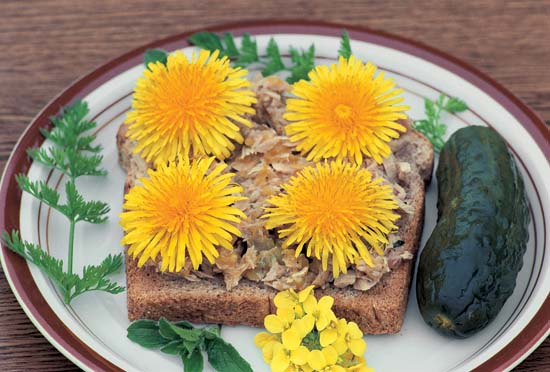
Tuna Fish Sandwich. Served with whole dandelion flowers, garnished with a pickle on the side for tartness and with wild carrot leaves (Daucus carota) and field mustard flowers. Eat as an open-faced sandwich or topped with another slice of toast.
The buds are delicate and can fall apart if processed too much. They can be pickled like capers, mixed in raw with other foods, or cooked like the leaves. You do not want to eat more than ten or so at a single sitting unless they are really young—by young I mean early in their development, not growing on stalks more than six inches long.
The flower petals are very flavorful. Once boiled, their flavor transforms from a sweet dry flower to a wonderful green leafy flavor. To make dandelion flower petal soup, use five to eight heads worth of petals for every cup of soup, boil for a couple of minutes, add salt to taste, and enjoy.
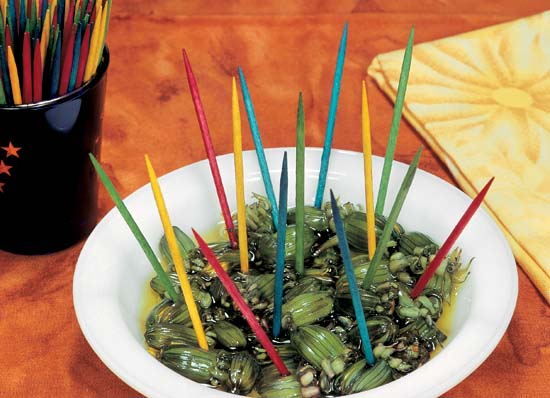
Raw dandelion buds, soaking in extra virgin olive oil marinated with rosemary and salt. Buds prepared in this way can be used as appetizers. Young buds are not bitter. Older buds add a predictable bite to the taste.

The mature flower stalks also make great straws for cool summer drinks. (Portrait of Kris Freitag, 2001.)
Other things can be made from dandelion flowers, including wine, syrup, and dandy burgers. (Gail, 1994; Strauss, 1997.) You are only limited by your imagination.
Dandelions are one of the most common and versatile greens you will find. Different parts of them are available most of the year under the right conditions. Their bitterness, once managed, allows them to be enjoyed in a wide variety of dishes.
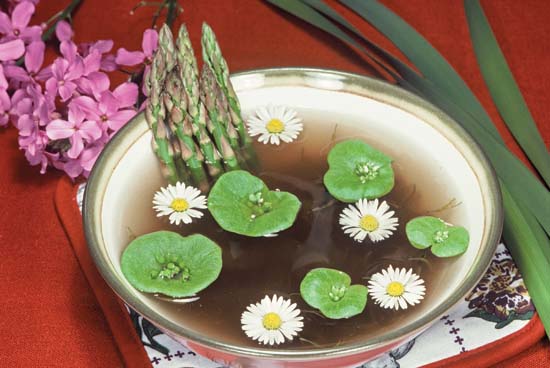
Pond Lily Soup. Made with dandelion flower petals as its flavor base. Use 5 to 10 heads’ worth of petals for each cup of soup—depending on how thick you like the broth. English daisy flowers (Bellis perennis) and miner’s lettuce (Claytonia perfoliata) leaves simulate pond lilies as they float atop the soup. The asparagus was the thin kind found in the supermarket. The broth temperature has to be at or below 120 degrees F for this to work. So make the soup, then let it cool down before adding the floating flowers and leaves. If it is too hot, the floaters will wilt, making this swamp soup—just as tasty but not as attractive.