Crafting a Wild Paradise
Let’s face it. Many of us just want to go out and gather wild food. It’s a simple and uncomplicated idea. We gather because we thirst for the quest, the journey, the adventure, and we thrive on the finding, gathering, and eating. But, in addition to the quest, wouldn’t it be great to have some of your favorite wild foods at whim, within reach, to have them more regularly and in abundance?
Many of us who have more feral yards and neighborhoods are lucky enough to have lots of wild foods nearby. I might have pokeweed and miner’s lettuce. A neighbor has a huge patch of chickweed. Down the street are massive amounts of wild spinach. Not everyone is so fortunate. Many people live in highly manicured areas—places where perfectly coiffed grass is exactingly trimmed along the sidewalks, and nary a weed is found under sculptured shrubbery.
To overcome society’s inclination for order, one might engage in mischievousness by fostering desirable weeds. Yes, you heard me—promote weed growth in your own yard. There are two ways of doing this. Both require some effort each year.
The first, a Wild Garden, is simple and provides bountiful results—great for an annual taking of plants. The second, a Wild Landscape, provides more variety, greater quantity, and better quality over a longer period of time. The wild landscape is a long-term approach—more work up front, but more long-lasting benefits.
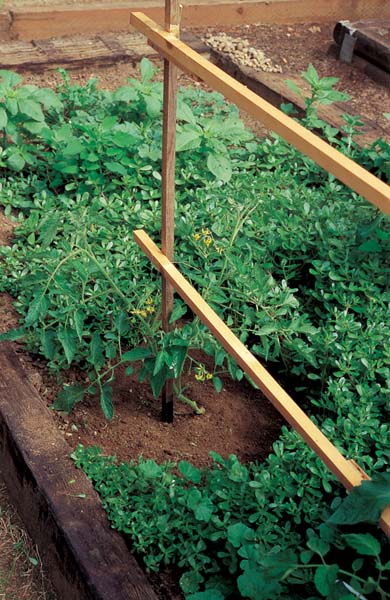
A tomato plant surrounded by edible weeds. The weeds closest to the tomato plant that would compete with it have been harvested. To prevent the soil from drying out, it’s a good idea to mulch the base of the plant where the earth has been exposed.
The Wild Garden
A wild garden is just that: a garden you manage differently from everyone else. Instead of grimacing, you cheer with joy as weed seedlings begin to sprout. Let’s examine how this works.
As you would in a regular garden, turn over the soil in spring as soon as it is workable. Mix in compost and whatever other soil amendments you typically use. Plant tomatoes, peas, and peppers. Water generously, regularly, and wait for the magic to happen. Soon you will see thousands of seedlings begin to sprout. With the help of this book, you will begin to recognize some of the seedlings of the weeds you want to keep. Pull or pinch off all the rest. In many situations, grass may be your biggest foe—always pull out any grass you see. If you do not recognize some seedlings, let a few continue to grow and study them over time, recording the progress with a camera. Let some of the unknowns grow to maturity if that is what it takes for you to identify them. Once you know what you have, pull the undesirables and never let them go to seed.
The fast-growing leaves of young plants are often considered the choicest. So, as your weeds are growing gatherable leaves and stems, thin them and eat the thinnings—assuming, of course, that you know which ones are edible. Gourmets would consider these baby greens. Your take can be quite substantial. Make salads, cook them, use them any way you want. The thinning process allows the remaining weeds to flourish due to less competition. You’ll see examples of these edible weeds at their prime for collecting as you read through the plant chapters of this book.
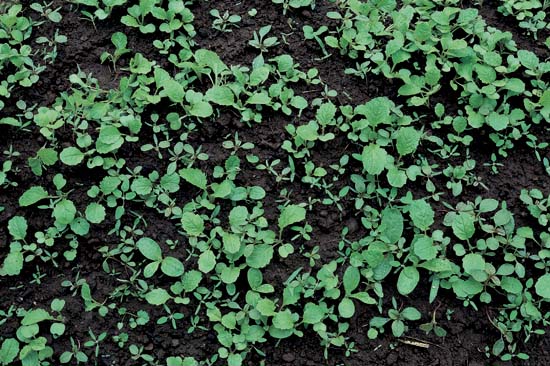
Weed sprouts emerging from a late spring garden. Plants in this picture include wild spinach, green amaranth, wild mustard, borage, and mallow.
At the same time you are thinning in general, selectively harvest the weeds around the base of your domesticated plants. Harvest from the base outward. When your tomatoes are two feet tall, you should have harvested everything within about six inches of their bases. Cover that now-barren ground with mulch. When the tomatoes are three feet tall, you should have harvested everything within a foot of the base. These are rough amounts; someday someone will do a study to calculate exactly how much space to allow. In the meantime, try what I have suggested; you will get the hang of it. Your goal is to grow as much weed as you can without choking out the domestic plants. Just like the weeds, your tomato plants will do better with plenty of soil nutrition, water, and sunlight.
If you plant your domestics close together, your gradual weed-harvesting process will result in whole patches of the garden being weedless. This is fine—continue to mulch those areas if you want. It is better for the soil creatures and your domestic plants to have mulch. Take care not to harvest all the weeds. For year-to-year sustainable yields of edible weeds, you need to let a few of them go to seed. Once the seeds begin to drop, aid the process by spreading them throughout the garden. When you turn the soil the next spring, the seeds will get mixed into different depths. The ones near the surface will germinate when the conditions are right again.
The fully wild garden
You can, of course, take this all a step further and create a fully wild garden, planting no cultivars at all. I find I now prefer this type of garden since I do not really have great gardening skills or the time to develop them. Plus, I want more wild food. Accomplishing this requires turning over the soil at least once, often twice, or even three times a year and watering as if you had domesticated plants to nurture. I prefer adding soil amendments like organic compost, minerals, and lime so that the weeds will really perform. As you will see throughout this book, some of our prime annual weeds will grow to sizes you can only imagine. This produces better-quality food over a much longer season in much greater quantities.
Some people love weeds because of their legendary tenaciousness. They believe that weeds are strong, vital, and stubborn, and will grow regardless of your neglect. These people are correct, sort of. Refuse to water or nourish the soil in your garden, particularly after continual harvests that deplete the soil, and the weeds will be happy to show you how strong, stubborn, tiny, stringy, fibrous, leafless, and generally useless as a food they can get. Starving them gives you starved plants. They will mature rapidly into tiny beings and be past their prime (if you can call it a prime) in the blink of an eye. If nature provides you with enough rain, then you can just sit by and watch. But without some soil amendments over time, you will deplete your soil and the wild foods will be much less productive.
To keep my annual weeds thriving year after year, I remove the debris of old stems and branches in the autumn and turn over selective parts of the garden before winter arrives. This allows the weed seeds to wait in the soil under ideal conditions for the next growing season. Some sprout in the fall but stay small and relatively dormant until they can explode with growth in the spring. Others, the biennials, develop their roots so that they can finish out their life in the second year. Where the biennials have started, I do not turn over the soil. Perennials that have sprouted in convenient corners of the garden are left undisturbed so they can continue to produce for me year after year.
After some of my early spring plants have spent themselves, I turn over part of the garden again to stimulate a new set of seeds into germination for a whole new crop of young plants.
Here are some basic considerations for keeping the garden productive. They are not much different from things a domesticated garden needs:
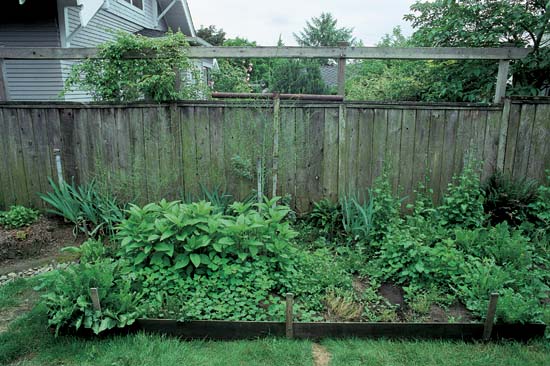
Part of my 2006 wild garden. Other than some perennial asparagus, French sorrel, and irises along the fence, this is all wild. Plants in this image include pokeweed, wild spinach, wild mustard, dandelion, mallow, nipplewort, and sheep sorrel.
Water supply: If you do not water regularly, your plants will not produce as much as they could. They will be small and short-lived with sparse leafage.
Soil amendments: If you do not enrich the soil, the depleted ground will starve the weeds over time, causing them to be small and unproductive. They will still grow and survive, but not enough to feed you. Harvesting weeds depletes the soil just as harvesting domesticated plants does.
Thinning: If you do not harvest (thin out excess plants) regularly, the weeds will compete with each other, and you will not like the results. Either they will be short and stunted or they will bolt into tall stringy plants with fewer leaves. Having to keep up with the growth of your weeds can be fun because you get all this fresh food in rapid succession. Often you will have to freeze, can, or dry some of it because it will be just too much to eat. With the wrong attitude, keeping up with rapid growth may become a chore. But if you really love eating wild foods, and you want your garden to be the most productive it can be, you will have to can, freeze, or dry some of it. If you don’t, the plants will go past their prime, and you will have lost the good stuff. If you are willing to do some of the basic things listed here, you will harvest more choice wild food than you could have imagined.
Even with successful crops of wild foods, you will find that some weeds will not be able to keep up with your insatiable hunger for them. If this is the case, try to go with the flow and take what your garden gives you. If you still want more, then go ahead and turn more of your yard into garden space and/or go foraging in your neighborhood.
Introducing wild seed into your garden or yard
There are many times over the years that I have wanted to expand the diversity of wild edible plants growing in my garden. Every time I move to a new home and landscape, I take the first year to assess which edible weeds are already in the soil. I decide which of my favorite plants are missing. Then I go on a quest in search of those plants. When I find them, I assess their form. Since each wild plant is an individual genetically, each can vary in how it grows. For example, a tall-stemmed wild spinach plant with few leaves will most likely produce the same kind of stemmed children. A plant crowded with large leaves will produce offspring that grow into plants crowded with large leaves. I wait till that preferred plant is going to seed, uproot it, and randomly spread the seed where I want it to grow. I’ve even transplanted immature plants into my backyard so they would eventually spread their seed where I wanted it.
If you are not careful, you will introduce bad seed (producing weeds with poor form) into your garden, and then you are stuck with its children for years.
The Wild Landscape
Landscaping is different from gardening. A landscape is more permanent than a garden and contains more perennials. It is usually located in areas around the perimeter of your yard, along sidewalks, and wherever grass is not intended.
Wild landscaping is what I have done around my house in addition to my wild garden. I did not go to the extent of replacing all the grass, but I did use the borders of the yard to foster a variety of mostly perennial wild foods. Anywhere that was available, I either let preexisting wild foods take over or brought in ones I wanted. Among others, I’ve introduced common blue violet (Viola sororia), sweet violet (Viola odorata), and miner’s lettuce (Claytonia perfoliata). All three are doing well and carpeting certain areas. Pokeweed (Phytolacca americana), tawny daylily (Hemerocallis fulva), and lady fern (Athyrium filix-femina) were already here.
“Edible landscaping” is the practice of planting food-producing trees, shrubs, vines, and perennial herbs on your land as opposed to or in addition to nonedibles. So, beyond just wild food perennials, consider planting fruit trees, nut trees, and spice bushes. You can get a huge amount of food from your own yard over time.
Edible landscaping is more productive if you are disciplined. It is just as much work as conventionally landscaping your yard if you want tight control over its look and productivity. If you do not care how wild it looks, it is a lot less work.
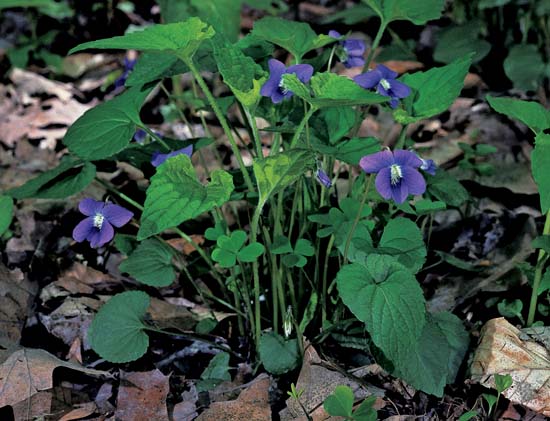
Eastern Blue Violet (Viola Sororia). This edible plant makes an excellent ground cover.
Care must be taken to understand and replicate the growing conditions for some of the more finicky annuals like miner’s lettuce (Claytonia perfoliata) and chickweed (Stellaria media). Certain plants require very soft soil, others like hard soil, and still others grow no matter where they are. Certain ones thrive in full sun, others despise it, and others adapt to whatever they get. You may have to transplant some wild edibles, soil and all, in order to get them established.
Ideal growing conditions for a plant may not be ideal growing conditions for harvesting and eating. You have to plan for this when deciding what plants should go where. While dandelion (Taraxacum officinale), a perennial, can grow in highly shaded to full-sun conditions, it is better for eating and harvesting if it is growing in well-shaded, well-watered areas. Full sun and dry soil make dandelions intolerable to eat for most of the year.
If you are diligent in the first few years of setting up your landscape, you will reach a point where there is less and less maintenance. The weeds you want will thrive; the weeds you don’t want will eventually have no seed left in the soil to grow. After a few years, I’m getting to the point now that whole areas of my yard are covered with only the plants I want. I can harvest at will from sustainable areas during their prime harvesting seasons.
There are edible weeds you may not want to allow in your yard or garden. Green amaranth (Amaranthus retroflexus), for instance, seems to outcompete all other weeds. Its roots are massive and spreading. It will choke out other weeds you want to thrive. Other examples of problem plants are mint (wild and domesticated varieties), henbit (Lamium purpureum), and Japanese knotweed (Polygonum cuspidatum). They spread underground and can stubbornly take over whole areas. Of course, you may actually want some plants to take over your yard.
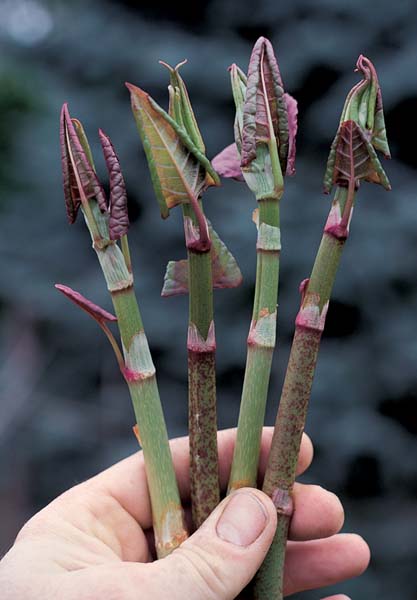
Japanese knotweed shoots (Polygonum cuspidatum). While delicious, this plant can spread out of control.