Feeding Yourself and Society
One day I was out on a u-pick farm, gathering cultivated marionberries. Surrounding the trellises that supported these plants were thousands and thousands of wild foods—mostly goosefoot and amaranth plants. There were rows and rows of them, vigorously growing anywhere the beds received water. In a few minutes, I had collected a bushel of the greens. As I was paying for the berries, I asked if there was any charge for the weeds I had gathered. After a perplexed look and sizing me up with some seriousness, she declared, “no charge.” When she realized that I was not an escapee from an asylum and learned how I was going to use them, her expression changed. She said that I was more than welcome to take as much as I wanted. “Come back soon,” she pleaded. “Take more!”
Another time I was on my friends’ organic vegetable farm. Their intended crops, as usual, were invaded extensively by wild spinach, amaranth, sheep sorrel, and field mustard. Volume-wise, there were much more of these weeds then there were the lettuce and spinach they had planted. As usual, I gathered a bunch for my own use.
This story is repeated every time I visit a farm. Gobs of wild edibles all over the place. Every farm in the world has to contend with these plants. Farmers spend great amounts of time and resources trying to kill them. Whether mechanical (pulling or machining under) or chemical (herbicides), these behaviors are expensive, burning fossil fuels and polluting the soil and groundwater.
There is a huge resource here—lots of lushly growing free food waiting to be harvested alongside the intended crops. The question is, what can we do about it? Is there a way to rid the farmer of a problem and help ourselves and others in the process? Can something be done on a large scale?
I’d like to propose several holistic approaches to combating the problem. These approaches will work only if the farm is organic and allows some proportion of their beds to be hand-weeded.
Feed Yourself—Help the Farmer
Fresh edible weeds can be collected by individuals for their own use. Setting up this arrangement requires developing a relationship with a farmer. One cannot just trespass, thinking that since they are doing a good deed (pulling weeds) that it is okay to invade someone else’s property unannounced. The individual will probably be allowed in the fields when others are either doing the same thing or when paid staff are pulling weeds. As a result of this book, and if there are enough people interested in this activity, clubs might form for just such a purpose and perhaps sponsor wild food dinners and other events from the foods collected.
In order for this to work, the farm would have to be open to coordinating days when outsiders can go into the fields—supervised or unsupervised. There would also have to be some sort of training mechanism to ensure that harvesters know the plants they are gathering, how to tell them from look-alikes, and how to work around the beds so that they do not damage them or any intended crops. Training could be done by farmers, the USDA’s Cooperative Extension Service, Master Gardener programs, or local wild food clubs.
In the process of making it possible for organic farmers to succeed, what follows are some of the benefits of wild foods for farmers and the society in general.
Farmers—Turn a Liability into an Asset
Edible weeds compete with farmland crops. Since the plants covered in this book are wonderful contributors of flavors and nutrients, why not create a new market? These are, after all, now considered exotic foods. I’ve seen fine restaurants tout dishes that include wild foods. Wild mushrooms are most commonly used, but more and more “exotic” and “wild” greens are being offered—often at premium prices.
Creating new markets would accomplish many things. Harvesting wild foods would provide the following:
-
Another tool would be added to the arsenal of integrated weed management. Many weeds would transform from a liability to an asset.
-
A more diversified crop portfolio would be available; both planted crops and weeds would be sold, increasing the variety of offerings and decreasing dependence on just a few plants. If certain crops failed, others would survive, particularly hardy weeds.
-
The farmer would benefit financially. The expense of hand-weeding would be offset by the income of harvested culinary weeds. Each plot could be harvested several times, bringing in additional income. Less money would be spent on killing or removing weeds.
-
More farmhands could find work and spend their money to help stimulate our economy. The profits produced by selling the wild foods would cover payrolls and bring additional income to the farm.
-
The population would benefit from an increase in the diversity of food supply. This would be true from both culinary and nutritional standpoints.
-
Harvesting edible weeds would be good for the environment; there would be no need for herbicides that leach into the groundwater, remain as residue on plants, or affect farmworkers.
One strategic option that farmers could choose is to dedicate whole plots and farms to wild foods. This would be less complicated overall—easier to manage, easier to monitor, easier to harvest, etc. Weeds are often more disease-resistant and require less care. Weeds are often hearty and can survive unexpected conditions that would cause many “conventional” crop plants to die.
Marketing Wild Foods to the Public
The difficulties in introducing new foods to the public should not be understated. Developing venues for new products takes sophisticated marketing, education, support, and follow-through. You cannot just introduce new foods (okay, these are old foods being reintroduced as new) and expect them to fly off the shelves. Underdeveloped introduction of these foods into the market would result in financial strain for the people attempting it.
For introduction of a wild edible to be successful, the public has to be made aware that these new “desirable” foods exist, of the general health benefits of increasing the diversity of vegetables in the diet, and of any known nutrient data. Consumers need to know how these foods can be used in conventional ways, of the great flavor possibilities, and they need to be intrigued enough to start experimenting with them.
Expectations must be positive, first experiences must be delightful (or at least comparable to conventional foods), consumers must be given access to easy starter recipes, and so on. Unless there is a grassroots movement driving the market, making wild foods a mainstream reality will require substantial up-front investments. I hope that this book will provide a user-friendly educational guide to help support at least some of this process.
In addition to consumer awareness, the management of these plants from germination to presentation in the marketplace needs to be worked out. Growth characteristics, optimal harvest times, mass-scale harvesting techniques, packing, transporting, shelf life, and shelf presentation all need to be established through testing and experience.
That being said, there is tremendous potential for many of the wild foods discussed in this book to become mainstream foods if managed properly.
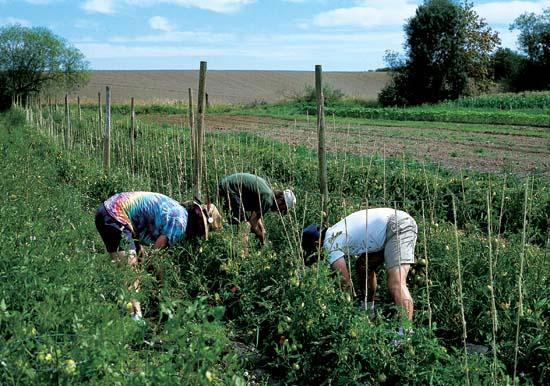
Farmhands weeding around tomato plants. Gleaners could harvest weeds from around cultivated plants to be used for a variety of food-related purposes.
Humanitarian Organizations—Fresh Food for the Poor
There are nonprofit groups that employ gleaners, who spread out over cropland that has already been harvested to collect any plants (broccoli, carrots, cabbage) that were missed or rejected for market. These foods are then delivered directly to the poor, given to humanitarian organizations, or served fresh or cooked in soup kitchens that serve the poor and homeless.
Gleaning for the remnants of a cultivated crop is limited to postharvest. For instance, gleaners have to wait until the cabbage has been harvested before they can go in to pick the leftover cabbage heads. Most leftovers are perfectly edible, just damaged or otherwise unattractive, and would not sell very well on the open market.
In contrast, wild food gleaners have the advantage of being able to harvest wild foods at their prime all season long. Wild foods grow in beds anytime the soil is turned and watered. Within weeks after any planting, a new crop of wild foods would be available. There are always weeds to pick.
For this to work, gleaners would have to be trained in the details of harvesting, packaging, and transporting these new foods. Food preparers would need to be trained in how to make best use of the plant matter they receive.
Wild foods represent a huge untapped resource that could, under the right circumstances, improve the food options of consumers, help the farmer, and improve the condition of many underprivileged people.