Wild Spinach
Wild spinach gives domesticated spinach a run for its money
Family: Chenopodiaceae
Species: Chenopodium album
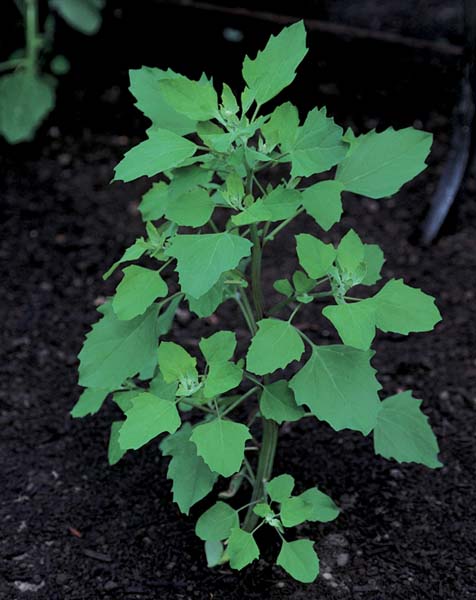
A rapidly growing wild spinach plant at about 12 inches tall in rich soil. This is a young plant prior to bud or flower formation.
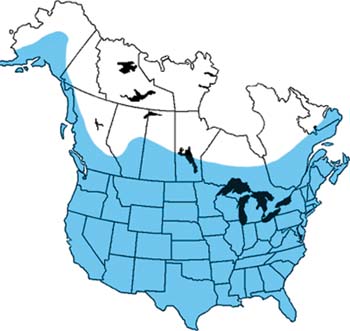
Estimated Range
Official Species Name:
Chenopodium album L.
Can be confused with and interbred with
Chenopodium berlandieri Moq.
Common Names:
Wild spinach
Lambsquarters
Goosefoot
Fat hen
Pigweed
Huauzontle, Quelite, Bledo
Quelite cenizo
Herbaceous weed naturalized from Europe. Widespread and abundant in North America where humans have invaded and where soil has been disturbed.
Edible Parts:
Growing tips of leafy stems
Leaves
Bud Clusters
Seeds
I prefer to call this plant wild spinach rather than lambsquarters, even though lambsquarters is a more commonly used name. I am not trying to create confusion by calling it wild spinach; rather, I am trying to give this plant the food-related name recognition it deserves.
North America was primarily an agricultural society a hundred years ago. So terms like lambsquarters, fat hen, and pigweed had a little more meaning to the everyday person. The number of people working on farms these days is only a small part of the population, so the old plant names retain little meaning.
What do the terms lambsquarters, fat hen, and pigweed all have in common? Farm animals. The impression one gets from these names is that this plant was well known for its ability to fatten up livestock. Farmers today use more systematically efficient ways to feed farm animals than bringing them wild plants. Even free-range animals may be systematically fed or not allowed to graze on wild plants.
To modern wild food enthusiasts, the name “pigweed” is more commonly used to refer to green amaranth (Amaranthus retroflexus) than to wild spinach. But, according to old-timers in a study I did in the 1980s, many different plants fed to pigs were called pigweed. Since the term pigweed can refer to more than one plant, it makes it a poor name.
So why “wild spinach”? Everyone in modern society knows what spinach is, and they know it is good for you. Spinach is a cousin of wild spinach. And while their flavors are different, young wild spinach flavor gives a hint of spinach. Most importantly, you could substitute wild spinach in any cooked recipe for domesticated spinach and, flavor-wise, few would notice the difference.
Wild spinach is one of the most nutritious leafy greens ever analyzed, beating out domestic spinach in fiber, beta-carotene (vitamin A), vitamin C, riboflavin, calcium, zinc, copper, and manganese. Domesticated spinach wins in omega-3s, folic acid, and iron. So both are exceptional foods and worthy of being part of a nutritious diet.
According to one study (Bianco, 1998), wild spinach’s potassium (K) is as high as 1,286mg/100 grams. That is two to four times higher than spinach, Swiss chard, and broccoli—all good sources. The study also found its magnesium at 117mg/100 grams of fresh material. That is higher than beet greens, which are also an excellent source of magnesium. Wild spinach is also a rich source of lutein and other carotinoids (Raju, 2007).
But nutrient data varies from study to study, particularly for plants growing in variable soils. A study by USDA (Release 18) says wild spinach has a third as much potassium and magnesium as the above study—still respectable amounts, but less. So don’t memorize these amounts; they are just here to give you the mind-set that this food is very good for you. Wild spinach is a great food and deserves to be in a complex diet complete with other great foods.
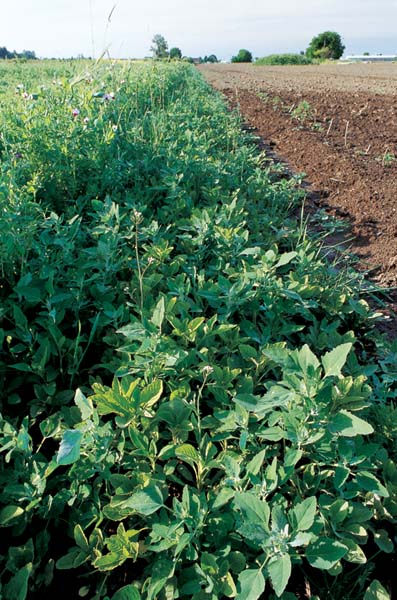
Wild spinach and green amaranth (Amaranthus retroflexus) dominating a planting bed on moist fertile farmland. As is common, the wild seed is already in the soil. It just needs to be tilled and watered to grow. None of these wild seeds were introduced by the farmer. They took over a bed planted with some intended crop that never survived the competition from our vigorous wild friends.
The phytochemical and antioxidant potential of this plant have yet to be investigated in depth or in any organized fashion. And even though this plant contains soluble oxalates like cultivated spinach, its widespread use in North America would be a great addition to the array of vegetables we eat. Widespread use already occurs in other parts of the globe.
Wild spinach contains a considerable amount of oxalic acid. Oxalates tend to bind with calcium and other minerals, making them partially unavailable. But in spite of that, wild spinach is still a nutritional powerhouse. Oxalates are not a problem for normal healthy people eating a good diverse diet.
Wild spinach has tremendous potential—as a wild food and as a new crop plant. It already grows with little effort on farmland and on any disturbed soil. Of all the foundational greens covered in this book, wild spinach may be the one most easily adapted by people who have not eaten wild foods before. It is delicious and abundant, produces lots of seeds for next year’s growth, is easily harvested, and requires no special preparation to fit into any conventional greens recipe.
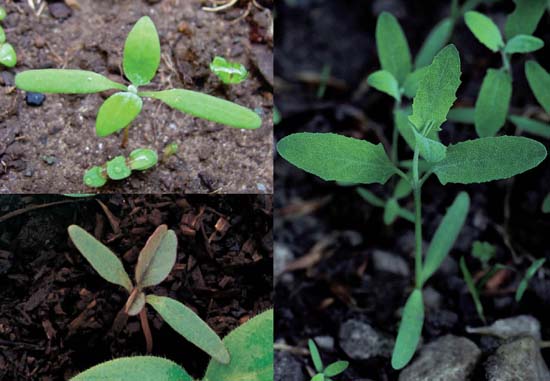
Wild spinach sprouts compared to green amaranth (Amaranthus retroflexus). Upper left and right are wild spinach sprouts. A green amaranth sprout is shown at lower left. Note the blunt to rounded tips on the spinach sprout’s leaves. The powder-like white crystals on the wild spinach is characteristic. Except for the first two embryonic leaves (cotyledons), green amaranth leaves have obvious veins and notched (indented) tips. Amaranth does not have a white crystalline powder.
Knowing Wild Spinach
Wild spinach seeds last for many years in the soil. When conditions are right, wild spinach will sprout in spring and summer. The sprouting season seems to stretch, depending on local conditions, from mid-May to mid-October. The prime growing season is June through August.
Sprouts: Wild spinach sprouts are small. By the time they have four leaves, they look a little like tiny green propellers. The cotyledons (first two leaves) are linear and straight with a rounded tip. The second two leaves are more lance-shaped (a little wider at the base) and occasionally show the beginnings of teeth along the margins. They are covered with hundreds of tiny glistening grains.
Sprouts of wild spinach and green amaranth can be confused. They are different in the following ways: amaranth’s cotyledons, while strap-like, are less straight along the edges, and their tips are round but show some tapering. Amaranth’s first two leaves after the cotyledons are often reddish and more rounded, and have a clear mid vein and a notched (indented) tip.
Leaves: One of the reasons that wild spinach is also called goosefoot is because the leaves eventually take on the appearance of web-footed waterfowl. That leaf shape can vary a bit from narrow and pointed to quite rounded. From an overhead view, the leaves are arranged in a starburst pattern, radiating out from the center.
Just like the sprouts, the whole plant is covered with a fine crystalline, waxy-like powder, which is most evident and denser at the growing tips, as can be seen in the center of these photographs.
As the growing tips expand in size, the powder spreads out and becomes less obvious. This powder is an important identifying characteristic for the plant and also renders the plant waterproof. Water droplets bead up and roll right off during a rain. You can use a spray mister to test this in the field.
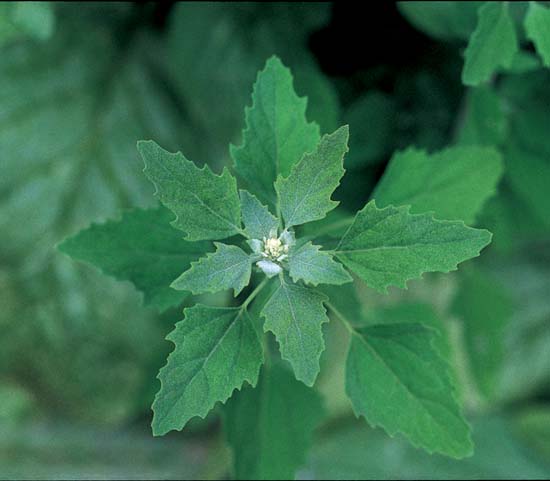
Wild spinach, narrow version.
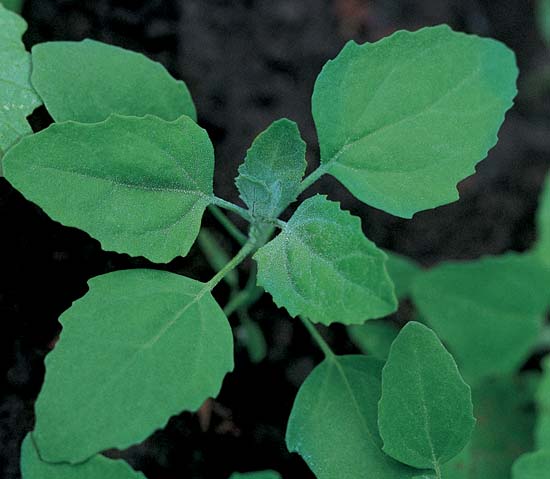
Wild spinach, rounded version.
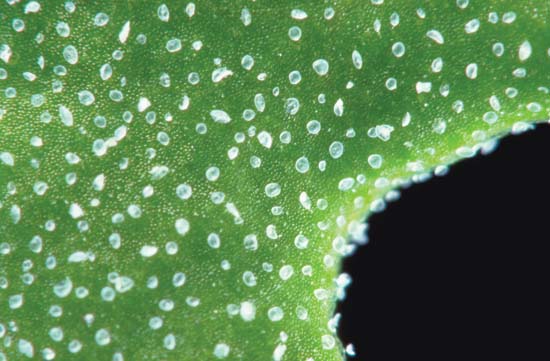
Wild spinach leaf magnified about 50 times. The powder on the leaf is made up of microscopic wax-like crystals. This wax helps make the leaves waterproof and may help repel insects.
Hairy Nightshade / Ground Cherry Nightshade
Solanum physalifolium / Solanum sarracoides / Solanum villosum
Toxic look-alike
Green parts of members of the Solanum genus are known to have the chemical solanine, a toxic alkaloid. For our purposes, we will consider hairy nightshade poisonous. A few small leaves in a salad will not hurt you. But avoid eating this plant until we know more. The leaves of hairy nightshade look enough like wild spinach that you should learn to know this plant. Hairy nightshade often intermixes with wild spinach and green amaranth. Like a chameleon, its leaves can mimic both plants.
So what are the differences? Hairy nightshade is hairy while wild spinach is not. Rather, wild spinach has a fine waxy powder covering its surface. The nightshade’s white flowers have the characteristic shape of the nightshade family and are larger than those of wild spinach, which are green and inconspicuous. The flowers are a dead giveaway.
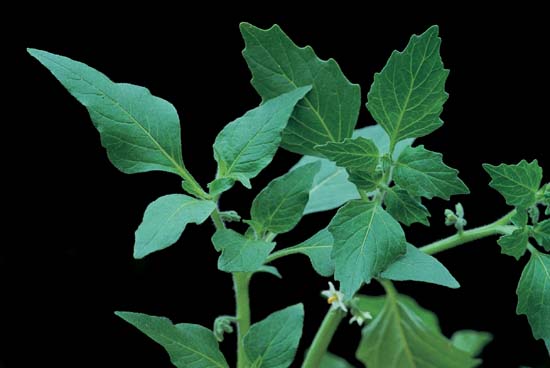
Two hairy nightshade plants compared. Even though these two plants are the same species, the leaves of the plant on the left resemble green amaranth; the leaves of the plant on the right resemble wild spinach.
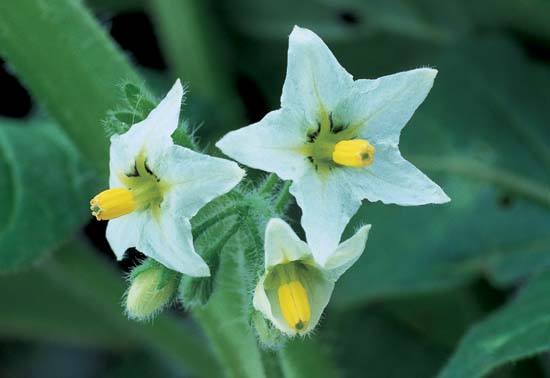
A close-up of hairy nightshade’s showy white flowers.
Plant Size and Form: The size of the plant can vary from a few inches to seven feet tall, depending on its life story. At the beginning of its growing season in June, a plant sprouting in rich soft soil without competition from other plants and with adequate water throughout its life can grow to six or seven feet tall, looking like a big shrub. A plant sprouting at the end of its growing season in hard dry ground may only grow to a few inches and have a single tiny stem with a few miniature leaves. The first would produce lots of leaves and stems (food for us); the second would not produce enough food to bother with. Most plants will be somewhere in between these two extremes at maturity—two to four feet tall.
Under good conditions, this plant grows fast and mostly upward. The primary stem elongates first, then the side branches grow in later. The stem is roundish but ridged. Leaves grow alternately on the stem.
As the plant grows older in good growing conditions, it takes on a Christmas tree shape. If the stems are clipped (due to harvesting), the side branches start growing out.
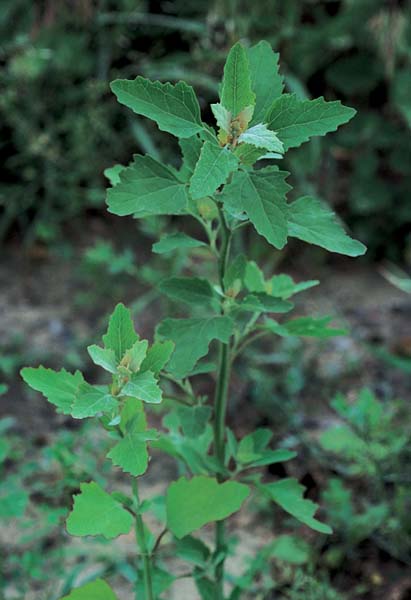
Wild spinach—healthy, young, and tall—prior to lateral branch formation. This plant is not quite 20 inches tall, and only the top 10 inches or so are shown.
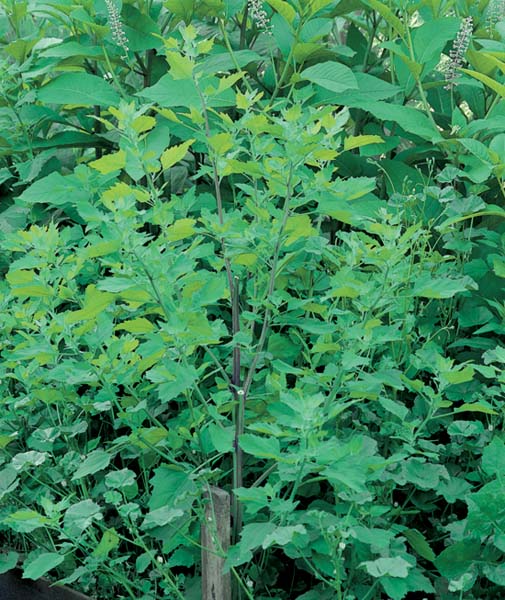
Wild spinach branching widely following a harvest. Branching eventually occurs in the process of normal development as the plant matures. You can see two places where the stem was cut from harvesting. Each time you trim a tender leafy stem away for food, branching is stimulated, resulting in many new growing tips for harvesting. This plant is almost 3 feet tall.
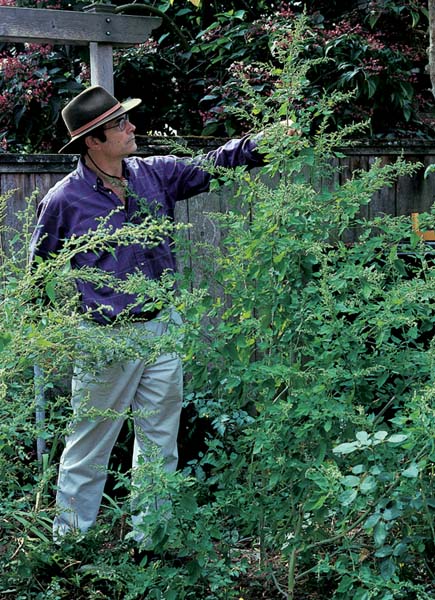
Wild spinach about 7 feet tall and fully mature. Well-fed wild spinach is well-branched and produces a huge quantity of seeds when mature. The leaves are still edible at this stage but are reduced in quality, taking on a somewhat off-flavor. According to research on other mature plants, the leaves on these older plants retain most of their nutrients and phytochemicals as long as they are still green. (The author stands in for perspective, 2006.)
At some point, the plant shifts from making leaves and stems to producing buds, flowers, and seeds. Many things can trigger this: the end of its natural season (cold sets in, shorter days), a lack of moisture, overharvesting, natural aging, etc. Once this seed production begins, there is little you can do to stop it. So if you have wild spinach growing in your yard, feed it, water it, nurture it for as long as you can. All these things help it, and other wild plants grow profusely and delay the onset of seed production. Feed it and it will feed you. If you just leave it, it will age faster with less growth and go to seed. This is why I have rarely seen a seven-foot-tall wild spinach plant outside my garden. Nature does not pamper them like I do.
Wild spinach buds open into tiny green inconspicuous flowers. You will not see them unless you look closely. Once these flowers are fertilized, they produce shiny black seeds that are eventually spread by dropping out of the flower’s ovary. If it is late in the season and you happen to brush by a mature wild spinach plant, you will hear thousands of seeds dropping to the ground. They’re hard to see easily, but you will definitely hear them hitting leaves as they drop.
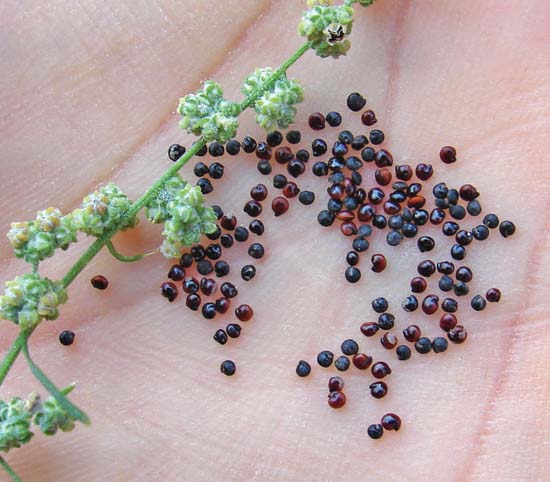
Wild spinach seeds in the palm of my hand next to the stem that’s dropping them. This enlarged image is actually about 1 3/8 inches wide. In order to show clean seeds, I took great pains to separate its wrapping, or pericarp, which is that part of the ovary directly surrounding the seed. The pericarp is often difficult to remove, particularly if the seeds are not allowed to fully ripen before harvest.
Harvesting and Serving Wild Spinach
I often say that nature is not here for our convenience, but in the case of wild spinach, it is. Insects don’t seem to like it, so it does not get eaten before you get there. The plant grows upright and produces plenty of growth, making it convenient to gather. I rarely have to clean it since it seems to reject most dirt. And it does not require any heroic processing procedures to make it edible or palatable—it’s delicious right off the plant. I love wild spinach!
Assuming you have a garden in which wild spinach is growing as a weed, you can really make good use of this plant. Whenever the soil is disturbed or turned over and watered within its growing season, wild spinach will sprout. You do not want all the sprouts to grow, so you thin out some of the plants at your convenience.
Thinning allows the remaining plants to grow in stronger. Don’t do this at the two- or four-leaf stage; wait until you have six or more leaves. By waiting, you can thin and harvest the “baby greens” at the same time instead of just killing them. Pluck the stems close to the ground where they will still snap cleanly. This should kill the root and gain you the young leafy stem as food. Depending on your land size, you should have enough salad to feed you and several other people. If you want to pull the plant up by its roots, take special care not to mix the dirt of the roots with your baby greens.
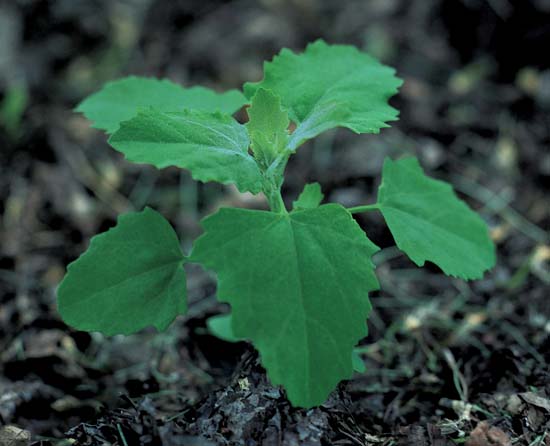
Wild spinach seedling. At only about 2 inches tall, this form is promising in that it may produce bigger and more densely growing leaves than the taller, thinner sprout seen earlier.
Baby greens are particularly susceptible to drying out, so placing them directly in a bowl of water (they will float) for up to fifteen minutes, or in a well-misted bag, will keep them fresh until used. The roots and the lower part of the stem will be too fibrous to eat, so discard those parts. What you are gathering is what I call the leafy stem. Picking off the individual leaves is unnecessary much of the time since the upper stem is perfectly edible and won’t be fibrous unless you clip it too low. You can indeed pluck individual leaves, but why bother at this stage? It is less work to collect them all at once by plucking the whole tender upper stem.
The same is true when the plant gets older. Anywhere you can snap the stem cleanly without it pulling, tearing, or shredding will be tender from that point upward. And as long as there are several branches below the point you are taking, the plant will not only continue to grow, it will be stimulated by your pruning.
The interesting thing about wild spinach leaves is that they never seem to get fibrous. So while you may be snapping off a tender leafy stem tip, you can gather additional leaves from anywhere on the plant, even where the stem is old and woody.
Harvesting Techniques
For Quick Salads: If I go into my backyard with an empty salad bowl, I’ll just clip off the most tender leaves and leafy stem tips, and add them to my bowl along with some salad dressing. That is all there is to it. If you want a more complex salad, add some more plants or other salad fixin’s. But a pure wild spinach salad is fine by itself in the same way that some people like a plain lettuce salad, only this salad is way more nutritious and flavorful. Be forewarned that a salad of only wild spinach leaves will be very dense and flat. For a more conventional airy salad, mix them with other greens, leafy stem tips, and bud clusters.
For Cooking: If you are gathering from this plant just for cooking and/or preserving, the fresh greens don’t have to look presentable. When this is the case, I use what I call the “squeegee method.” This works on any relatively straight stem or branch. I grasp the stem down near where it is branching and pull upward or outward, gathering up all its leaves and small tender side stems in one long stroke. This gives me a mass of leaves that are good for chopping and cooking but would look damaged in a salad. If you use this method, gathering is extremely fast, but you will have to pick through the mass of greens to take out any fibrous material that tagged along. Some of the greens will be damaged from this rough method, but since you are cooking them anyway, you won’t notice.
For Mass-Collecting: Mass-collect if you need lots of greens for a big meal or a potluck, or for freezing or canning. Your goal is to gather quickly in the field and do the finishing work in the food-preparation area. To do this, you are either taking whole young aboveground plants anywhere from ten to twenty inches tall or whole upper branches from larger plants. Take care to keep your harvest moist. Note that you are carrying off some of the stiff fibrous stem material, which will not be eaten. It is only serving as a food transport carrier for all the attached leaves.
In less hectic times, food preparers would sit around a table, socializing and peeling potatoes, scoring nuts, or in some way processing food for dinner, for big events, or for food preservation. Here, you and family and friends can sit around plucking leaves from bushels of wild spinach stems. The more stems you gather, the more time it will take. Talk, socialize, learn your kids’ names. Once you separate the edible material, you can use it in any way you would use regular spinach, discarding the fibrous stems, of course.
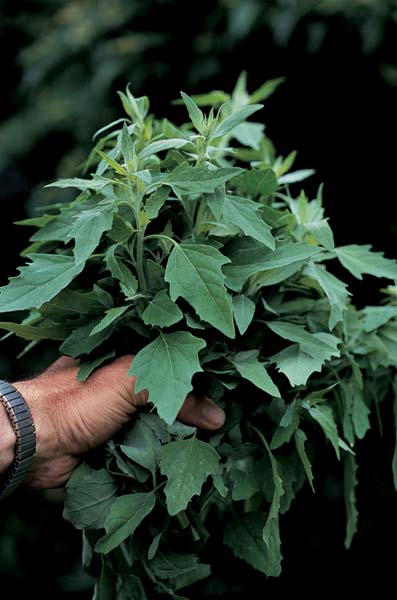
Mass collection of upper stems. This mass of greens required about 10 seconds of leafy stems collection and about 5 minutes of kitchen leaf and upper leafy-stem plucking. The fibrous stem remnants were composted.
When plucking leaves, I put them directly into a large bowl filled with cold water. This keeps them fresh until use. The leaves will mostly float because the waxy powder repels the water; but contact with the water somehow keeps them hydrated.
As I’ve said, the leaves remain relatively tender throughout the life of the plant. But older leaves can start taking on a mild off-flavor and even become bitter. My guess is that the off-flavor may be partially due to the buildup of saponins in the aging plant. Current research suggests that some saponins in small quantities are considered potential phytonutrients. And while whatever is causing the bitterness makes the fresh greens a little less desirable to me, most off-flavors go away with boiling. The occasional bitterness of older leaves is less noticeable and often disappears if the greens are included as part of a more complex dish. From a flavor standpoint, as long as they are young, leaves and leafy stems can be used interchangeably in a variety of dishes. They are all delicious.
Harvesting and processing flower buds and seeds
Flower Bud Clusters: I like to call the flower bud clusters spinach-broccoli. If you want to enjoy the flower buds, gather them when they first appear at the tips of the upper stems. Your goal is to find tenderness. You can partially gauge the tenderness of the bud clusters by the snap-ability of the stem that supports them. If the stem snaps crisp and clean, then there is a good chance that everything above that point will be tender. If you are tugging, pulling, and finally tearing a fibrous stem, then the buds have already begun maturing into seeds—a whole different food. You might want to taste a sample just to make sure the batch you are collecting is not beyond the bud stage. The flavor should be fresh and leaf-like. If they are bitter, you’ve arrived too late. To keep your harvest fresh, treat it as you would the leaves.
Young wild spinach bud clusters, as seen below, are packed together and not very defined in shape. Once they start spreading out on thin stems, flowering, and going to seed, they become progressively more bitter.
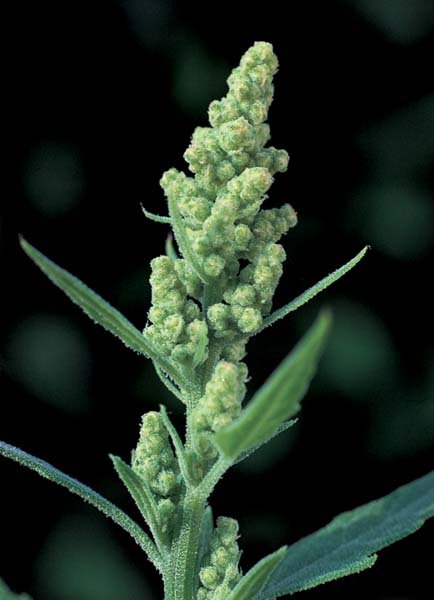
Young wild spinach buds tightly clustered prior to spreading out. These clusters are analogous to broccoli, which is also a grouping of bud clusters. Note the waxy granules on all the surfaces. This photograph shows the plant tip at about 3 times life-size. When the plant matures (like in the previous photograph), the buds spread out on thin branchlets.
Seeds and Seed Capsules: As the bud clusters flower and begin transforming into seed-producing capsules, they get crunchier and the stem stiffens. This stiffness allows you to use the squeegee method to harvest the capsules. These seed-producing capsules include all the flower parts surrounding the seed. As you squeegee, try to get as little stem material as possible.
The use of these seed capsules or just the seeds as a cooked porridge is complicated by a bitterness. This bitterness makes the seed capsules unpalatable and somewhat toxic in large amounts. If wild spinach is like Chenopodium quinoa and Chenopodium berlandieri, both with a history of seed processing, the bitterness is due to saponins. I find this very likely, because if you mix uncleaned seeds (those with the chaff still surrounding the seed) in a little water and stir vigorously, a saponin-like foam develops.
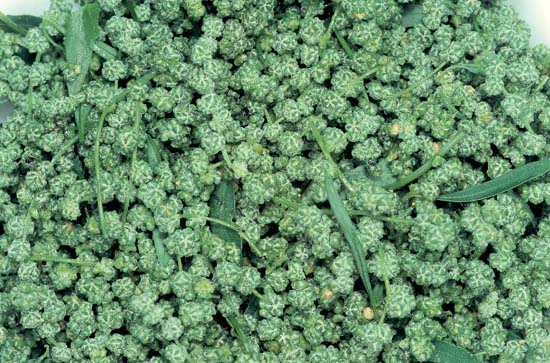
Wild spinach seed-producing capsules.
I’ve recently discovered that baking soda (bicarbonate of soda) added to soaking or boiling seed capsules or seeds can remove the bitterness, but I have not yet developed any consistent recipes to do that.
Quinoa (Chenopodium quinoa), a close relative of wild spinach, has a long history of use by the Incas and now more and more by modern society. The seeds produced by quinoa are greater than four times the size of wild spinach. They have a shell that is roughly the same light color as the nut meat. That shell is covered with several different saponins. Quinoa is often processed to remove that thin surface layer.
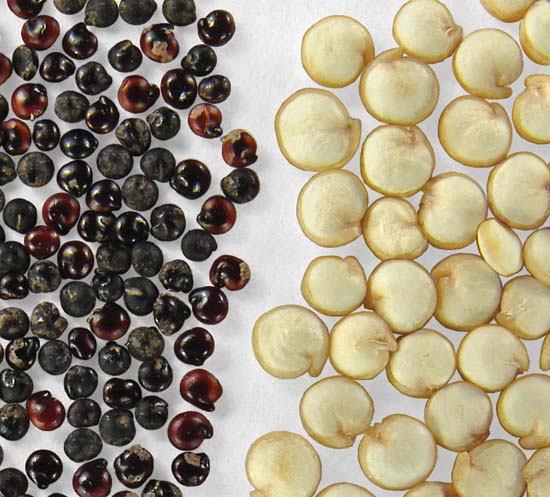
Wild spinach (left) and quinoa seed compared. Wild spinach seeds are about 1mm in diameter. Store-bought quinoa seeds are about 2-1/2 mm in diameter. Quinoa comes polished by its manufacturer to remove surface saponins. These are closely related plants that produce copious amounts of seeds. Note that the pericarp (remnants of the ovary) sticks to most of the wild spinach seeds, making some of them dull in appearance.
The quote below is part of an interesting account of Bolivian quinoa processing, which may shed some light on the processing of wild spinach seeds:
Quinoa seeds are coated with a layer of saponins, exceedingly bitter toxic chemicals. To get rid of this layer, women first toast the seeds on a metal tray over a fire. This helps to loosen the saponin layer and, while it may not be strictly necessary, enhances the flavour of the seeds. Then the hot seeds are tipped into a stone basin and the women tread them with their bare feet. The friction loosens the saponin coat and reduces it to dust. Treading also often gives the women blisters and chronic lower back pain. The saponin powder now has to be cleaned from the seeds, which is done by waiting for a day with the right kind of steady wind and then winnowing the seeds repeatedly so that the wind blows the dust away. Finally the seeds are rinsed in a couple of changes of water and set out to dry. (Anonymous, 2006.)
Wild spinach produces copious amounts of seed. Quinoa, its close relative, is known to be a nutritious grain. This raises the hope that wild spinach seed may also be a valuable food.
Serving Techniques
Using Leafy Stem Tips: When most people think of salads, they think of light airy collections of greens. In contrast, individual wild spinach leaves are relatively flat in shape. They sort of stack upon each other like playing cards. A salad of just leaves would be very dense, filling, and not very airy. Why is this an issue? The more the food tastes, feels, and reminds them of something they are familiar with, the more likely they will be open-minded about what they are eating.
So how do you make flat wild spinach leaves airy? You mix the leaves that you have with a generous amount of leafy stem tips, which are quite three-dimensional, holding themselves up and creating air spaces. This simulates a more conventional airy salad and prevents stacking. This technique will also work for other greens that we will cover later. Make sure the leafy stem tips are bite-size so they will fit easily on a fork and in the mouth.

Wild spinach, used fresh in a cheese-melt fish sandwich and on the side as cooked greens. Since wild spinach is so substantial, the bowl of cooked greens shown here is enough for 3 or 4 servings.
Cooking Leafy Stems: Tender edible leafy stems can be made into fine cooked dishes. Whenever you have very rapidly growing stems prior to any flower bud development, the part of the stem that is tender can be up to about six inches long. Once the leaves are removed for some other use, that stem becomes analogous to asparagus. So any asparagus recipe will work great with wild spinach stems—except that they taste like wild spinach—and that is a good thing. Like asparagus, fresh stems may seem somewhat fibrous when raw, even if they snap cleanly from the plant; but they will tenderize upon boiling. The longer you steam or boil them, the more tender they get—though six minutes is often enough.
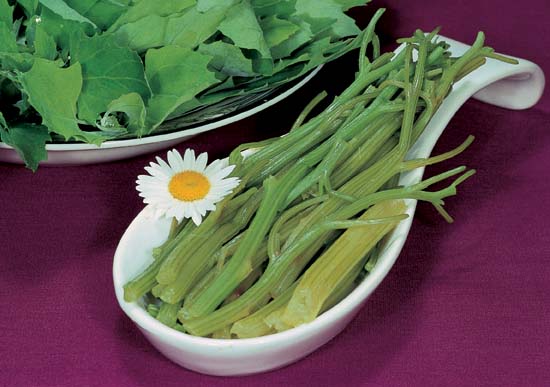
Tender Wild Spinach Stems. Steamed upper stems, drizzled in olive oil and red wine vinegar with a pinch of salt, and garnished with an ox-eye daisy flower (Leucanthemum vulgare).
Mixing with Other Greens: While a pure wild spinach salad is perfectly great on its own for people like me, there are a couple of considerations to keep in mind—both having to do with those cute little waxy crystals that cover the plant. First, they make wild spinach relatively waterproof. This means that some dressings will bead up and roll right off. This is only a minor nuisance that you will be able to manage with time and experience. The tiny waxy crystals can also give a slightly dry (though not astringent) feeling to the mouth. However, it’s only a big issue to those cranky and finicky people in the world. The solution to both is to mix the raw wild spinach with other greens. Even a 50-50 mix goes a long way. Besides, eating a diversity of greens is better for you than just eating one.

Wild Spinach Pizza. Whether starting from scratch or adding to a frozen pizza, wild spinach is a great addition. The key is to steam the greens, then mix them with enough olive oil to coat them before adding them to the pizza. The oil prevents the greens from drying out. If you want more greens in your pizza, put a whole layer of finely chopped wild spinach between the tomato sauce and the cheese.
Boiling and Steaming: Whether you boil or steam wild spinach, it mats down, compacts, and becomes rather dense. This is a feature to be aware of to help you design good dishes. Finely chopping the greens and mixing them with other foods before you cook them will allow them to separate better when serving. Wild spinach is a substantial food; learn to use it wisely. Experience will be your best teacher.