Wintercress
A versatile spring succulent
Family: Brassicaceae
Species: Barbarea vulgaris
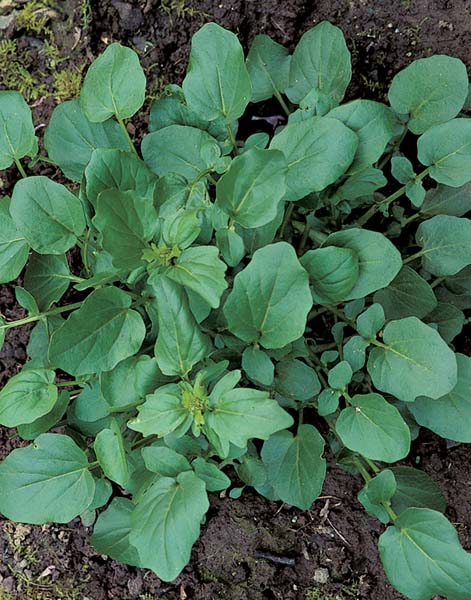
Several wintercress plants in basal rosettes just prior to bolting. It’s a cold, hardy, rubbery-looking plant that produces greens throughout the spring and flowers soon after field mustard.
Estimated Range
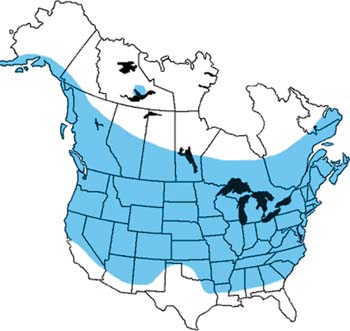
Official Species Name:
Barbarea vulgaris Ait. f.
Synonyms (Historical Names):
Barbarea arcuata (Opiz ex J.& K. Presl) Reichenb.
Barbarea stricta auct. non Andrz.
Campe barbarea (L.) W. Wight ex Piper
Campe stricta auct. non (Andrz.) W. Wight ex Piper
Common Names:
Wintercress
Yellow rocket
Garden yellow rocket
Bittercress
Creasy greens
An herbaceous weed naturalized from southern Europe, wintercress is widespread and abundant in North America, primarily where humans have invaded and where soil has been disturbed.
Edible Parts:
Growing tips of leafy stems
Leaves
Buds
Flowers
The first time I saw wintercress, I was on a research farm on the Michigan State University campus. It was late winter, patches of melting snow were still around, and I was walking through a pasture that was quite muddy from lots of farm animal traffic. One green plant was growing all over the place. The recent freezes had not killed it; the leaves had overwintered. In Michigan, the winters get pretty cold—down to 15 degrees below zero on occasion. Yet here was this plant—not looking great, but alive. I had found my first wintercress.
So wintercress is a good name. It is a cress (a member of the mustard family), and it survives the winters. Like other overwintering plants, it prepares for freezing temperatures by decreasing the amount of water it retains, producing alcohols and sugars, and undergoing other changes. The added chemistry allows wintercress to get super cold without forming the ice crystals that would ordinarily destroy plant cells. It does not grow during the harsh parts of the winter; it mostly sits there, trying not to die. So as long as the frozen-looking greens are not damaged physically, the plant survives to photosynthesize (provide food for the rest of the plant) when temperatures rise in the late winter or early spring. Overwintering leaves like this are not worthy of eating. Let these old tattered leaves remain for the local deer and rabbit populations.
Wintercress can be a biennial or a short-lived perennial. If the seeds sprout in the fall, the plant gets its start, overwinters, and produces flowers the next spring—making it a biennial (sometimes this is called a winter annual). No matter when it gets its start, if conditions are right, wintercress can live for three years—making it a short-lived perennial. Favorable conditions are shade, good soil, and reasonable moisture throughout the year.
The first time you see it, it might be growing in a moist field or along a sidewalk, often as a colony of flowering plants. If it is off in a field, then all you’ll see is a cluster of yellow flowers barely overtopping all the surrounding green plants. Wintercress is only about a half to a third the height of field mustard, given the same growing conditions.
There has not been a lot of research on the nutritional value of wintercress. We know it is very high in vitamin C, has reasonable amounts of beta-carotene, and contains the phytochemical glucosinolate. The seeds have been analyzed for macronutrients. When the moisture has been removed, the seeds are 40 percent fiber, 34 percent fat, 19 percent protein, and 7 percent ash. There is virtually no starch in wintercress seed. Of the total fat in the seeds, 28 percent is erucic acid, 23 percent is oleic acid, 21 percent is linoleic acid, and 10 percent is linolenic acid. (Andersson, 1999.)
As I stated in the introduction to this section, the seeds of any mustard plant will contain erucic acid. Eating them occasionally as a wild food treat in mustard preparations or as a spice in meals in the context of a diverse and healthy diet is likely to make you healthier than if you did not. But do not overdo it.
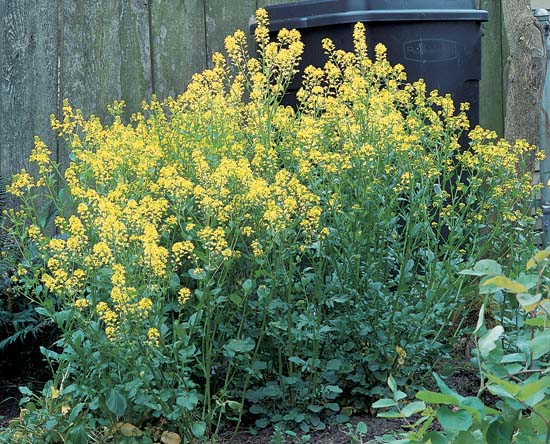
Healthy flowering wintercress plants in great growing conditions.
I believe watercress to be a good food. If you search the Internet, however, you will find the following warning: “Wintercress could cause kidney malfunction.” The first source I could find to state this was Foster and Duke’s A Field Guide to Medicinal Plants (Houghton Mifflin Co., 1990), and then repeated in Dr. James Duke’s Handbook of Edible Weeds (CRC press, 1992). Unfortunately, neither book offered the original source of the warning. After searching the literature and e-mailing Dr. Duke (personal communication, January 13, 2006), I have been unable to substantiate this kidney problem. I have not found any recorded incidents of humans being harmed by eating wintercress. Both Dr. Duke and I eat wintercress.
A good testament to the value of wintercress is that it was eaten by the Greeks, Italians, Russians, many people in the southeastern United States, and probably additional southern European cultures. Even my mom knew this plant as “creasy greens” from her father picking them in Ohio. Creasy greens more commonly refers to upland cress (Barbarea verna), an edible plant similarly used throughout the southeastern United States.
Wintercress greens are a great springtime food. Let’s get to know it a little better.
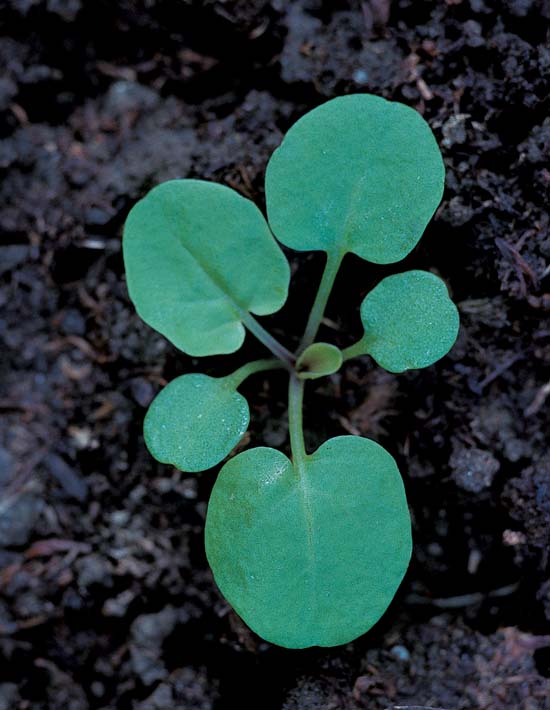
Wintercress seedling. The cotyledons are the smallest leaves at the mid-upper and mid-lower left of the photograph. The three larger leaves are the first true leaves. These seedlings can be mistaken for bitter cress (Cardamine oligosperma), another edible mustard.
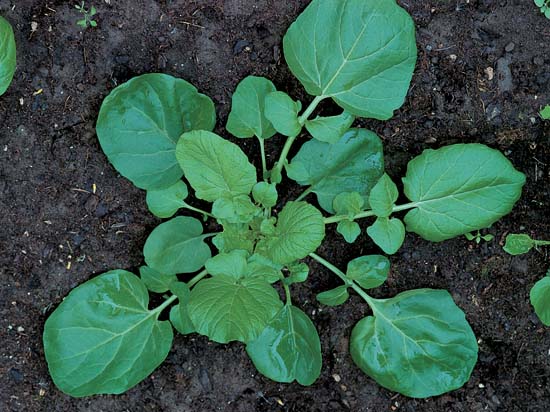
Young wintercress growing in good moist shady conditions. This plant is in my garden, where it gets watered regularly. The leaves here are about 7 inches long from center to tip. Plants in the wild are smaller and struggle in the warm months because I am not pampering them. New leaves emerge from the center and then recline to the side as newer leaves replace them.
Knowing Wintercress
Wintercress seeds germinate any time the conditions are right: regular moisture, disturbed soil or seeds near or at the surface, longer days, and the beginning of warmer temperatures. The seeds may also have to overwinter once before they have the capability to germinate.
Wintercress is very adaptive and quite hardy. It can grow in almost any kind of ground, from rich topsoil to gravel to sand; it can grow in open sun or deep shade; and it thrives in temperatures anywhere from 35 to 70 degrees F. With enough moisture, it grows modestly in higher temperatures of summer. The seeds can survive in the ground for years, waiting for the right conditions.
Wintercress can take over areas, outcompeting other plants, due to high seed production, good winter survival (giving it a head start on competitors), strong growth, development of a sturdy taproot, and adaptation to whatever soil it is growing in.
All leaves of the first-year plant are relatively the same shape. They have a terminal or end lobe that is larger than all the other lobes. Down the leaf stem are typically two to four pairs of smaller lobes. All these leaves originate from a short stem above the root and radiate outward. This arrangement is called a basal rosette. Many of the plants in this book, including dandelions, field mustard, and cat’s ear, have a basal rosette stage.
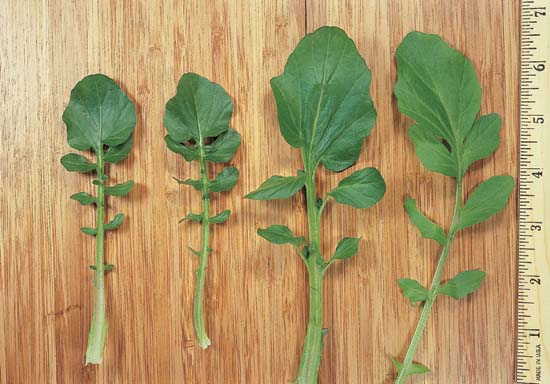
Basal leaves displayed. These are the ones growing closest to the ground. All the leaves from a first-year wintercress plant look like this and radiate out from the root at ground level. The second-year plant that has grown a stalk has leaves that change shape as they go up the stem. At the base of the second-year plant, the leaves still have this shape.
Wintercress has two growing periods when it thrives—spring and autumn. The cooler temperatures and the moisture of these two seasons support better growth. It grows slowly in summer and just survives in winter.
In most of North America, where winters are severe, wintercress stops growing and goes into a hibernation mode. In temperate areas like the Pacific Northwest and the Deep South, it will continue to grow very slowly throughout the winter. If you attempt to harvest some of its leaves in the winter, no new leaves grow back to replace them until spring.
As spring arrives, wintercress comes back to life, forming thick leafy growth particularly wherever it has no real competition. When it is crowded with grass or other densely rooted plants, growth will be less—making the plant smaller.
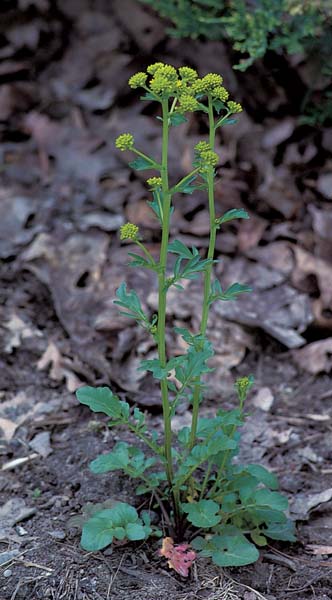
Bolted wintercress showing bud clusters spreading out prior to flowering. This plant was never watered, and it is growing in hard soil. So its growth and end size are less than you would see from pampered garden plants—less leaves, less dense growth, fewer stems.
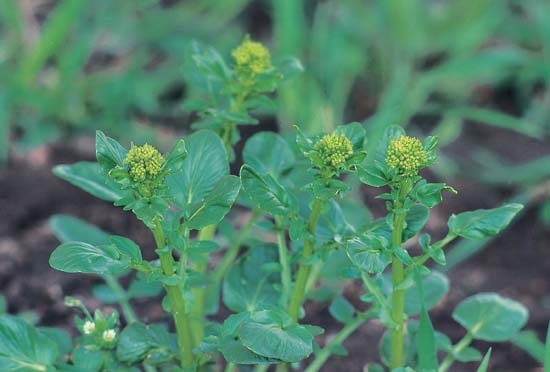
Younger, tightly clustered buds and upper stems. The buds are shown prior to spreading out.
Wintercress bolts when the days get longer and temperatures begin to reach into the 50s F. At first, the basal rosette starts to look a little different, sort of like there are green starbursts emanating from the center of the basal leaves. The photograph previous shows this stage clearly.
The plants begin to send up one or more stems from each root. The more rigorous the first year’s growth, the larger the root, the greater the number of stems the plant produces, and the more luxuriant the growth.
Bolting is a quick process. Flower buds begin forming while the stems are still short. They are found at the tip of each stem and look like miniature broccoli heads. At first, the buds are tightly clustered; then, as the stem elongates further, the buds begin separating into several smaller clusters.
At this point, the plant’s full diversity of leaf shapes appear. All the leaves, regardless of shape, clasp the stem; that is, they wrap around the stem. At the base of the second-year plant are the same-shaped leaves we’ve seen on the first-year plants. As you follow the stem upward, the lobes on the sides of the leaves become narrower, and the terminal lobe takes on an interesting arrowhead-like design.
A wintercress stem is ridged along its length. Sometimes called eight-sided (a poor description), the ridges are angular in shape. The tip of each major ridge supports a leaf and a branch of the stem.
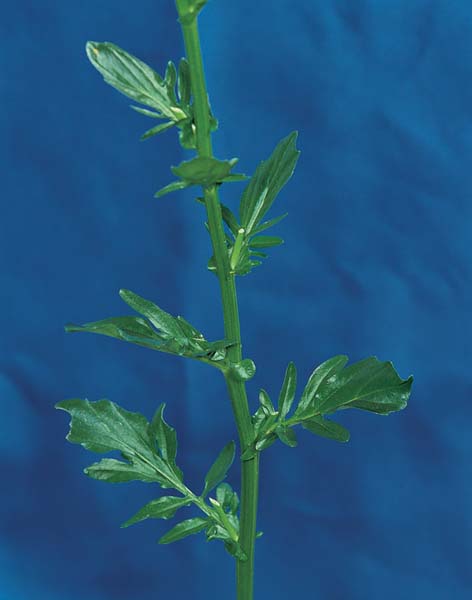
The mid stem showing leaves that are changing from bottom to top. Lower leaves look more like the basal leaves. Top leaves look more like the unlobed upper leaves. The bases of all these leaves clasp the stem.
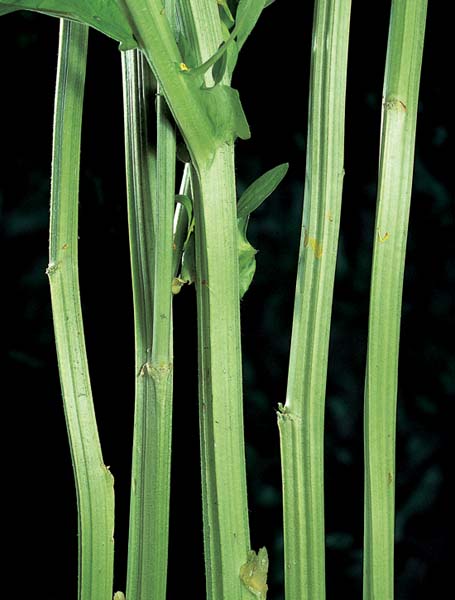
Wintercress stems are ridged along their length. Leaves and branches have been removed from these stems to reveal the ridges.
Flowers begin blossoming sometime in April or May, depending on where you are in North America. They open to the side of the newly formed central buds. As the stems elongate, buds continue to form at the tips, and flowers spread down that stem. At this point, wintercress becomes visible from a distance. Patches of it are seen here and there. Whenever you find a field with patches of yellow flowers, it is likely a mustard family plant of some sort. You should investigate to see if you can determine which one it is.
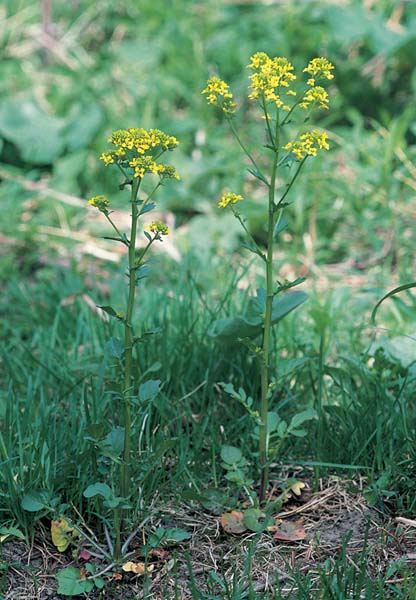
Bolted wintercress showing open flowers. These plants were never watered and are growing in hard soil, so they are smaller and less lush than they might be. They had to compete with grass, some of which I pulled to get this view. Grass roots compete with wintercress for both water and nutrients.
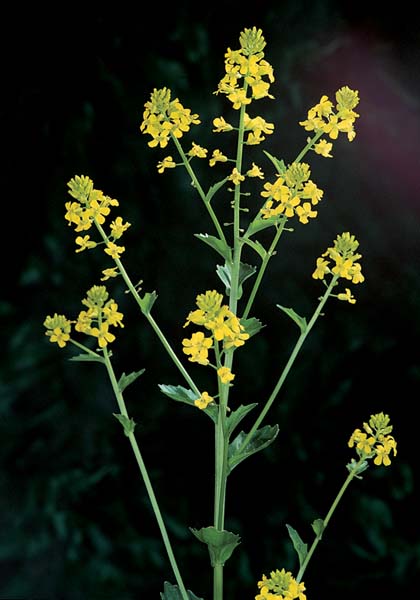
The top of an adult wintercress plant. Here are terminal buds, flowers, and the tiny beginnings of seedpods down the stem where the first flowers used to be.
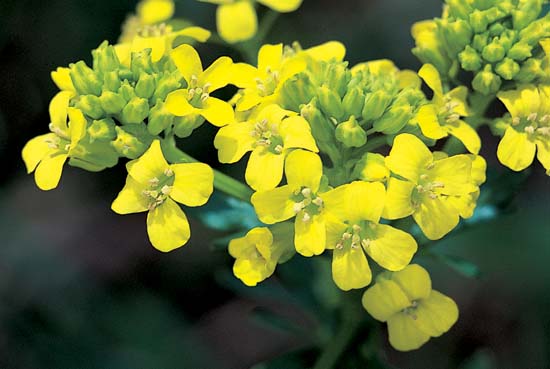
Wintercress flower heads and their bud clusters. Some of the older side buds have blossomed into flowers. Like all other mustard family plants, wintercress has four petals and six stamens—four long and two short.
Upland cress (Barbarea verna) is a less-common relative of wintercress. It grows throughout eastern North America, particularly in the Southeast and along the Pacific coast, west of the coastal mountain range. Note the longer, more lobed leaves. It is purported to have the same uses as wintercress. I do not have any direct experience or knowledge about it. It is shown here for comparison.
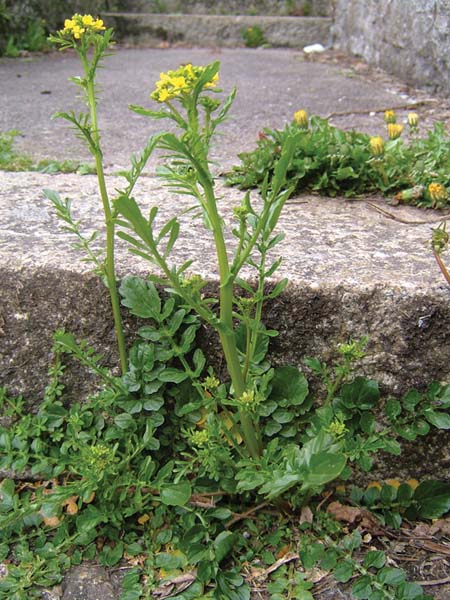
Upland cress (Barbarea verna)—a close relative to wintercress. This view shows the extra numbers of lobes that leaves have for this species. (Printed with permission from “A Photo Flora”: www.aphotofauna.com.)
The flower stalks, which become pod stalks, can get very long, producing thousands of seeds. The pods transform from green to brown as they mature. When dry, they break open, releasing seeds within a few feet of the original plant.
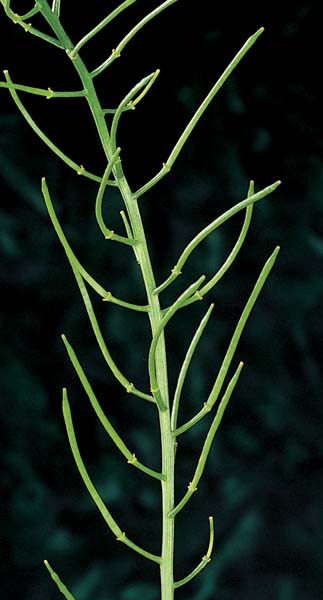
Seedpods growing along the lower flower stem. The seedpods are long, thin, and angled up and outward. They have a short thin neck (peduncle) and a small beak at their tip. The beak is nothing more than a small area that is not fattened by seeds.
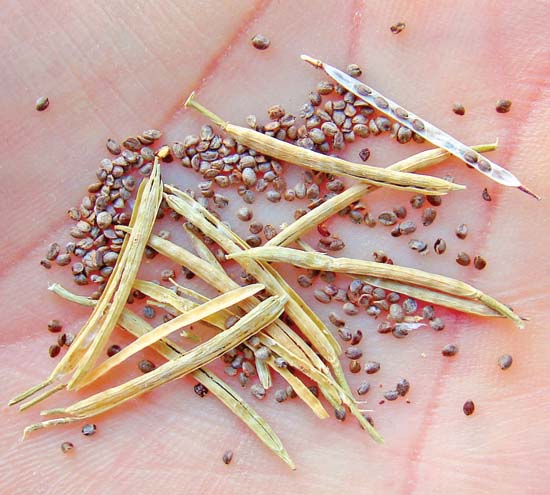
Wintercress seeds and open pods in hand. This photo shows about a 1-1/4-inch-wide section of my hand.
Harvesting Wintercress
Leaves: The leaves of wintercress can be gathered anytime they look fresh and clean. First-year or second-year plant leaves are good. The earliest spring leaves are only slightly less bitter than the leaves at any other time of the year, so getting them earlier is no great benefit.
Since there is a thickness to wintercress leaves, they do not tend to dry out as easily as field mustard leaves. But, whenever possible, you should always spray-mist them to keep them fresh. Due to the smaller leaf size, gathering from this plant can be a little more time-consuming than collecting field mustard. If you have lush growth, gathering is easy and you’ll get what you need in no time.
Bud Clusters: To gather the broccoli-like buds, snap the stem about an inch or two below the buds. Wintercress bud stems are fibrous almost as soon as they are formed, so only that still-growing upper inch or two will be tender enough to chew. If you are not going to use them right away, cut the stems longer and place them in water like you would do for flowers. Cover loosely with a plastic bag and place them in the fridge. They will keep fresh for several days. When ready to use, cut off and discard all but the upper inch or two of stem.
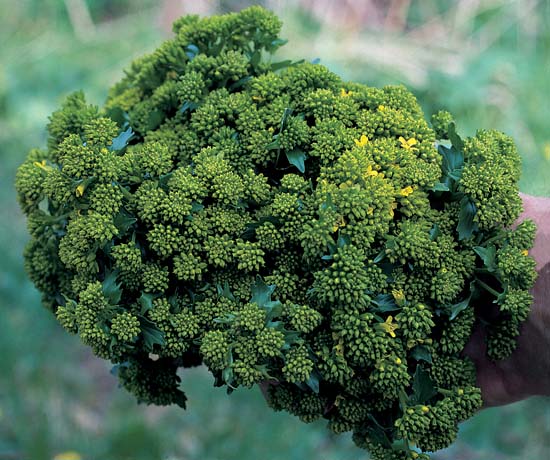
A collection of flower bud clusters. This mass of buds is from the tops of about 15 plants held together to resemble a large head of broccoli.
Flowers: The flowers are small, so the best way to collect them is to clip whole flower-laden stems. Put the stems in water, as you would ornamental flowers, until ready for use. Just before serving that wild salad garnished with wintercress flowers, pluck them from the stem, which is too fibrous to include with the flowers. If you just want the petals, place vases of these flowering stems over newspaper or plastic. As the flowers mature, their petals will drop. When enough have fallen onto your collecting surface, you can gather and use them for tea.
Pods: Only the young, newly formed pods are tender enough to eat. They are too small for me to enjoy. If you want them, either eat them off the plant or collect the stems, holding them as you would collect the flowers. Keep the stems alive in water. Pluck the pods free when you are ready to use them. The stem attached to any pod is too fibrous for use.
Seeds: Trying to gather seeds directly from a mature plant is difficult. If you want the seeds, your goal is to remove the plant from its natural environment and continue the ripening process in a controlled situation. For directions, refer to the field mustard chapter and follow its seed-harvesting technique.
Cooking and Serving Wintercress
Leaves, Fresh: Wintercress leaves are bitter and pungent in the raw form, and they can leave a strong bitter aftertaste. If you love bitter, enjoy them raw. I need to mix wintercress leaves with other foods in order to enjoy them. This allows the bitterness to add character to what I’m eating rather than overpowering the dish. I love adding the leaves to salads and sandwiches as well as cold vegetable and fruit dishes. Remember that anywhere you are adding wintercress greens, you are adding bitterness and pungency. Here are some general tips to enjoy its flavors:
Make wintercress greens only about a fourth to a fifth of the mass of a salad. Always make bite-size pieces to avoid grabbing a large whole leaf on a fork unless you really love the bitterness.
Sandwiches heavy with other ingredients, particularly meat, cheese, and sauces, will welcome wintercress greens just as they are, in place of lettuce. Those other ingredients will mute the bitterness. You are the best judge about just how much is enough.
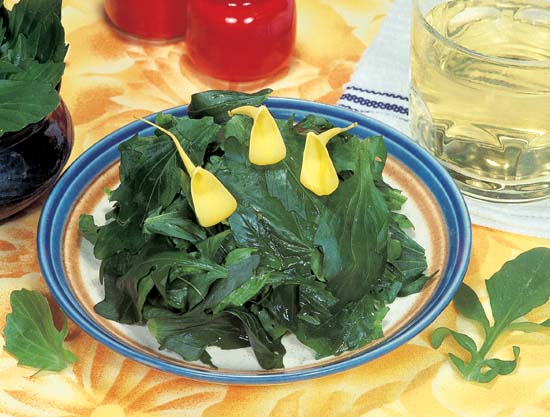
Wintercress Greens. Boiled and served with a little olive oil and a squeeze of lemon, and topped with columbine flower petals (Aquilegia chrysantha).
Leaves, Cooked: There are thousands of bitter substances in foods. Humans have thousands of different taste buds to sense different bitters. To me, the bitters in raw wintercress are particularly strong. If you want to reduce that bitterness and eat wintercress like a regular vegetable, it’s time to grab a pot. Boiling will greatly expand your ability to eat more wintercress in different ways.
In my experience, the bitterness in wintercress evaporates when heat is applied, and the best medium to make that happen is through boiling without a lid so the bitterness can escape into the air. The underlying non-bitter flavors are superb. After just a few minutes of boiling, wintercress goes from a bitter green to a foundational green that can be used anywhere spinach is eaten.
To make boiled wintercress, preheat a pot of water to a rapid boil (with the lid on to conserve energy). Remove the lid and add chopped wintercress leaves. There should be enough water for the greens to move about freely while they are boiling. After three minutes, taste a sample. If it is to your liking, remove the greens, drain, and use immediately; or immerse in cold water to stop the cooking process. If still bitter after sampling, continue boiling the greens until they meet your taste needs. I suggest boiling them as little as necessary. Save the cooking broth for soup stock.
Steaming does not always remove all the bitterness. This is probably because the pot lid, necessary for steaming, prevents some of the bitter from escaping. Steaming is also not as successful as boiling because there is no agitation from the water to massage out all the bitter. After about five minutes of steaming, the greens retain some bitterness. When wintercress is dressed or added to other foods, that bitterness becomes an interesting character of the greens. If you are still not a fan, then just use the boiling method.
Sautéing in oil removes even less of the bitterness. But the oil blended with the greens is interesting and enjoyable, particularly if lots of herbs and seasonings are added. Again, if you are bitter-intolerant, you might want to stick to boiling.
Buds, Fresh: The buds are just as bitter as the leaves. Since they are more three-dimensional than the leaves, you will get big mouthfuls of bitterness with every bud cluster you bite into unless you chop them up. So, raw buds are for the creative food preparer who knows how to use protein, fat, and carbohydrate foods to mask the bitterness. For people who love this kind of bitter or who have no bitter taste buds, use the fresh wintercress buds any way you want.
Buds, Cooked: Cook the buds as you would the leaves. But because the bud clusters are three-dimensional, they will be more bitter than the leaves when steamed or sautéed—everything else being equal.
Flowers, Fresh: Whole flowers are mildly bitter, much less bitter than the greens or buds. That bitterness goes unnoticed if those flowers are used as a garnish to add color to a salad or dinner plate.
The flower petals can be used to make a tea. The petals by themselves are sweet in flavor. Place a teaspoon of dried petals in a tea bag and steep in previously boiled water until the flavor has emerged. Drink as is or add your favorite sweetener.
Seeds: Like other mustard plants, the seeds might be ground to season foods or to make condiments.
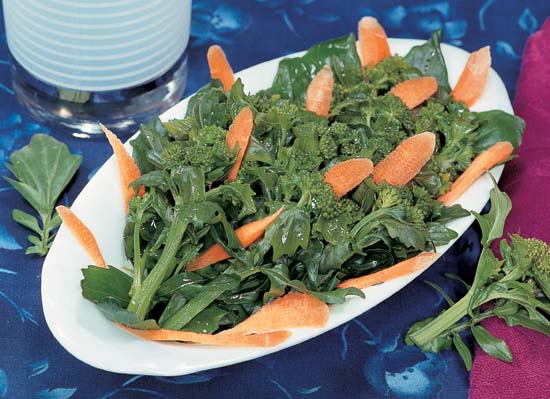
Wintercress for dinner. Bud clusters are boiled for three minutes, presented carefully on a plate, and garnished with thin carrot slices. Serve with your favorite sauce.