Sow Thistle
A delightful food that is one of the most widely used wild edibles in the Mediterranean
Family: Asteraceae
Species: Sonchus oleraceus
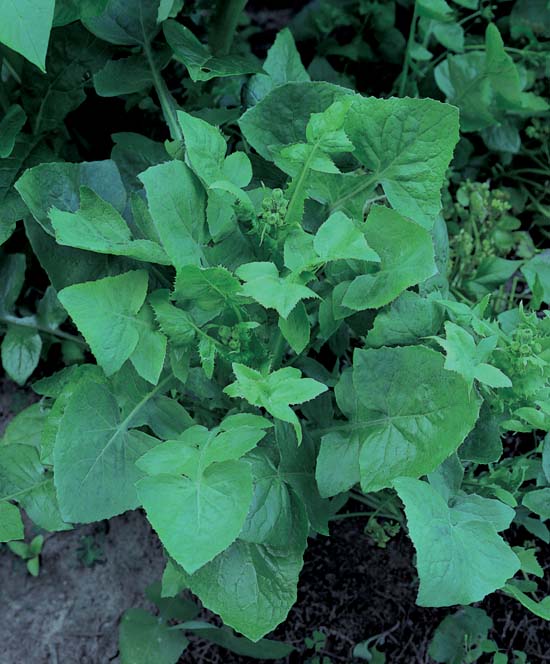
Vigorously growing sow thistle. Young stems are developing and buds are just beginning to form at the growth tips.
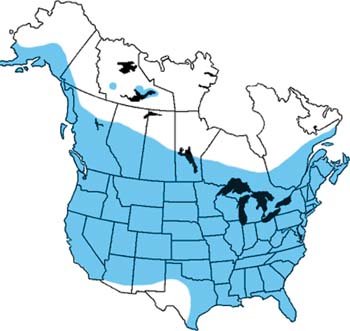
Estimated Range
Official Species Name:
-
Sonchus oleraceus L.
Synonyms:
-
None
Common Names:
-
Sow thistle
-
Annual Sow Thistle
-
Smooth Sow Thistle
-
Hare’s Lettuce
-
Quelite de leche
-
Zochos or Tsochos (Greece)
-
Zuccho or Sivone (Italy)
-
Cerrajas or Forrajas (Spain)
-
Yellow Pualele (Hawaii)
An herbaceous weed naturalized from southern Europe and Asia, sow thistle is widespread and abundant in North America, primarily where humans have invaded and where soil has been disturbed.
Edible Parts:
-
Rapidly growing leaves of any size
-
Growing tips of leafy stems
-
Flower bud stems
-
Pre-stem Roots
I do not know where or when I first learned about sow thistle. As a mild bitter, I initially avoided it, as I did most of the other bitter greens before I understood them better. But over the last couple of years, I have become more and more impressed with this plant’s capabilities. I now look forward to eating it every year.
For those of us who did not grow up on a farm, sow is a strange word. A sow is a female pig. So why “sow thistle”? Why not “pig thistle”? Female pigs are mammals that breastfeed their offspring. Sow thistle is notorious for bleeding a milky sap, and lots of it. It may have seemed logical for farmers to hope that sows eating this plant would produce more milk for their offspring. Of course, the sap is only milk-like in appearance. The chemistry of plant sap and breast milk are unrelated. It is unknown if sow thistle has any effect on milk production in mammals, other than being another nutritious food.
There are several plants in the Sonchus genus known as sow thistle. The one I’m focusing on in this chapter is annual or smooth sow thistle (Sonchus oleraceus) as opposed to spiny sow thistle (Sonchus asper) or perennial sow thistle (Sonchus arvensis). All three have similar edibilities.
Apparently sow thistle is not a true thistle. As far as I can tell, that distinction has been bequeathed to three genera: Cirsium, Carduus, and Onopordum. I do not know what the criterion for a true thistle is or if the distinction is scientific or folklore. All I know is that Sonchus is not one of those three.
Like many vegetables, some edible parts are fleeting, meaning that you have a short window of opportunity to harvest some of the good parts before you lose them to adult onset fibrousness or bitterness. So you adapt by eating seasonally—which is one of today’s popular trends. The cool thing about sow thistle is that it can produce multiple crops during the growing season if the soil is repeatedly disturbed.
Nutritionally, sow thistle is higher in omega-3 fatty acids, zinc, and manganese than any of our domesticated greens. In fact, it has the highest source of manganese of any of the foods in our two charts. It has good amounts of copper and iron, and average amounts of beta-carotene, vitamin C, calcium, and fiber.
From a phytochemical standpoint, the edible parts of sow thistle have shown a high antioxidant activity in laboratory tests (Pieroni, 2002). The greens contain polyphenols and flavonoids, including aspigenin, kaempferol, luteolin, myricetin, and quercetin. Sonchus oleraceus has four times more myricetin than red wine and twelve times more than black tea. It has about half as much quercetin as onions. (Trichopoulou, 2000b.)
Knowing Sow Thistle
Seeds: Sow thistle is an annual that only grows from seed. If it gets a late start, it can overwinter to complete its life in the spring. Overwintering can happen in moderate climates, but I am not sure that sow thistle can survive harsh winters. Its seeds can germinate anytime during the growing seasons when conditions are right. So if there is moisture and seed near the surface, sprouting can happen.
Seedlings: Sow thistle seedlings are somewhat difficult to distinguish from nipplewort and a few other plants. The cotyledons resemble Ping-Pong paddles. The first true leaves are shaped like tennis rackets with spines around their margins. Some of the spines point up, some out, some down towards the base of the plant.
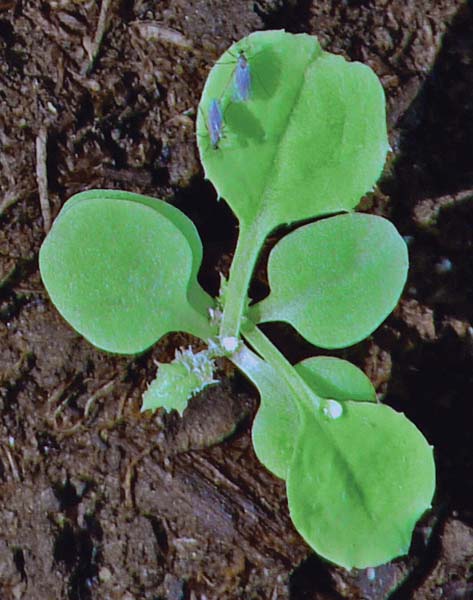
Two sow thistle seedlings so close to each other that they are overlapping. The cotyledons look like Ping-Pong paddles. The first true leaves look like tennis rackets. All but the cotyledons will continue to grow in size. You can see the sharply pointed adult form leaves emerging from the growth point of each seedling. These seedlings are about 5/8 inch in diameter.
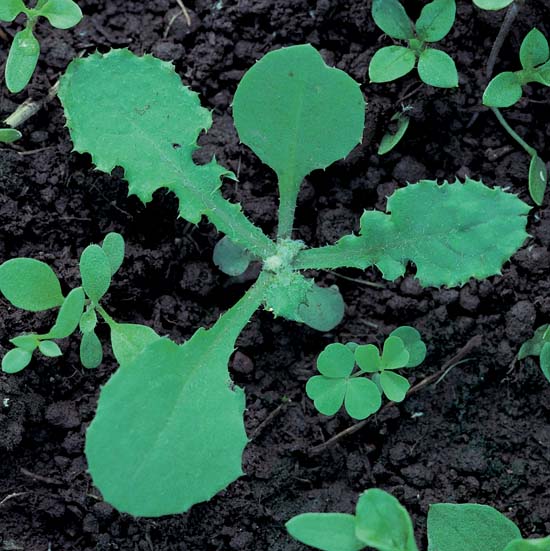
Young sow thistle, about 3 inches in diameter. The two tiny cotyledons are partially obscured by the growing true leaves. Notice the tennis-racket-shaped leaves as intermediaries between the cotyledons and the more raspy mature form of the leaves. The tennis racket leaves are now about ten times the size of the cotyledons. Note the chickweed sprouts and small clover plant.
The third set of leaves has a choice: the leaves can be elongated versions of the tennis racket shape, or they can be miniature versions of the shape that the mature basal leaves will become. The mature shape is somewhat dandelion-like but with its own character.
Why all this detail on seedlings? Because it helps you to know which ones to let grow when you are weeding your garden—taking out all those inedible weeds.
If you still need help identifying a plant as sow thistle, spray-mist it. If the water beads up and drips off the leaves, you have one more piece of evidence that it is sow thistle. If the leaf just gets wet, it is an indication that you have nipplewort or some other plant. Sow thistle is hairless—further distinguishing it from nipplewort. And finally, the color of the leaves tends towards cyan but can be green. Nipplewort is mostly just green.
Leaves: At some point, the leaves start to multiply, forming a basal rosette. The more the plant is under stress (lack of water and nutrients), the fewer and smaller leaves are produced. If it is growing in lush conditions, a large amount of leaves will form.
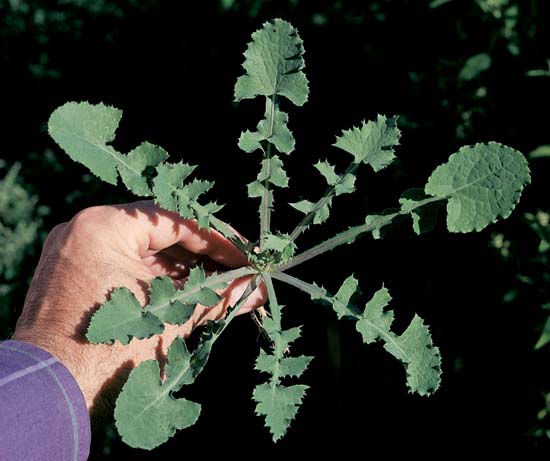
Basal rosette of fully formed leaves. This plant shows both rounded and more triangular tipped leaves. The basal leaves can get much bigger than this.
Adult leaves also vary in shape, depending on where the plant is in its growth cycle. Younger plants, particularly within the basal rosette, tend to have round-tipped leaves. As the plant gets older, there is a tendency to produce leaves whose tips are more triangular. The leaf tip outline transitions from fat triangular to thin triangular as the leaves are followed up the plant stem.
A full basal rosette lasts for a couple of weeks before a stem is formed. How quickly it produces that stem and goes to seed is determined by the season and its growth needs. Sow thistle germinating early in the spring will live longer and produce more leaves and larger stems before it buds and flowers than if it germinates in the summer or fall.
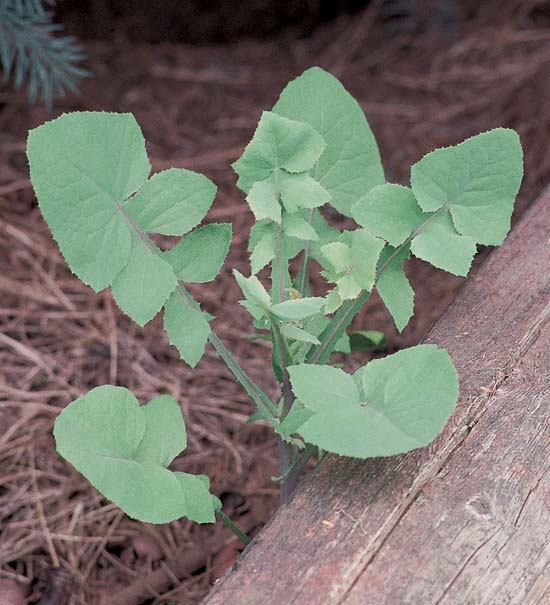
Young sow thistle sending up its new stem. This plant is about 8 inches tall and shows leaf tips in the fat triangular form.
Spring-germinated plants are in no hurry to reproduce; they’ve got lots of time to grow vegetable matter prior to seed production. That extra vegetable matter has the capacity to do more photosynthesis, which provides more food for the plant to feed its eventual seed production. This not only produces more food for us in its vegetative forms, it produces more seed later, which is its true mission in life.
Sow thistles germinating in the summer or fall do not live as long as spring plants. Nature somehow tells them to have a shorter life, to go to seed sooner, before they die from the heat of summer or the cold of winter. Both these scenarios make the plant want to produce seed quickly before the end arrives. These plants are shorter in height, produce less vegetative growth, and pass their prime (from a food perspective) very quickly.
Each leaf is directly attached to the stem in an alternating pattern. Down past their tips, individual leaves have a series of lobes extending from each side of the main vein. The lobes follow the example of the tips and get thinner and more pointed as you examine leaves up the plant stem.
Sow thistle leaves tend to look spiny due to the shape of their margins. The margins are toothed, often ending with sharply pointed tips. The margins are often wavy, and the teeth can be irregularly shaped. Some individual leaves have lots of large and obvious points; others are more subtle. The softer the leaves, the softer the pointed teeth along the margins. Older leaves stiffen up, making the points stiffer so that they begin to feel spiny. Sow thistle has no real spines or thorns.
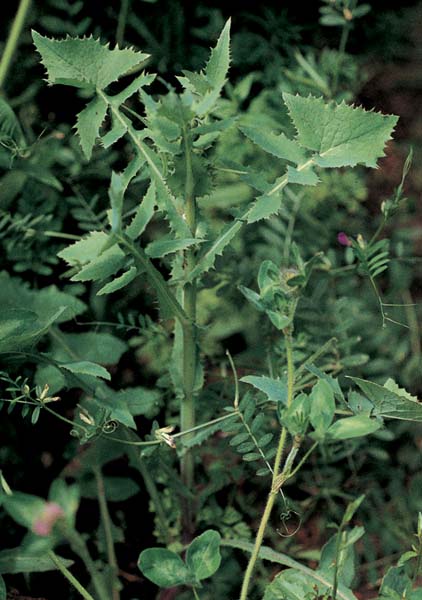
A comparison of sow thistle’s basic two forms: sharply triangular and rounded triangular:
The upper 14 inches of a 32-inch-tall plant This plant’s upper leaf tips are clearly in the sharp triangular form and are bright green in color.
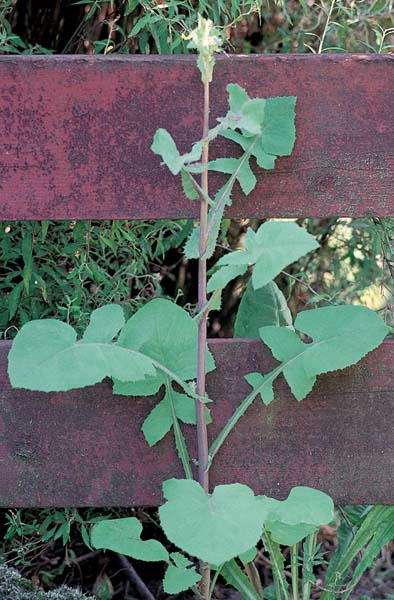
A comparison of sow thistle’s basic two forms: sharply triangular and rounded triangular:
A 40-inch-tall sow thistle plant. The leaves are larger, fatter, and softer than the more triangular form. Note the color variation in the stem. While the predominant color is bluish green, this plant sometimes produces some purplish coloration to leaves and/or stems.
All sow thistle leaf bases wrap around the main stalk. But as you observe upwards, you see that leaf stems transform from long and narrow to short and wide until they disappear. These upper teardrop-shaped leaves wrap all the way around that stem; its leaf blade itself wraps around the stem. The wrapping lobes often overlap each other.
As you can see in these photographs, sow thistle plants demonstrate a lot of leaf variation. But after a short learning period, you will be able to spot a sow thistle plant from at least thirty feet.
Every location where a leaf attaches to the stem is a potential spot for a new shoot to grow; new shoots form new branches.
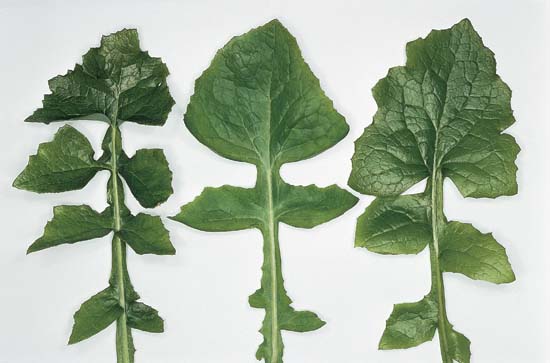
Sow thistle leaf variation. These mature leaves found near the base of the sow thistle plants are about 8 inches long. The lower leaf stems are cut out of the picture. The lobes of these leaves vary in shape, size, and number (some have more lobes than others).
Stem: Sow thistle’s stem is quite stout, oddly shaped, and roughly five-sided. The stem twists gently as it travels upwards. On close observation, you’ll see that these sides are related to how the leaves are attached to the stem. There is actually a sixth side, but it is much reduced. Now that I’ve told you about this five-angled stem, I have to add that sometimes that stem is more rounded. Don’t ask me why—I do not have a clue. I chalk it up to natural variation. Always remember that nature is not here for our convenience.
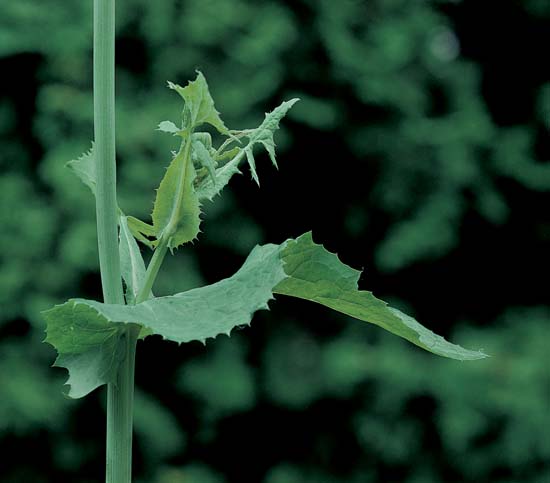
Upper leaves are teardrop-shaped and clasp, or wrap around, the stem where it is attached. It wraps all the way around to the point of overlapping itself. A new shoot is emerging where the leaf meets the stem.
Spiny Sow Thistle
Sonchus asper
Edible brother of sow thistle with similar uses
Spiny sow thistle is like the wild misbehaving brother of smooth sow thistle. Some people think smooth sow thistle is spiny—but wait till you see spiny sow thistle. Like smooth sow thistle, spiny sow thistle has no true spines or thorns. But the teeth on its leaf margins are wild, pointing this way and that. The margin itself is undulating—curving those wild teeth into even more wildness. The shape of the margins gives the impression of being on fire.
Another thing making it feel spinier is that the leaves, in general, are tougher, stronger, and more solid than smooth sow thistle, making the teeth and their tips tougher/sharper to the touch. These differences impact its use as a food. To make its spininess more palatable, it requires longer cooking times to soften it up and/or chopping into smaller pieces to lessen the chewing discomfort.
In almost all other ways, smooth and spiny sow thistle are similar: both form a basal rosette of leaves prior to developing a stalk, both form a five-sided stalk, leaf stems (petioles) get shorter as they travel up the main stalk, and they both have similar buds, flowers, and seed heads.
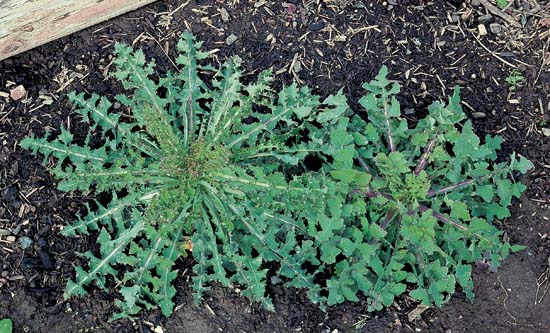
Basal rosettes of spiny sow thistle (left) and smooth sow thistle.
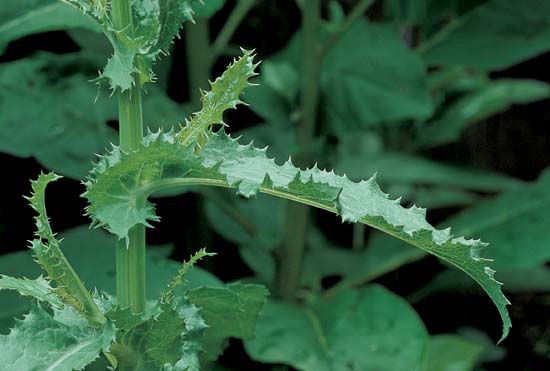
Upper leaf on a spiny sow thistle stem. Like smooth sow thistle, this leaf is teardrop-shaped, and its basal lobes clasp the stem. The leaf margins here are distinct, due to their wild spinyness.
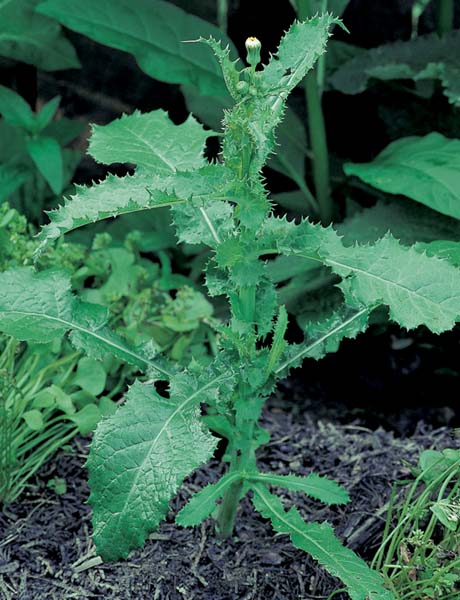
A maturing spiny sow thistle plant with buds and almost-open flower. This is an adult plant even though it is stunted to only about 14 inches tall. It germinated in the summer, so got a late start in the growing season for this species. Because of that, it grew a short stalk and went into flower within a few weeks. Had it germinated earlier in the spring (allowing it a much longer season), it would have been a much taller plant.
Buds: Sow thistle buds form early in stalk development. But if the plant is growing in good conditions, the stem can get quite tall before those buds bloom into flowers. The buds are distinct in shape. They resemble human nipples—cylindrical in shape and about the right size. So you’d think that this plant would be called nipple thistle. But no. The next plant in the book (nipplewort) got that name even though its buds are tiny—about the size I would imagine guinea pig nipples to be: tiny, thin, and narrow.
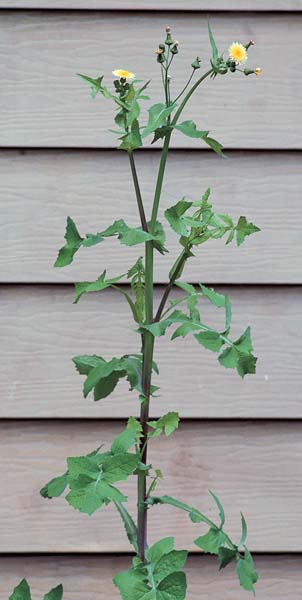
A 4-foot-tall mature sow thistle showing buds and flowers on upper branches. This plant germinated in the spring under normal circumstances and enjoys normal growth to maturity.
Flowers: The flowers are yellow and dandelion-like, growing in clusters at the tips of branched stems. They are smaller than dandelion flowers, about three-quarters of an inch across or less.
Bloom time is determined by local climatic conditions. For instance, in southern British Columbia, sow thistle blooms around June. In Phoenix, Arizona, it blooms around early March. That is a three-month difference.
Once the flowers mature, they produce rounded seed heads reminiscent of small dandelion puffballs. Once the seeds mature, the puffballs break apart, allowing the seeds to be carried away by the wind.
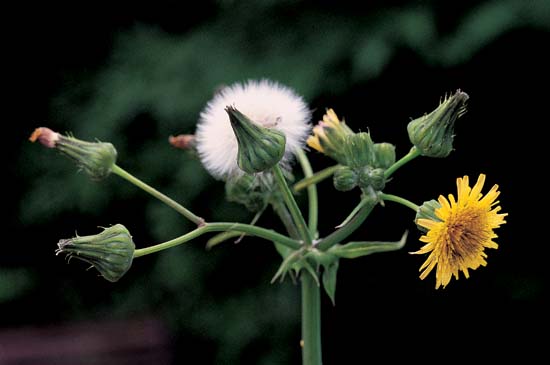
Sow thistle buds, flowers, and seed heads. The buds are tiny and cylindrical in shape. The closed flowers are fat at their bases and narrow at their tips. The white seed head is smaller than an inch in diameter.
Taproot: Sow thistle and spiny sow thistle each grow from a taproot.
Harvesting Sow Thistle
Like other plants in the aster family, sow thistle bleeds a milky sap. As I advised with cat’s ear, you want to consider managing the sap that bleeds out. You’ll have better control if you cut parts off with a pair of scissors. Then keep all those parts together while you are handling and bagging them. Sow thistle bleeds more milky sap than most plants, so be prepared.
Like with all other harvested plants, keep sow thistle greens fresh by spray-misting them, storing them in plastic bags, keeping them cool and out of the sun, and using them as soon as possible. Any part that you cut will bleed the milky sap. Anything the sap touches will stain brown. For appearances, you should trim off any cut stained parts just before using. The brown dye here is not as strong as the stain from cat’s ear.
Sow thistle leaves can be almost as tough as collard greens. So for almost all uses, I chop them into small pieces. This goes a long way in tenderizing them for fresh or cooked applications. Chopping is even more important when using the tougher, spiny, sow thistle leaves. Do not chop sow thistle leaves until you are ready to use them. And when you do, soak them immediately in cold water. The water will wash away the sap from the cut ends—preventing staining and keeping the leaves looking fresh and green.
Leaf stems are particularly tough, almost as tough as collard greens stems. So I typically discard the leaf stem below the leaf blade; that removes about one-third the length of the leaf. When gathering the upper five or six inches of the rapidly growing main stem, make sure your knife or scissors slices through easily. If you feel toughness while you are cutting the stem, it indicates that that part of the stem is too tough to eat. So cut higher until the slice is easy. If any attached leaves are longer than three inches, remove them. You can leave on all the buds and smaller leaves if you want. The more leafage you remove, the more the stem will look asparagus-like. Any leaves removed can be used elsewhere.
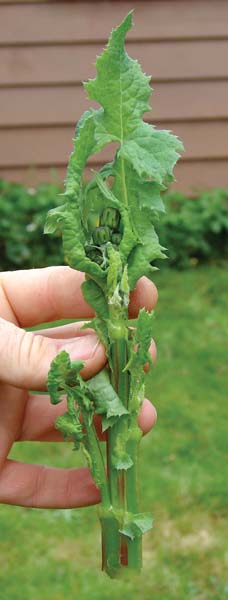
Sowsparagus. The upper 6 or so inches of a rapidly growing healthy plant is tender and collectable. At the cut point, they can be anywhere from 3/8 to 1 inch in diameter. Note the buds located near the base of the top leaf. Everything you see here is tender and edible.
The first harvest off a particular plant will always be the best. Whenever you cut the stem, you stimulate new growth in the remaining plant. This means new leaves and stems can be harvested later. But be aware that once the stem is cut, the plant goes into survival mode and wants to go to seed as soon as possible. So while more vegetative growth forms, it will be smaller with the plant rapidly progressing toward seed development.
Prior to cooking the upper stem (or sowsparagus, as I call it), take a barbecue skewer and force it up the hollow stem. This will pierce all the chambers trapping air within the stem. Doing this prevents the stem from exploding when you heat the greens. The explosions are minor but fun to hear—giving off a “POP” sound as each air-trapped chamber bursts. You do not see food flying across the room, but allowing the bursts deteriorates the appearance of the cooked sowsparagus.
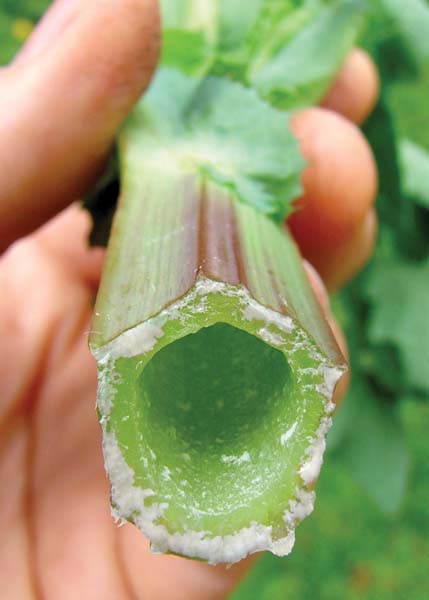
Hollow stems, mostly five-sided. Nodes separate the hollow stem into separate air chambers. A sort of sixth side is at the top of this view. Sow thistle is a prolific producer of milky sap that bleeds whenever the plant is injured.
As the stem gets older and more fibrous, you can always gather the still-tender tips containing the buds and one or two leaves. But once the flowers have opened, you’ve passed the time when the stem will still be usably tender.
No matter how old the stem is, if you can see unopened bud clusters, you can still collect buds. They will be tender and delicious when prepared properly. Be aware that aphids love sow thistle upper stems and buds. Sometimes when I am hoping to collect some, there are so many aphids that I can barely see the buds. Be brave—cook and eat the whole thing. I’ll bet aphids are highly nutritious.
If you are collecting the buds, make sure you remove all the open and closed flowers as well as the seed heads. All parts except the buds and uppermost bud stems are fibrous. In fact, the flower heads are so fibrous, you could use them as a masticator (a non-sweet chewing gum). But it’s not like gum; it is like chewing on soft vegetable matter that won’t break down easily. I don’t find it bitter like most of the rest of the plant. Try it for the fun of it.
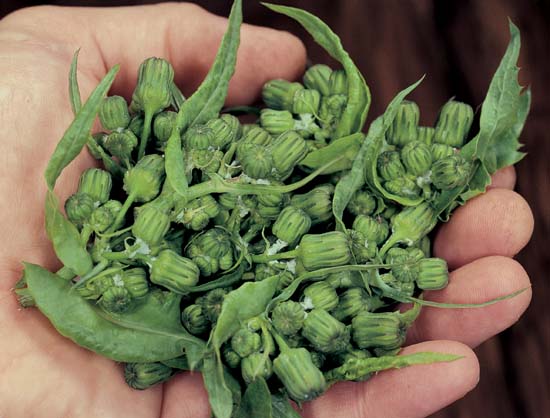
Flower bud clusters. The buds and their short supporting stems are edible and ready for use. Once the buds start opening into flowers, the stems quickly become fibrous. Closed flowers are vase-shaped and too fibrous to eat.
Serving Sow Thistle
Leaves: The younger the leaves, no matter how old the plant, the more tender they will be. The most tender leaves are found on healthy, rapidly growing basal rosettes. The faster the plant grows, the less bitter the rapidly growing leaves. Sow thistle leaves are only a fraction of the bitterness of dandelion leaves.
When managed appropriately, sow thistle is a delicious green, and its mild bitterness works well in complex green, fruit, and meat salads. It can work almost anywhere that collard greens can.
Cooking sow thistle reduces both the bitterness and the crunchiness found in some of the older leaves. Boiling young rapidly growing leaves for three to five minutes can remove the bitterness completely. Boiling them for ten minutes makes them much more tender. If you boil them, how long you boil them is determined by how you want to use them. If they are destined for a mixed dish, they need less boiling. If you are making a pure batch of sow thistle greens, only boil them until they reach your desired flavor and texture. Remember to keep sampling the cooking greens for the flavor and texture you are looking for. The cooking water from the boiling process makes a great broth or soup stock.
Steaming sow thistle leaves has about the same effect on chewiness as boiling. But it does not remove the bitterness as well. Steaming for longer periods can help some, but so can adding lemon juice, olive oil, salt, or some kind of sauce to the cooked greens. Salad dressings work wonders to help temper the bitterness.
Sowsparagus: This is my favorite part of sow thistle. If you are lucky enough to find a bunch of lavishly growing plants producing thick upper stems, call me. It is the tenderest part of the plant and is delicious. Raw, the upper stem and buds are only mildly bitter—good in many mixed dishes or chopped into salads. Boiled two to five minutes, they have a flavor reminiscent of asparagus crossed with artichoke hearts. Mmmmm—my mouth is watering.
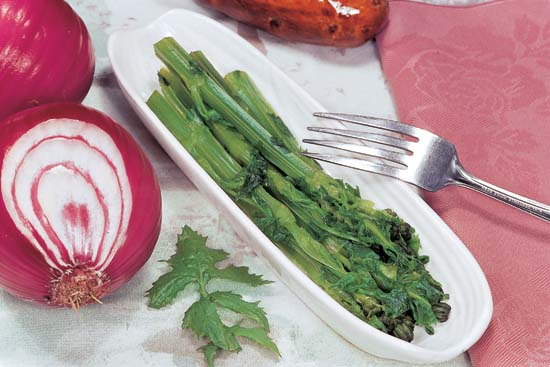
Sowsparagus. Boiled and served with extra virgin olive oil, lemon juice, and a touch of salt.
Flowers: These become less chewy after fifteen or more minutes of boiling. They are at their best when used in soups and stews that require long boiling times.
Taproot: The taproot of the basal rosette works fine as a cooked vegetable. Rip off all fibrous roots attached to the taproots you’ve gathered and boil them for five to ten minutes. They are good anywhere you would use potatoes. Use them as an accent in mixed dishes. Once the stalk is forming, the taproot gets fibrous and bitter. Even boiling for twenty minutes in two changes of water will not improve the flavor or texture of the older roots.
Pasta with Sow Thistle Greens
Many kinds of sauces and creams would work in this recipe in place of olive oil. Try spaghetti sauce or pesto. Serves 4.
Ingredients:
| 1 pound of pasta, any kind |
| 1/3 cup extra virgin olive oil |
| 4 cups finely chopped young sow thistle leaves |
| 3 cloves garlic, finely minced |
| Salt and pepper, to taste |
| Parmesan cheese (optional) |
Directions:
Cook pasta, remove from heat, and drain. Over medium heat in a separate skillet, heat 3 tablespoons olive oil until shimmering. Add greens and sauté for about 7 minutes, or until the greens become tender. Stir in garlic and continue sautéing for about 3 minutes. Pour cooked greens and remaining olive oil into your pasta pot. Return to heat and stir the greens and pasta mixture until hot. Remove from heat. Season with salt and pepper, and add Parmesan if you’d like. Serve immediately.
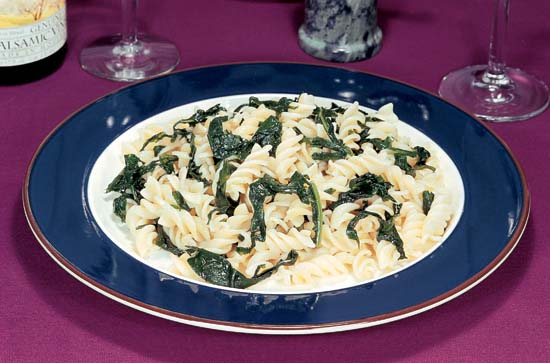
Pasta with Sow Thistle Greens.