Cat’s Ear
Often mistaken for dandelion, this Old World green works well in many dishes.
Family: Asteraceae
Species: Hypochaeris radicata
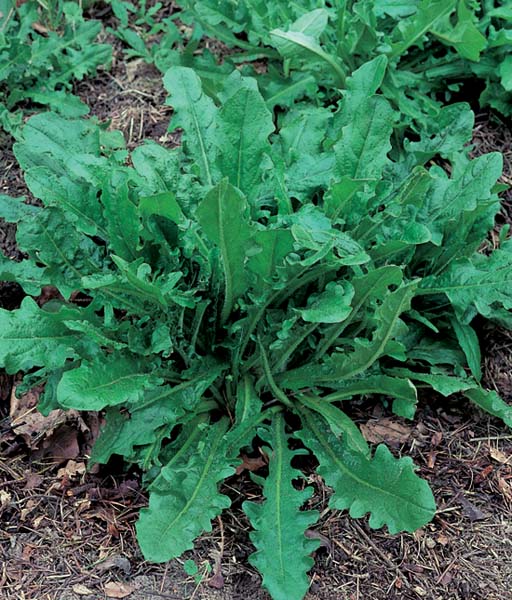
Cat’s Ear in full glory. It is more prevalent then dandelion in some parts of the country, grows in the same habitats, is much more annoying to lawn keepers, and is as good in flavor.
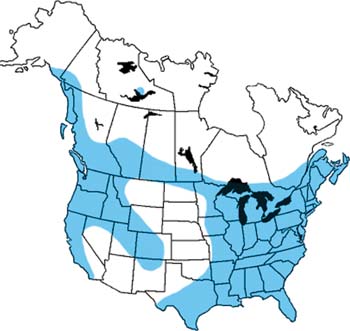
Estimated Range
Official Species Name:
-
Hypochaeris radicata L.
Alternatively Spelled:
-
Hypochoeris radicata
Synonyms:
-
None
Common Names:
-
Cat’s ear
-
False dandelion
-
Gosmore
-
Flatweed
-
Frogbit
-
Hairy cat’s ear
-
Spotted cat’s ear
An herbaceous perennial weed naturalized from Eurasia, cat’s ear is widespread and abundant in North America, primarily where humans have invaded and mostly where soil is stable, particularly lawns, vacant lots, waysides, pastures, and old fields.
Edible Parts:
-
Leaves
-
Buds and bud stems
-
Flowers
Cat’s ear is an odd name for a plant. It is not as soft as a cat’s ear, but it is shaped like one if you just consider the tip of the leaf, which is hairy on both sides.
There are good reasons that cat’s ear is confused with dandelion. In fact, it is better known as “false dandelion.” Its leaves and flowers are similar, it grows in the same kinds of habitats, it is a lawn nuisance, it bleeds a milky juice, and it has similar food properties.
In many parts of Europe, cat’s ear and dandelion have names that, when translated into English, both signify “dandelion.” This raises the question: How many traditional dandelion recipes actually originated from the consumption of cat’s ear and vice versa?
The confusion also makes it more difficult to know what the research has found when plant identification is not verified. A nutrition or cardiac researcher studying the dietary habits of villagers in rural parts of Greece might ask participants what wild foods they eat. If the local name of cat’s ear translates into dandelion, whatever nutrition or health data they generate may mistakenly be attributed to dandelion.
You might have seen cat’s ear many times but just did not know it. Most people mistakenly think it is dandelion taking over their yard. Cat’s ear is also more destructive to lawns than dandelion.
The range map I’ve shown you skips a part of the central U.S. and Canada. Cat’s ear can likely grow anywhere within the map. I think the problem is a matter of poor and outdated records. I’ve seen it almost everywhere I’ve traveled. In some areas of the northeastern U.S. and in the Pacific Northwest west of the Cascade mountain range, the plant is prolific and in a huge variety of habitats.
I have seen secondary reports that cat’s ear is high in calcium, phosphorus, and copper, but I will not commit that to the nutrient chart until I can verify those claims. Regarding phytochemicals, the flowers appear to have significant amounts of lutein and total carotinoids (Valadon, 1967). Extracts from the leaves have shown high antioxidant activity and antiradical power (Zeghichi, 2003).
Knowing Cat’s Ear
Under normal circumstances, cat’s ear germinates in the spring and fall. It requires enough moisture to establish a root that will sustain it. Cat’s ear prefers solid soil to germinate, unlike many of the other plants in this book. My lawn is filled with cat’s ear, but my garden next to it nurtures only one or two plants a season. There are seeds in my garden—they just prefer to grow in the lawn.
The seeds can sprout soon after being dropped from the seed head of a mature plant. All they need is moist soil. I’ve heard that the viability of dried seeds saved indoors decreases dramatically for every year of storage. I have not tested these claims.

Cat’s ear takes over many lawns. You might first notice this plant during its flowering season, as seen below. There are some dandelions in this yard, but it’s about a month past their flowering season. In contrast, cat’s ear flowers most during the longest days of the year.
Leaves: The seedling’s cotyledons are round to slightly oblong. The first true leaves have the look of a baby dandelion leaf, sort of. As more and larger leaves develop, they remain relatively flat or their sawtoothed margins curve upward.
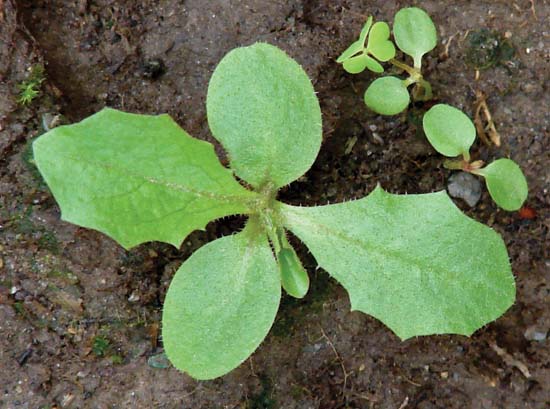
Cat’s ear seedling. From left to right, this sprout is only 3/4 of an inch long. The cotyledons are roundish. The first two leaves are barely toothed. The third leaf in this image is just starting to unfurl. At the upper right are wood sorrel seedlings.
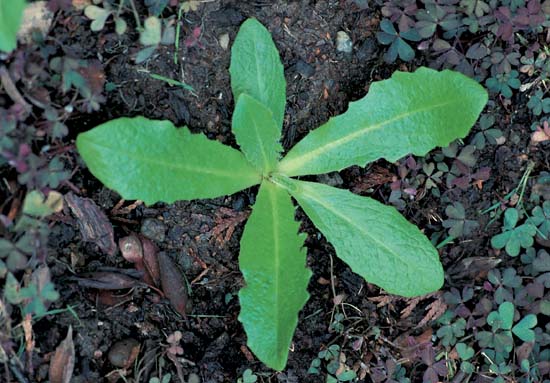
A young cat’s ear plant. This one is about 5 inches in diameter, still just a baby.
Once cat’s ear develops a full healthy basal rosette of leaves, it can take two general forms: flat and upright. Those forms are situation-dependent. The fact that cat’s ear can morph into the flat form is a wonderful example of co-evolution. From many years of lawn mowing, this plant has apparently learned to grow low to the ground—below where blades can cut. The plants actually depress down somewhat into the earth so their leaves and young stalks are below the grass-cutting level. I call this lawn-adapted cat’s ear.
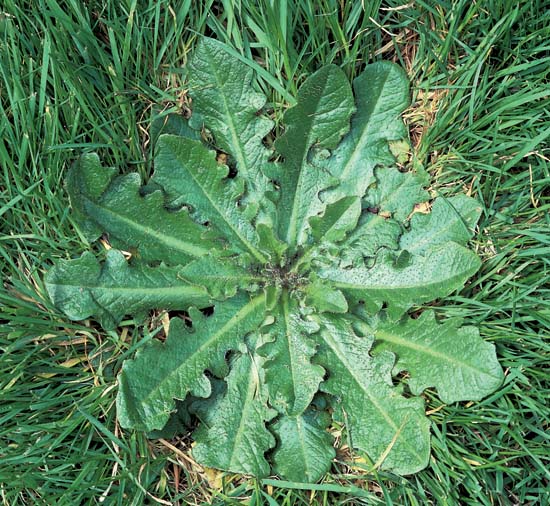
Lawn-adapted cat’s ear. This plant is obviously avoiding lawn-mower blades. This growth form gives you a clue as to why this plant is also known as flatweed.
Cool as that is, even the eventual flower stalks adapt. At first, the stalks are hard to cut and can survive by bending as a push mower passes over. After a day, many of those stalks have recovered, uprighted themselves, and continue to reproduce. If they are cut and recut from frequent mowings, new rapidly growing flower stalks get shorter and shorter, maturing faster and faster.
Not only does this flat version sink into the earth, it depresses the growth of plants it is competing with. Even its own offspring will not sprout within leaf distance. This is one aggressive plant! These flattening, growth-depressing characteristics make cat’s ear worse than dandelions from the perspective of weeding or harvesting. If a dandelion is pulled up by its roots, the scar left over is minimal, and the surrounding grass covers the hole. If cat’s ear is pulled up by its roots, there is a big bare spot of soil exposed. Like pulling the toupee off a partially bald head, a big bare spot is revealed that’s hard to ignore. If you pull up thirty to ninety cat’s ear rosettes, your yard looks like a detonated minefield. Each bare spot can be three to five inches in diameter.
The upright form is my favorite of the two forms because it produces lots of easily accessible leaves. It occurs anywhere the plant is allowed to grow freely without the fear of mowing. In fact, a lawn-adapted form can convert to an upright form if you stop mowing the area.
The upright form will roughly resemble the flattened form if it is starved for nutrients and water throughout its life; it will be a small plant with a minimal number of leaves. In contrast, if it gets a good supply of water over long periods in the spring and summer, it will grow many healthy leaves.
The growth spurt of cat’s ear follows dandelions by about a month. In mid-May to mid-June, cat’s ear leaves begin to grow rapidly, lengthening, and the flower stalks emerge. Up until the growth spurt, cat’s ear leaves stay small—4 to 6 inches—and limited in number.
Cat’s ear flourishes when the ground is moist and rich, and when it gets full sunlight. It can be shaded out by other plants—shrubs, trees, and thick tall weeds.
As I’ve shown in the last chapter, cat’s ear leaves are similar in shape to dandelion and chicory leaves. Distinguishing them is more difficult prior to stalk development because all you see is the leaves. There are ways to tell them apart. Close observation helps, as well as experience that you will get over time. Since nature is not here for our convenience, you might see some variation from my list of differences, but it is a pretty good list.
First, cat’s ear leaves are conspicuously hairy on both sides, like the ears of a cat. Dandelion leaves have no hair to speak of—a few tiny random ones here and there, but nothing easily observable. Chicory is hairy on the bottom side, particularly along the main vein.
Second, neither dandelion nor chicory have a lawn-adapted flat form that presses into the ground.
Third, the lobes along the leaf margins of the upright form of cat’s ear are typically long, fat, and often twisted. Even when they are short and toothed, like in the photograph here, cat’s ear teeth are slightly fatter than chicory teeth.
Fourth, whole chicory leaves often gently twist or coil. Dandelion and cat’s ear may cup or bend downward, but they do not twist. Cat’s ear lobes may twist, but the leaves do not.
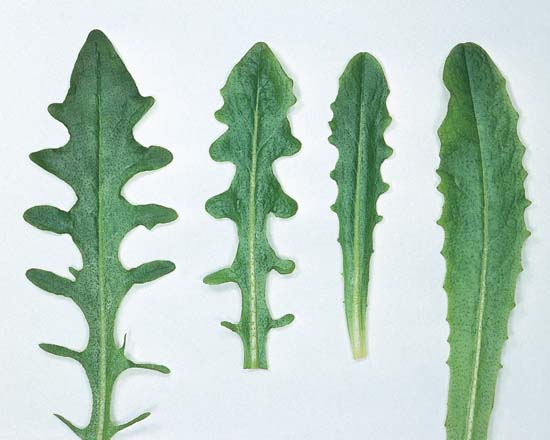
Cat’s ear leaf variation. These are all cat’s ear leaves showing some of the possible variations. Compare these to the photographs previously, which contrast cat’s ear, dandelion, and chicory.
Root System: Cat’s ear roots typically have somewhat of a bulge at the top, just below where the leaves emerge. This is called a caudex. It gets larger as the plant matures. It may be a storage organ for water or some kind of protective or supportive structure. Older ones seem to get woody.
The caudex and rind, combined with a deep root system, help cat’s ear survive harsh dry conditions. It’s sort of like the camel of the plant world.

Cat’s ear caudex and roots. The caudex is the enlarged portion of the stem just below the leaves. The two plants on the left are more than a year old, producing a more complex combination caudex. The three on the right are this year’s plants with a simple caudex.
Flower Stalks, Flowers: At some point after the first month of spring growth, overwintered plants send up one or more flower stalks. If growing conditions are good, the stalks are thick and plentiful. Very early on, you can see immature flower buds and early branching at the tip of the stalk. The stalk is nearly leafless.
The flower stalks are a solid green in color and branch, eventually forming a flower head at the tip of each branch. In contrast, dandelions have a single, unbranched, greenish-white stalk per flower head.
Under harsh sun and lack of water, cat’s ear will favor producing flower stalks and flowers over leaves. If you run across a lawn exposed to these conditions, the grass will be dead and brown. The cat’s ear plants will be green with small leaves and lots of branching, flowering stems.
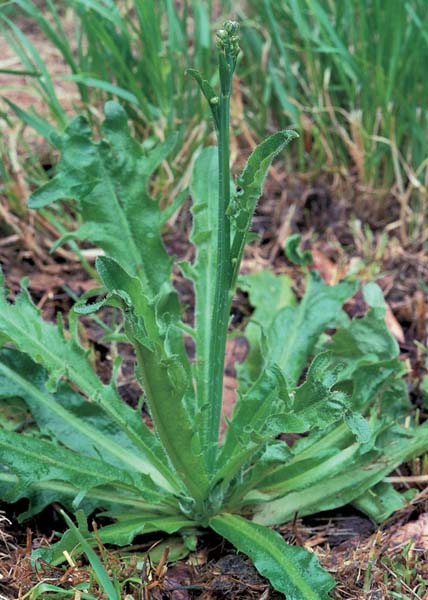
A healthy cat’s ear plant producing its first flowering stalk. This first thick young stalk is great for eating. Flower buds are just forming at the tip.
Major simultaneous blooming of cat’s ear occurs in June or July. That is about a month after the dandelion burst. Cat’s ear flowers can appear sporadically from May through early November, depending on the individual plant and its environmental influences.
When mature, cat’s ear flower heads can look remarkably like dandelions from the top. And like dandelions, cat’s ear flowers open in the morning light and close as the sun lowers in the sky. The flowers are different in a couple of ways. Dandelion flowers open on the first day with all their petals fully developed. In contrast, cat’s ear flowers bloom on the first day with only the outer petals open, with the remaining petals unfolding gradually over several days. Newly opened flowers are smaller, growing in size as they mature. Given the same conditions, mature cat’s ear flower heads are, on the average, only 40 to 75 percent the size of dandelion flowers.
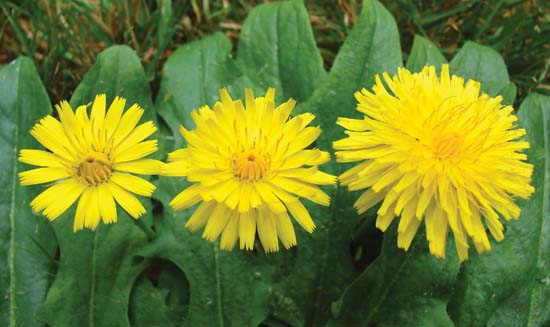
Cat’s ear flowers at different stages of maturation. This process takes about 3 days from first opening to the full flower you see at right. A dandelion flower head “looks like” the fully open cat’s ear flower head on the right, except the dandelion is larger and looks that way from the start.
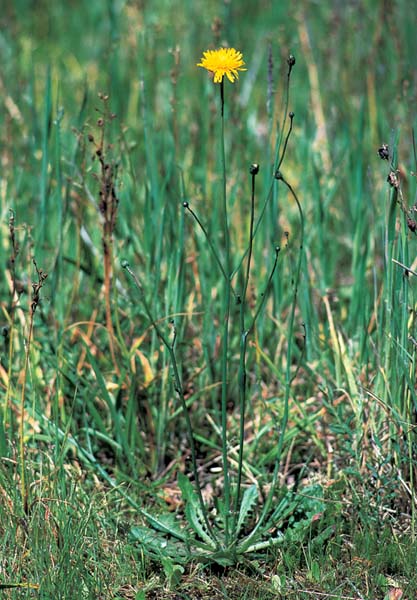
Water-stressed cat’s ear produces small and few basal leaves. Even under stress, this plant produces many thin branching flower stalks.
Bracts, Puffballs, Seeds: The green bracts subtending the flower heads are different. Dandelion has two sets of bracts—one that curves upward and a second set that curves downward. Cat’s ear bracts all curve upwards and have an overlapping pattern like shingles on a roof.
Cat’s ear is fast-growing, proceeding from germination to seed production in about sixty days. These are perennials that produce flowers their first year and every year thereafter.
The puffball that develops is similar to dandelion, except that it seems to have a pattern of stray fibers jutting out here and there. The seeds attached to these fibers are dispersed by wind once they have matured enough to be released. On the average, these heads are smaller than dandelion puffballs.
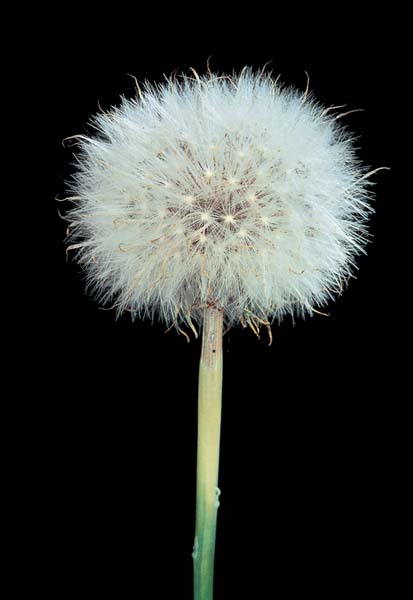
Cat’s ear seed head. Similar to dandelion, except for seemingly stray fibers that jut out unevenly from the puff ball. It is like a smaller dandelion puffball that has had a bad hair day.
Harvesting Cat’s Ear
Leaves: Cat’s ear leaves are edible. Like dandelions, healthy rapidly growing leaves are preferable to slow-growing leaves. So find them in places where they get plenty of moisture. Season does not matter; as long as the plant is healthy, thriving, and producing new leaves, the leaves are good. Great conditions are more likely to exist in the spring while the soil is moist on its own, in well-watered grass, or on the edge of watered gardens and landscape.
If I have a choice, I prefer to harvest from cat’s ear that is growing upright, but lawn-adapted leaves are acceptable. Always gather the inner upper leaves, particularly with lawn-adapted plants. The lower outer leaves will be older and will be clinging to dirt. Choose beautiful-looking young leaves. End-size leaves have very chewy mid veins.
Like dandelions, cat’s ear bleeds a milky white sap—about half to a third as much sap as dandelions. This juice stains everything brown it touches—gathered greens, your clothes, and you. The staining is much greater than that of dandelion sap. Natural fabric dye might be made from this stuff. So if you care about such things, gather the greens with care.
Use a pair of scissors to clip the leaves. This makes a clean cut in a location of the leaf that you can control. As you gather, keep the cut ends in one place. When you bag them, point the cut ends into a bottom corner of the bag. If you follow these steps, you are less likely to drip the sap on something.
No matter how you collect them, keep them hydrated like all the other plants you gather. The sooner you get them soaking in water, the easier it is to wash away the sap.
After a short period, the sap dries, discoloring the leaf ends you’ve collected. If you want to use the fresh greens and you want them to look good, put a bowl of cold water next to your cutting board. Cut off and discard the already-discolored ends. Then chop the greens into the size suitable for your use and put them immediately in the cold water. The water will wash away the sap and refresh the leaves. Swish them around to make sure the sap gets dispersed. Then spin the water out of the leaves and use to your liking.
Bud Stalks: Cat’s ear bud stalks are an excellent food. They are very easy to gather and almost always free of dirt and other debris. In a healthy, rapidly growing plant, the upper four inches are typically tender enough to eat. Their tenderness is revealed when you snap them free from the lower stalk. On stressed plants, the stems age more quickly and fibrousness develops sooner. So if you collect from stressed plants, you may have to be satisfied with a shorter piece of the upper bud stem. If the stem is just emerging from the basal rosette, you can take the whole thing. With a little practice, you’ll soon figure out how to make use of the buds and their stems.
The same sap management technique used for the leaves can be used with the bud stalks. Scissors, however, are less necessary because the stalks snap cleanly. You can easily keep all the sap-dripping ends together. Point all the cut ends into one corner of your collecting bag. As with the leaves, you’ll want to trim off the brown cut ends and put them in water prior to food preparation to keep them aesthetically pleasing.
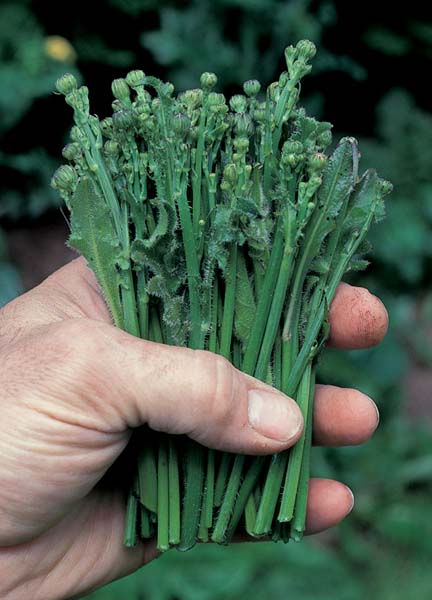
Cat’s ear flower bud stalks. These are easily gathered in quantity for use in your kitchen.
Cooking and Serving Cat’s Ear
Raw: Cat’s ear leaves and bud stems are, to me, only 50 to 80 percent as bitter as dandelion leaves, so use them accordingly. They work well in mixed dishes where a little bitterness adds character and interest. I enjoy a fresh salad that is about a third cat’s ear, a third foundational green, and a third sour green. Whole salads of cat’s ear are way too bitter for me. The raw leaves and bud stems have a sticky texture if eaten alone. This is not an inherently bad feel, just different. It is likely caused by the milky sap.
When whole, the leaves are somewhat chewy. The lower part of the leaf stem is particularly tough. I typically chop off the lower fourth of the leaf blades I want to consume. That lower part is mostly stem anyway, with very little leaf blade. The remaining upper three-quarters of the leaf then needs to be chopped into bite-size pieces. These work better in salads and as cooked greens. I prefer chopping the leaves to no smaller than half-inch squares unless they are unusually chewy. (If so, I chiffonade them.) The bud stems are tender and do not need to be chopped.
Cat’s ear flowers have much in common with dandelion flowers. They are both edible and can be used in many of the same ways. Put them in salads and sandwiches or throw them in soups, stews, and omelets. The differences are practical. Cat’s ear flowers are slightly smaller than dandelion flowers and only about 30 percent the mass. That smaller mass means that they will have less presence and less impact when used to replace dandelions in recipes. This difference becomes apparent if you boil the flower heads. The cat’s ear head shrinks into a tiny mass.
Cat’s ear flowers can close up quickly once picked. To keep them open for better presentation, don’t pick them until the last minute; gather them with enough stem to put them in a vase of cold, preferably iced water as they are cut; assuming they are in water, keep them in the brightest light of the day (sunlight keeps them open); pluck them from their stems as you are serving your meal.
Unlike dandelions, the petals themselves have some minor bitterness to them. You only notice this if you are plucking the petals to eat out of hand. You do not notice the bitterness if you are sprinkling the petals on a salad for color or making flower petal soup. Like dandelion flowers, try not to overdo it—eating more than ten or fifteen full heads at a time might induce a mild headache.
Boiled: The bitterness is easily removed from cat’s ear by cooking, and boiling is the fastest method. Throw your chopped cat’s ear leaves or bud stems into boiling water, and they should be free of bitterness in two to five minutes. Taste as you boil and remove the greens as soon as you are happy with the flavor. Remember, you do not have to remove all the bitterness. Leave some in. Drain the cooking water, drizzle with a little extra virgin olive oil, add a spritz of lemon and a little salt, and try it. The slight remaining bitterness will add depth without harshness. Boil them eight minutes or more to completely tenderize the leaves.
Steamed: This method removes about 80 percent of the bitterness in about eight minutes. Leaf tenderness improves gradually as the greens are boiled or steamed. After about ten minutes, they are cooked enough to be considered tender.
The broth left over from the steaming process is quite good for use as a soup stock. I prefer it over the cooking water used for boiling.
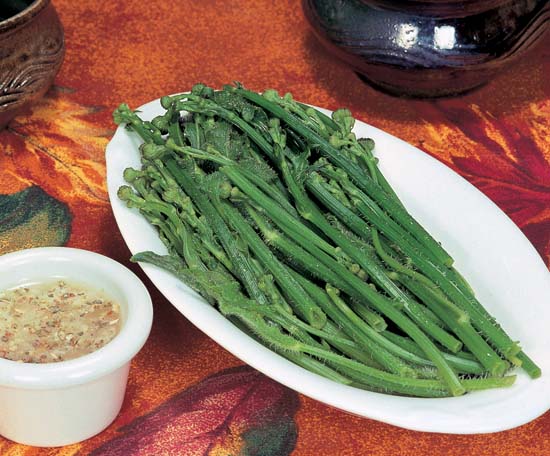
Cat’s Ear Stems. Steamed and served like asparagus. You have to place them carefully to look like this because the stems relax quite a bit once cooked. Directions: Steam the stems for 5 minutes or boil for 3 minutes. Add your favorite sauce. Season with salt and pepper to taste.
Sautéed: The whole bud stems and the chopped leaves work great in sautéed dishes and stir-fries. I really enjoy adding them to sautéed or steamed vegetables that go into my breakfast omelet.
Cat’s Ear with Peppers and Onions
Add garlic at the same time you are adding the greens. You’ll love the results. Serves 2 to 5 as a side dish.
Ingredients:
| 2 tablespoons extra virgin olive oil |
| 1 small onion, sliced |
| 1/3 red bell pepper, sliced |
| 1/3 yellow bell pepper, sliced |
| 1 clove garlic, minced |
| 5 cups chopped cat’s ear greens |
| Salt and pepper, to taste |
Directions:
In a skillet, heat the olive oil on medium high until shimmering. Add onion slices and sauté until softened and somewhat translucent. Add the peppers and garlic, stirring until slightly cooked. Add the cat’s ear leaves and cook until wilted. Season with salt and pepper.
The stems relax so much upon cooking, you could use them like green noodles. Just cook, add your favorite spaghetti sauce, and serve with a little Parmesan cheese.

Cat’s Ear with Peppers and Onions. Cat’s ear works great in any stir-fry.